
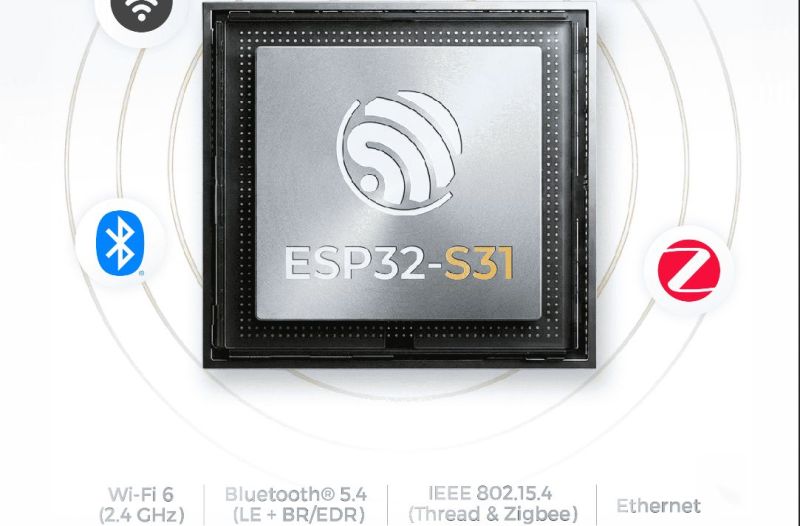
In a move that’s no doubt going to upset and confuse many, Espressif has released its newest microcontroller — the ESP32-S31. The confusing part here is that the ESP32-S series was always the one based on Tensilica Xtensa LX7 cores, while the ESP32-C series was the one using RISC-V cores.
That said, if one looks at it as a beefier -S3 MCU it does have some appealing upgrades. The most obvious improvements are with the use of WiFi 6, as well as Bluetooth Classic and LE 5.4, including LE Audio. There is also Thread and Zigbee support for those who are into such things.
The Ethernet MAC got a bump from the 100 Mbit RMII MAC in previous MCUs and is now gigabit-rated, while the number of GPIO is significantly higher at 60 instead of 45 on the -S3. On the RAM side, things are mostly the same, except for DDR PSRAM support, with octal SPI offering up to 250 MHz compared to 80 MHz on the -S3.
On the CPU side the up-to-320 MHz RISC-V cores are likely to be about as powerful as the 240 MHz LX7 cores in the -S3, based on the ESP32-C series performance in terms of IPC. Overall it does seem like a pretty nice MCU, it’s just confusing that it doesn’t use LX7 cores with the series it was put into. When this MCU will be available for sale doesn’t seem to be known yet, with only samples available to select customers.












Sounds good. Hopefully they have a better ADC on their roadmap too.
THIS eleventy times one thousand. Not having to bring a dac board into the mix on many projects would be a welcome relief and firmly cement it in my stable. Glad someone else gets it.
2.4Ghz WiFi is completely useless in North American apartment buildings, yet Espressif continues to produce those 2.4Ghz-only chips year after year. Claiming that 2.4Ghz is WiFi6 is outrageous – the speed is goint to be at par with 802.1b (WiFi1) or even worse, as it will be losing packets 99% of time due to enormous congestion.
While the 2.4 GHz band is indeed crowded in many urban environments, WiFi 6 introduces several mechanisms that substantially improve performance and reliability even under heavy interference. 802.11ax isn’t about raw throughput alone — its biggest gain is efficiency. Features like OFDMA (Orthogonal Frequency Division Multiple Access) and TWT (Target Wake Time) allow multiple clients to share the channel more predictably, reducing contention and latency compared to legacy CSMA/CA behavior. Also, BSS Coloring helps differentiate overlapping networks, allowing simultaneous transmissions in environments where the older standards would stall due to perceived collisions. Combined with more resilient modulation and uplink MU‑MIMO, the result should be a higher effective throughput and lower packet loss even on congested 2.4 GHz channels.
But as long as the legacy equipment doesn’t use WiFi6, the gain in performance might be limited.
That it is compatible with a standard doesn’t mean that it operates at the max limits of that standard. Wifi in apartment building is dubious at best. You are living in a tight space with many people surrounding you in all directions, all broadcasting heavily within the same band. Sure it can work, the protocol can handle it, but don’t expect max throughput under those conditions.
Wifi is kind of being at a birthday party. When you are the first visitor, you can speak with a gentle voice with a person on the other side of the room, you can have a normal conversation. Then other visitors start to come in and the background noise raises, you start missing parts of the conversation so you’ll say plenty of times “excuse me, can you repeat that”. Then more visitors come, the children they bring start to shout and run and you decide to raise your voice (wifi equivalent, you install a signal booster/repeater) at first this seems to work, yet the other people have the same problems so they do the same, they raise their voice too (more boosters are added to the network) and we’re back to the previous situation but worse since the network is overloaded with users that boost their signal with repeaters doubling their impact (repeaters occupy 2 bands) on the network resulting is only more overload. The best thing you can do at the party is to sit directly next to the person you are talking to or in reality… stop using wireless shit and use a cable, reliable, energy efficient, high throughput… but yeah… a cable, not an option on a phone or a laptop (since most modern laptops don’t have network interfaces any more). So you option would be to move to an area with a less noisy Wifi “ether”.
Then you gave the problem of range, lower freq. Wifi has a greater chance of working at more places due to the signal penetration. And despite the fact that 2.4GHz isn’t the only freq. for wifi anymore for years, it still is the most used world wide, making it more usable if you are selling those things. The “newer” higher frequency routers can handle the 2.4GHz fine, but the “older” 2.4GHz only routers can’t handle the higher freq.
Also 5GHz band has poor penetration through solid (stone, concrete, bricks) buildings with rather thick walls. In US it´s less a problem with 4×6 + panels…
no in AMERICA we have the TOUGHEST wall panels! our wall panels are almost as good as our health care!
That’s exactly right😀
In an apartment the lack of penetration might be a good thing.
Well, so Espressif is not producing only for north America…
Naming has always been the weak point of Espressif MCUs. I am just waiting for their RiscV to finally get an MMU. Linux would be really nice on those otherwise very capable MCUs.
I think there are ways to build linux for machine without MMU, but it’s probably not very well supported https://hackaday.com/2023/10/11/tiny-linux-on-a-no-mmu-risc-v-microcontroller/
Probably you can just build kernel without CONFIG_MMU=y ?
They have a MMU in this chip. However, it’s likely not what you think it is. The memory for the chip is only 512kB. The PSRAM stuff is just a hack used to lower the cost of the system (it happens that PSRAM is cheaper than onboard SRAM and simpler than DDR chip). Using linux with only half a GB/s memory bandwidth and less than 16MB of memory will likely prove suicidal.
I think you are wrong. Espressif already posted a Linux BSP for it, and there are 2 “famous” projects already providing MMU linux for it:
https://github.com/annoyedmilk/esp32-s31-linux
https://github.com/GrieferPig/esp32-s31-linux
Avoid Espressif, their variants go obsolete in 2years… Choose ST with 10yrs of availability.
[Citation needed]
https://www.espressif.com/en/products/longevity-commitment
Does ST have an MCU with BLE AND Bluetooth Classic?
Yes, even pre certified modules
Any IoT device with connectivity shouldn’t be left to rot for 10+ years in the wild without firmware updates for security resasons. ESP appeals to the IoT market – fast evolution. Why aren’t you revising your hardware designs regularly? Commercial designs use pin-compatible RF module form factors anyway because they’re pre-certified.
Gigabit ethernet on an ESP32?
Do you think we could have an ESP32 based NAS server? Well consisting of SD cards…but still!
For a NAS you want to have some sort of RAM that can buffer basic organization data like directory structures (including file attributes) and file allocation structures. SSDs might be fast, but if everything results in a call to read another sector from it, it might be very slow. And then there is writing data, too.
Remember: those esp32 have 768 kb maximum 32-Bit-RAM (P4, S3/S32 512k RAM), PSRAM is 8-bit, real existing (aka “I can get it from Aliex”) PSRAM is 4-bit. Now it needs ethernet, wifi, file system, smb/nfs inside that.
Possible? Sure.
Making sense? No. For what use case?
Espressif employee here: We actually never intended the CPU architecture to be part of the name, as for 99.9% of all users, it doesn’t matter: you write your code in C or some other language, and the compiler plasters over any difference in ISA. Available peripherals, supported radio protocols and CPU power and memory are more important. Also, I’d expect the -S31 to be a fair bit faster than the aging LX7 cores: the RiscV core it has actually is a derivative of the one in the ESP32-P4 and that is a fair bit faster (6.92 vs 5.54 coremarks/MHz). All in all, extrapolating from there, I’d imagine the -S31 to be almost 2x as fast as the -S3.
Thank you for that information. It’ll be interesting to see how fast the -S31 is compared to the -S3, especially with the much faster PSRAM option, as that’s the bottleneck that I have mostly struggled with between the ESP32 and -S3, with octal SPI PSRAM being basically a requirement for some tasks.
My assumption about the RV core assumption was based on the benchmarks with the -C3 and similar MCUs, which looked significantly less impressive than even the Lx6 cores of the ESP32. It’s good to hear that some progress has been made here.
For some applications you may want to use ASM, though I agree that generally the ESP-IDF smooths it over quite well. I’d be more than happy to give the ESP32-S31 a shot at the very least, to see how much breathing it gives me for certain projects, as well as for finally having BT Classic back alongside BLE without having to drop back to the OG ESP32 :)
Got any idea when the -S31 will be available for the average Joe to buy?
Nothing I can say officially, but unofficially I can tell you the P4 had a whole bunch of ‘firsts’ making development bumpy, to say the least. Given that the ESP32-S31 more-or-less cherrypicks already working bits from the P4 and other ESP chips, I’d expect the road to full availability to have a lot fewer potholes.
Thank you, that does sound promising :)
While I hadn’t really looked at the P4, the -C series MCUs had definitely left a bit of an underwhelming experience, while the -S3 was getting a bit long in the tooth. I’ll await the release of the -S31 with bated breath :)
Great product, I just hope this S31 doesn’t end up like the P4, which is basically impossible to find on the market.
Hardly impossible. The usual suspects have multiple devboards available — including on Amazon!
There’s also multiple pre-built modules with a C6 integrated as a radio coprocessor readily available:
https://www.waveshare.com/esp32-p4-module.htm
Thanks you for your insights!
Eh…don’t listen to the nay sayers and bellyachers. There’s just no pleasing some people. I’m old enough to remember what the world USED to be like. These are amazing products …for a few bucks or more! Recently payed $5.32 per S3. I think that’s… Pretty freaking amazing!
Perspective! Espressif makes a solid product that both pros and makers can use and let their imagination and ingenuity shine! Great support community as well.
So…don’t let the bellyachers win. Keep making them … we’ll keep buying them!
Cheers!
Dear Sprite,
Can you clarify the number and types of cores in the S31? Are there two P4-derived, 320MHz-capable cores, in addition to a third ULP core? Or is there only one P4-derived, 320Mhz-capable core, in addition to a lesser core with specs to be finalized? 🤔
The official product announcement is unclear — it notes that only one core has SIMD extensions (like the S3 and P4 do), which to my mind would indicate heterogenous dual-core rather than the S3’s homogenous cores…
Appreciate any insight you are allowed to share! 🙂
So excited about this! No more cobbling Bluetooth classic boards together with S3 boards, hooray! Can’t wait.
1G ethernet + 60 GPIOs is a good recipe for super cheap streaming logic analyzer.
Oh wow. I want this with a PoE module, I will buy a dozen and use them for smart home stuff all over the place.
Well.. ESP32 modules with POE ethernet exist already. What’s stopping you?
What is “Octal SPI”? Isn’t that just the same as an 8 bit databus with a latch signal?
What is “USB”? Isn’t it just low voltage differential signaling with power pins?
Isn’t it all just some conductors with moving charge carriers?
Isn’t just a bunch of atoms doing atom stuff?
It uses octalram. Much faster.
1 bit wide setup, 8 bit wide transfers afterwards.
Vs OPI that does wide/paralell for all data.
Also check HyperBus, it seems to be relevant.
Is this yet another chip that takes years to make it to production. What ever happened to the p4.
The P4 is available in multiple shipping dev boards and products. I own four! All were available on Amazon.
You mean this one?
https://www.aliexpress.com/item/1005010074038669.html
VERY excited. A spiritual raspberry successor for a lot of use cases (ones that will fit in memory ofc)
I had an idea to make a unix/linux-like layer on top of the IDF, and started working on it a few weeks before I discovered the S31 and the Linux efforts for it.
Funny how life works. Still pursuing it, as I believe it has value. Please check it out: https://github.com/RoanBrand/espix