
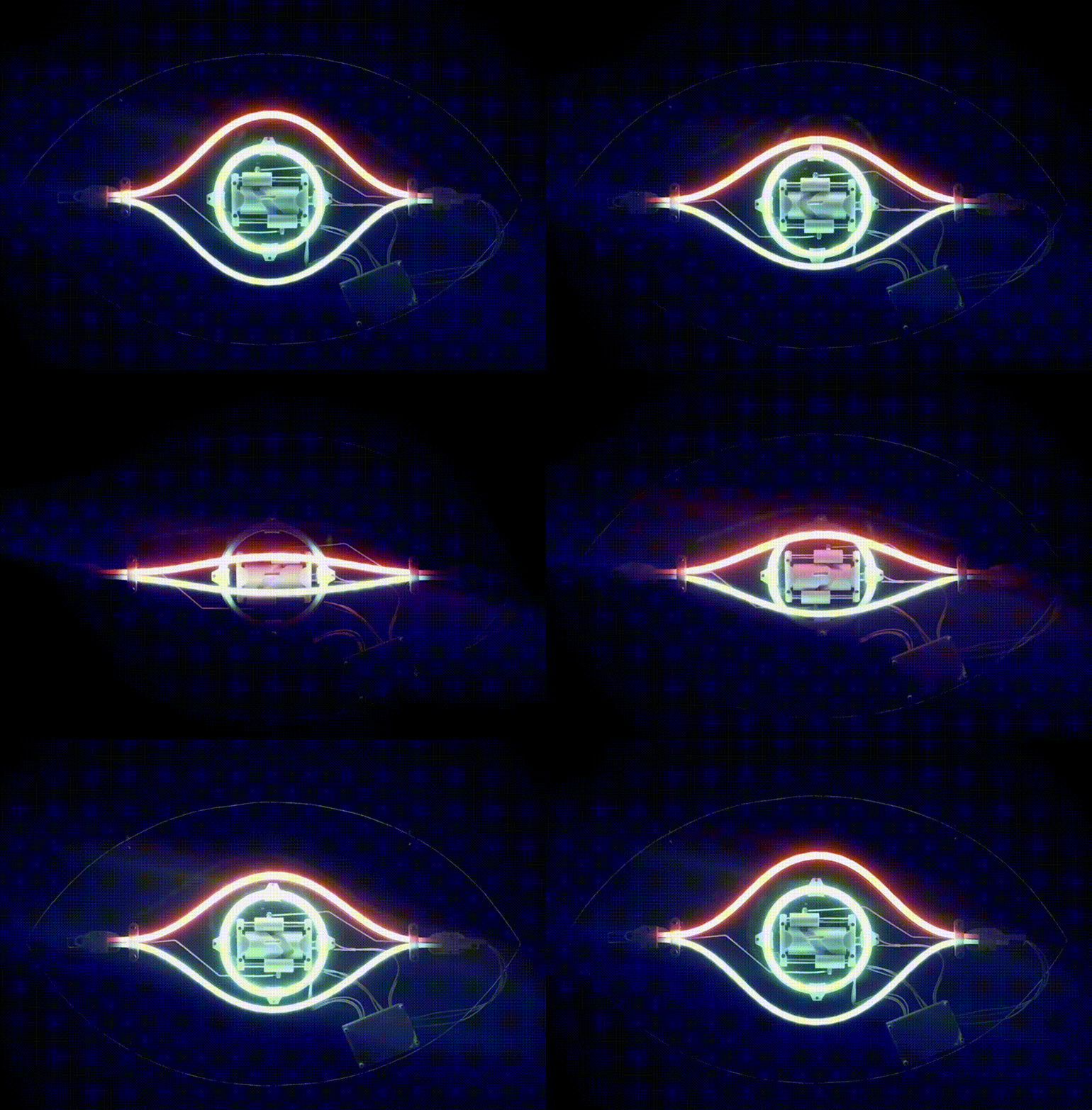
Odds are, if you like neon lights, you’re not thrilled with the LED faux-“neon” strips that are supposed to replace them. They’ve got their advantages, but the light quality of RGB LEDs lacks something compared to the emission spectrum of nobel gas, at least to purists. On the other hand, you cannot create an animation by bending glass tubes, like [David Hamp-Gonsalves] has demonstrated with his Neon Animated Eye.
Back in the day, you’d have needed dozens of tubes for a flickery animation, but [David] figured that since these LED strips are flexible, why not flex them? He’s using addressable LEDs — WS2812s, specifically — so activating and deactivating the pupil of the eye is easy-peasy. Opening and closing the lid is accomplished with a geared motor driven by a TB6612 driver turning a barrel cam. The ends of the stiff LED strip being brought together and pulled apart result in the blinking effect here, but as [David] points out you’re hardly limited that specific motion. There’s a whole world of Tron-like glowing animatronics that can be created with this technique. Code and STLs are available on GitHub, though, if you want to replicate the eye exactly.
[David] says he’d like to see this in a storefront someday, but given that fatigue life is a thing, it might be something to keep in your back pocket for seasonal displays like Christmas and Halloween rather than something that’s going to run 24/7. On the other hand, if you’re careful about limiting flexion and which faux-neon strip you buy, you might be able to create an animation that can last for years.
This is hardly the first time we’ve seen these faux-neon strips , but it is the first time we’ve seen them animated. We can’t help but think the Hauntimator software we featured before would be a good paring with this hack.









OK. I’ll be that guy.
It’s noble gases. Nobel is the inventor of dynamite, pretty much the opposite of a noble gas.
(And we’ll let “paring” slide, because I think paring software is a noble pursuit.)
I caught that too, and am relieved not to have to bring it up myself! You’re doing Saint Tesla’s work, my friend.
Good catch. I was wondering whether the spelling in the article is correct.
While I appreciate the smooth motion this allows, I find a certain nostalgic charm in the old multi-tube animations. I think of it in the same way as 7-segment LED numeric displays vs. Nixie tubes with their distinct digits. Maybe I’m just old.
Given this particular animation, you could also make it by rotating a bent tube instead of flexing it. It would be a 3D animation.
Same thought here.
Unless it has to remain in a single plane(ish), just rotating the tubes could bring the “eyelids” together. But, that wouldn’t create the effect of blocking out the eye. One could maybe do that part by attaching a pleated shade eyelid, contoured to match the bend of the tube, to each tube so that it expands from the back substrate as the tube rotated, acting like an eyelid. Maybe cloth with stays or ribs(?) like a convertible car top.
Personally, I think some of the best nostalgia referencing modern implementations are ones with clear anachronistic elements clearly communicated upfront and highly reinforced, that then do something unexpectedly impossible with the original technology.
So a sign that had multiple led strips with the stop motion lighting sequence required by neon tubes, but then incorporated a moving, bending element for the final part of the sequence… to me, THAT would be exciting due to setting the expectation and obvious reference, reinforcing it, and then surprising with the subversion of it.
It’s a bit like a magic trick. You’ve got to get people’s minds into the frame of really buying into the belief that it’s one thing, then have it do something that should be impossible for that. You have to commit to building up the illusion first to make the trick actually exciting.
This is, obviously, smart and a great point to make (if the strip can handle the repeated motion, but the bend radius here might be ok?), and the exposed mechanics are quite attractive and neat, but it does feel like it’s missing out on that nostalgic vibe.
So you guys have eyelids on the top and bottom and they move symmetrically right?
Just wondering.
I’m just a normal alien like you guys, don’t get the wrong impression, I’m just checking if there any of those nasty humans around.
Hah, I actually (I’m the one who built this) working on a two cycle blink that lets the top lid move down further for more realism. I need to switch to a larger motor so that I can get a wider range of motor speeds but its in the works.
Yes. We also catch flies with them, Aeon Flux style. Why do you ask?