
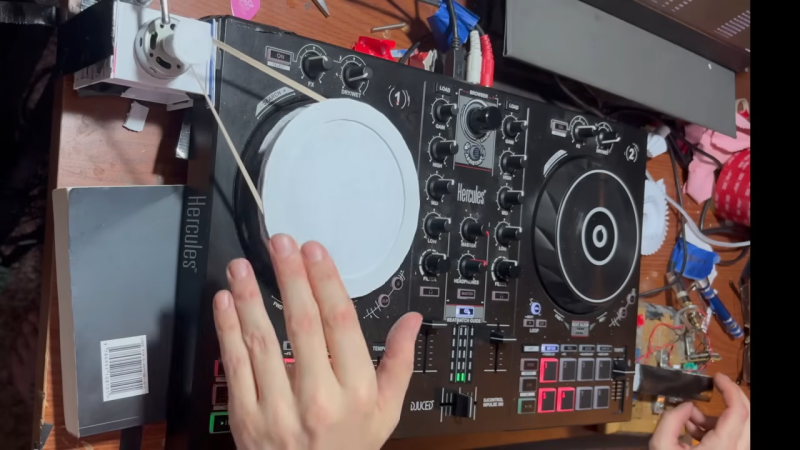
[Jeremy Bell] loves scratching, but he had a problem. His Hercules DJ controller wasn’t really doing a great job at emulating the kind of action one would get with a real turntable. The solution was both mechanical and electronic in nature!
As stock, the Hercules MIDI rig lets you scratch in a relatively simplistic way. When it detects a finger touching the rotary control, it lets you scratch back and forth with great motion tracking. However, when you let go, playback resumes at regular speed instantaneously, which creates a somewhat inorganic sound.
The fix was to make some mechanical mods to the MIDI controller. [Jeremy] tried out a variety of different methods of using a motor to spin the rotary control continuously, from geared rigs to belt-driven setups. It was then possible to scratch on the controller, and then let it return to normal rotational speed, creating much smoother auditory transitions. However, this was imperfect, as for whatever reason, the Hercules rig would stop tracking the rotary control accurately unless it detected a finger was touching it. [Jeremy] worked around this by whipping up a slip-ring-like setup to keep his body permanently in contact with the rotary control even while spinning.
The results are pretty great—they’re both mechanically janky and fantastically satisfying to listen to. We’ve featured some other great DJ controller hacks over the years, like this sweet Pioneer UI upgrade.












I always thought you use real turntables with a real vinyl record that has digital timecodes instead of music on it which then a software applies to the music you choose on the computer, if you are really into scratching.
Faux platters dont rotate and dont behave identically to timecode vinyl setups. Timecode vinyl is extremely close to audio vinyl in terms of interaction. Physical motions result in the same audio artifacts or effects.
PhaseDJ does this with a gyroscope.
Having seen up close a number of DJs, the complexity of regurgitating undigested shreds of soundscape is comparable to spending some time learning real instrument/instruments with which one can play his own music from scratch, pun intended. Samplers, yes, even using samplers as the sound source. If one has a talent he/she can play sticks and stones.
Makes me wonder that perhaps the nadir of DJing was passed in the 1990s, and not much new has been invented every since, only better tools accomplishing about the same results overall.
Either that or go the experimental music route and let AI assist you with the soundscape you cannot easily create yourself (say, philharmonic orchestra, composition, arrangement, conducting, recording, mastering and producing, complete cycle, from start to finish).
Concepts-wise, IMHO, I’d say DJing falls somewhere between street organ and hurdy-gurdy, and my friends who took top prizes were closer to reinventing art of hurdy-gurdy.