
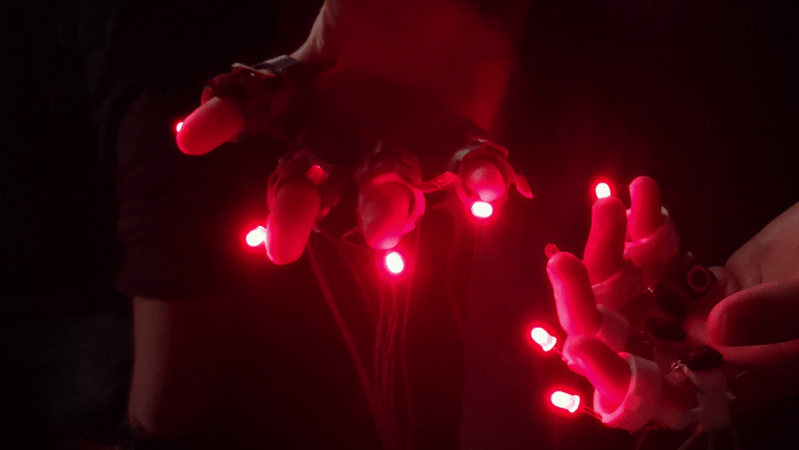
Most synths happily get by with keyboard or pad inputs and make lovely sounds in response. [Becky Clarke] and her fellow collaborators are building a synth that works rather differently. DigitSynth is a wearable controller that’s rather fun to interact with.
The heart of the build is a Raspberry Pi 5. It’s set up to talk to a TI ADS1115 ADC chip that lets it read a bunch of analog flex sensors embedded in a right-hand glove, while the Pi can also read a bunch of tactile buttons activated by the left hand. The flex sensors are used to control synth parameters like LFO rate and filter cutoffs, while the buttons control chord changes. The Raspberry Pi runs custom code to read these devices and generate the requisite MIDI commands to send to a Roland JD-Xi synth which is responsible for actually making the sound. Both sets of fingers are also dotted with LEDs for visual feedback, controlled via a TLC59711 PWM driver.
It’s a fun build that creates some ethereal sounds in an intuitive way, thanks to the nature of the interface. We’ve featured some similar builds before, using the flexure of the hand to create musical soundscapes. Video after the break.












I am misunderstanding what this does or is a Pi5 way too owerpowed for this and a simple microcontroler would also work (esp32, stm32, etc.)?
I guess an esp32 would be perfect for this job, it has the analogue inputs for the flex sensors, pwm outputs for the leds, gpio for buttons and you can do midi over Bluetooth, but perhaps i a missing something?
It is the problem of the generation(s) that have way overpowered tools and cannot use it to its extent. The problem is on so many levels that I will not atempt to present the analisis – HaD is way to shallow for this.
the pico is great because it created the whole new genre of projects: shoulda used a pico instead of a pi :)
I have no blocking on HaD or youtube but tube ads don’t play in embedded videos here, OK. Instragm whatever is blank in both videos, so no go for me. I’d like to see the videos on a public site.
With enough motion channels and filter frequencies you should be able to exceed the original voder of the thirties. Nearly a century of synth sound creations.
So, something like this: https://mimugloves.com ?
(They’re $3,000, but the development path was fascinating, been following these (and Imogen Heap’s music and involvement) for years).