
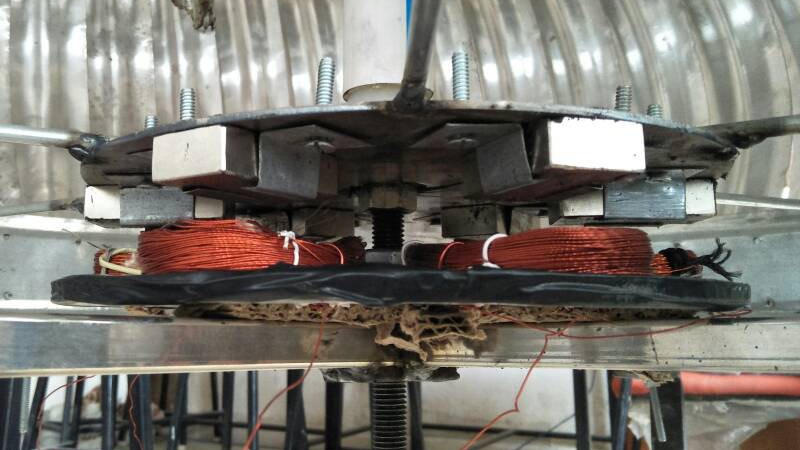
Have you ever looked out across the rooftops of a city and idly gazed at the infrastructure that remains unseen from the street? It seems [varunsontakke80] has, because here’s their project, harvesting energy from the rotation of a rooftop ventilator.
The build is a relatively straightforward one, with a pair of disks with magnets attached being mounted on the ventilator shaft inside its dome. A third disk sits between them and is stationary, with a set of coils in which the magnets induce current as they move. A rectifier and charge circuit completes the picture.
This appears to be part of a college project, but despite searching, we can’t find any measure of how much power this thing generates. We’d be concerned that it might reduce the efficiency of the ventilator somewhat. There will be an inevitable tradeoff as power is harvested. Still, it’s a neat use of a ubiquitous piece of hardware, and we like it for that.
This hack is part of our 2026 Green Powered Challenge. You’ve got time to get your own entry in, so get a move on!













Facepalm.
Those funny looking fan/turbine things on the roof are there to ensure your passive ventilation in the kitchen and bathroom works correctly by sucking air and dumping it outside, not reverse. In general, correctly working ventillation moves air constantly through the rooms to ensure sick building syndrome doesn’t occur.
If this things generates any power it will k*ll said passive ventillation, which in turn opens a way for mould to thrive. If it doesn’t… what a waste of time and effort.
No grant money on the line = “yeah sure do whatever you want kid, don’t bother me”
Also is it really the professor’s fault at this point if the student doesn’t understand what a passive ventilation systems is, and how it works?
Still its valuable hands on experience. You’d be surprised but barely any college students these days wind their own transformers or coils anymore.
Stop and take a breath. Then realize that this will only work if there’s air movement in the first place.
Yes, it extracts power from the airstream. Yes, it would impose some backpressure doing so. Yes, it probably even reduces the flow somewhat. But in order for it to work at all, there must be ventilation happening.
And, yes, it’s obvious it could be engineered more efficiently. But as we know, that’s HaD’s raison d’être: To be a forum for those who need to blat about other people’s inefficient devices and faulty thought processes.
Also, you only need a certain amount of ventilation, and anything more than that doesn’t improve things any. A generator like this will load the ventilator down proportionally to the rate at which it is spinning. At the minimum speed necessary to provide sufficient ventilation, it probably won’t generate much power at all, and once it IS generating significant power, that’s power that is in excess of what was needed for ventilation.
The way these generators work, they need really high RPM to generate any useful power. To remedy that, you need to add iron cores to the coils and decrease the air gap to a minimum to increase the magnetic flux density through the coil. Once you do that, the magnets get aligned to the iron and you need a fairly high torque to get it spinning. It basically gets stuck.
The rooftop ventilator will still “work”, in the sense that any hole through the roof will permit hot air to rise.
Facepalm.
How much ventilation is needed? Quantify it, please.
Then tell me how much one of these things does for that.
Then tell me how much this device chokes the flow.
You insufferable “umm, actually” dorks would shit your pants if you actually had to do anything other than throw bullshit gotchas at people experimenting with things.
eh, i agree that you can’t say it ruins everything without measuring the degree of ruination. but also, “you’re ruining it” is often a perfectly adequate attitude when “you actually have to do” home ventilation.
This project is of dubious merit, but your criticism is also misleading. Turbine ventilators are like any other ventilators on the roof – they are designed to ventilate the attic or roof space, not the living space. the issues with passive ventilation in the living space that you raise are only tangentially related.
Are we not allowed to say “kill” on Hackaday? I’m pretty sure we can. Kill. What about kill switch? I’m pretty sure even the reported comments go thru a proper human before getting memory holed… At least when internet jerks aren’t running bots to report ALL the comments.
The fundamental flaw, of course, is that approximately zero non-trivial building ventilation systems are passive: Most actually require electrical power input. Extracting power from the exhaust like this ultimately simply siphons off some of that input power.
Even in the trivial example of a typical house (i.e., mine): the passive whirly-things on the roof are just attic ventilation. The kitchen, bathrooms & laundry room ventilators, shop exhaust (lasers, 3d printers, dust extractor), furnace and water heater exhaust, clothes dryer and ERV/HVAC systems all are active, powered exhausts. The only things that are not are the emergency backup heaters (gas and wood).
I beg to differ, there are many passive building ventilation system dating back to pre-electric era.
Some of them were also cooling systems. Pay a visit to Yazd city and witness systems that are way older than the society you live in.
Basically heat something up and tap the out stream.
Those passive whirly-things are exactly the topic of the article. Yes, they only ventilate the attic, and they do so without needing electrical power. So I’m not sure where you get “approximately zero non-trivial building ventilation” from, since these devices DO have a use. Those other powered exhausts have their own roof vents, so scavenging power from the “trivial” whirly-things is very nearly free power.
They don’t do anything more than a non-moving vent of similar cross-sectional area, though. The spinning comes from extracting some of the energy of the escaping hot air, so it actually is less efficient.
They got popular simply because they look cool.
My understanding though I have never seen one in person was they are vastly better than the non moving vent as a rule, as they are using the outdoor wind to actively drive the desired airflow – its not meant to be powered by the indoor air its venting.
It might well sometimes be spinning because of the air its venting should the day be very still, in which case yes its probably going to be less efficient, though even then maybe not as a more complete mixing of the vented air and the ambient air might well actually create a bit of extra pressure difference at the outlet and so higher airflow through the vent.
Yep. They’re centrifugal fans spun by wind.
The criticism still applies: it’s basically like a savonius turbine. They have a relatively narrow optimum tip speed ratio (basically, RPM needs to match wind speed in a narrow range) and if the load isn’t well matched they will bog down.
In a design like this, once the generator voltage exceeds the battery voltage, it will be like hitting a brick wall – the generator will initially offer no load, and then all the load the battery can sink because a slight increase in voltage will drive a high current, so the RPM won’t rise much above the point where the battery starts charging. If the wind speed goes up, the turbine will lose torque and power as it becomes saturated by spinning too slowly relative to the wind. If the wind speed picks up even more, the turbine stops. If the wind speed drops below the charging RPM, the turbine will spin idle and generate no power.
So it will be generating power only in a narrow range of wind speeds, and while it’s doing that, it’s reducing the effectiveness of the vent.
Reference:
https://www.researchgate.net/figure/Power-coefficient-versus-tip-speed-ratio-for-a-variety-of-turbine-configurations-20_fig2_344979324
Basically, if the wind blows more than about 1.5 times the tip speed of the blades, the efficiency collapses to zero and the turbine stops. This happens because the air packs up in front of the turbine instead of swirling around and that blocks the blades.
So for the turbine to work, it pretty much has to spin freely as fast as the wind. If you load it up, the load has to scale up proportional to the wind. The generator load goes up sharply after it exceeds the battery voltage, so it’s a bad match and difficult to make it work at all without active MPPT control.
Also, another function of these things is to act as a wind shield. In high winds, the turbine blocks the wind from blowing down the vent and causing pressure oscillations like blowing across the open neck of a bottle.
It’s some sort of R&D project so part of it is to learn something, many above say it won’t work – and they may very well be correct. However I would like to see more data, how much power is produced for what conditions, does generating power slow the ventilator down too much, data where the generator is switched in and out, air flow up the shaft and so on. Doing the extra data will teach the student much.
But getting much data is the first step, maybe the system could be modified to produce more power. Good luck to the team
This appears to be a master’s level project in a college.
The only figures given in the report they have written is that the generator supposedly makes 500 mA or 18.5 Volts at 885 RPM. The report doesn’t indicate whether this was measured separately or concurrently, or what was spinning the generator. No other performance stats are given, and no actual evaluation of system performance can be found. It’s not a very good report and wouldn’t pass as a thesis yet, but it would be acceptable as some sort of capstone project.
No one here seems to know that these turbines are wind powered by passing breezes in any direction and that mostly powers their rotation and subsequent ventilation of the under side. It would have to be quite hot to make them move much at all if they didn’t work that way. Nothing wrong with a omni wind turbine!
Pigeons love to twirl on roof ridges to show off to get it on. There’s a video of a pigeon on top of one of these turbines and it’s loving it powered by the turbine. It must generate many likes.