
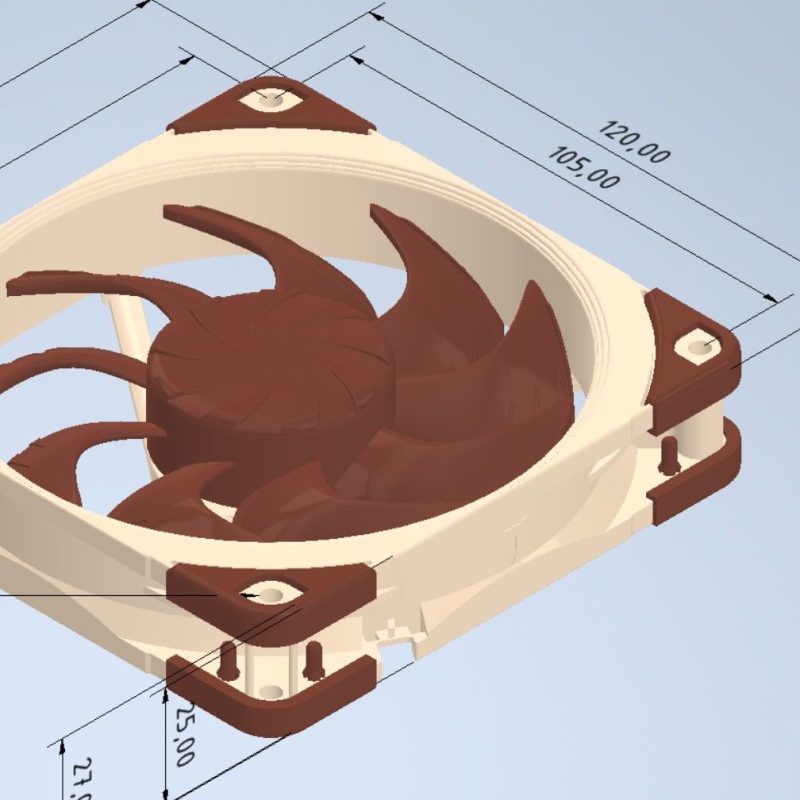
Noctua wants to make life easier for fans of its…fans. To that end, the company has released a bevy of 3D models across its various product lines, all available to download for free.
If you’re not familiar with the company, Noctua specializes in high-quality cooling systems for the PC market. Its hope is that by freely providing 3D models of its components, it will aid aftermarket companies and DIYers that wish to integrate Noctua fans into their gear. In the company’s own words, these files are made available for “mechanical design, rendering, or animations.” They will let people check things like mountings and fitment without having to have the parts on hand, or to create demo visuals featuring the company’s products.
Don’t get too excited, though, because Noctua has already thought ahead. The company has specifically noted these parts aren’t intended for 3D printing, and critical components like fan blades have modified geometry so as to not compromise the companies IP. You could try and print these models, but they won’t perform like the real thing, and Noctua notes they shouldn’t be used for simulation purposes either. They’re intentionally not accurate to what the company actually sells in that regard.
That isn’t to say Noctua is totally against 3D printing. They have lots of parts available on Printables that they’d love you to try—everything from fan grilles to ducts to anti-vibration pads. Most are useful accessories—the kind of little bits of plastic that make using the products easier—that don’t threaten Noctua’s core product line in the marketplace.
If you’re whipping up a custom PC case and you want to kit it out with Noctua goodies, these models might help you refine your design. It’s funny how it’s such an opposite tactic to that taken by Honda, in terms of embracing the free exchange of 3D models on the open Internet. It’s a move that will surely be appreciated as a great convenience, and we’d love to see more companies follow this fine example.
Thanks to [irox] for the tip!












Scanning the original parts is relatively trivial. If you had a perfectly accurate model of a Noctua fan, you’d still have nothing at all.
Their most popular design was a copy of the Nidec Servo Gentle Typhoon which was discontinued in 2010 according to some seconds of googling.
I’m not saying that they haven’t improved on the design or that their reputation for quality is undeserved. Just there is no point copying Noctua, it’s the quality we want, not the look (unless you are on the Noctua fanboy subreddit, which routinely budgets the price of a Ryzen X3D processor for fans XD)
Lol… good luck with that.
I would love to see someone 3d scanning one of the fans and comparing to the published 3d model of the same partnumber, just to learn how they modified the geometry to protect their IP
Maybe it’s very obvious, if not then yeah that would be intriguing.
This whole thing überhaupt sort of screams ‘somebody make a scan version’ doesn’t it.
I’d be more interested in digging up a 16 year old Nidec Servo ‘Gentle Typhoon’ and seeing what Noctua did to make their copy of that design different.
I have a lower-mid-range 3D scanner, and an NH-D15 with a third fan. I could scan one of the 140mm fans, if you like.
Oh that’s really useful. I have a home made air filter based around a noctua 120mm fan and couldn’t be bothered making a seal with the rubber vibration damping bits included so just removed them and used tape for the seal. A better model would let me revisit that work.
I can’t imagine a scenario where so many people are 3d printing their own fans that fewer are purchased. That said… there is a guy on Youtube that has been running sort of an ongoing competition for designing better fan blades for Noctua fans for years now. So.. if you really wanted to.. you could probably mix his stuff with theirs to overcome whatever Noctua munged and perhaps even get something that works better than the original.
Still, I can’t see this possibly being serious competition for just buying a fan. I think actually printing a fan is going to be limited to DIY purists going for a project where maximum DIY is the point not the end device. Or maybe people on a really really tight budget. The former could result in more fan sales when others duplicate their project but aren’t set on going quite so extreme diy. The latter would standardize on that design then start buying them later in life when they are more financially established.
That is of course.. only if there is a satisfactory answer to the question on my mind… if someone won’t even buy a muffin fan then what is available that they will buy to use as the motor?
Also, if one did want to steal from Noctua… And they did already have the perfect motor… They would get the already open source blade design from the other guy, what’s left to copy? The cage? It’s a rectangle. With screw holes in the corners. Come on now…
I could potentially see the case for changing the blade design on a fan(either if you’ve got an odd and very tightly constrained set of dimensions that doesn’t match off-the-shelf ones well; or potentially if you score a batch of dimensionally odd fans with gorgeous production values being sold off for a pittance because some stupidly expensive widget that used those custom fans is now EOL and irrelevant); but it’s harder to think of a DIY fan scenario where you wouldn’t start with a fan and work from there.
Also, for Noctua, the risk of 3d printers displacing their sales seems less plausible just because there’s an established “don’t pay Noctua prices for fans” strategy that involves buying fans from cheaper vendors; ideally the ones that are only a little less good for significantly less money. There is essentially zero chance that trying to do small batch Noctua clones at home is going to beat just buying from someone manufacturing them at scale.
It’s not really end users with 3d printers they’re concerned about (their comment is purely “don’t 3d print this because the result will suck.”) The model is nerfed specifically to prevent it being used to make commercial quantities of counterfeit fans.
Sure, they can still get a real fan and scan it, but there’s a step difference between that and an original engineering model.
If Noctua really wants people to use its products and help us, then how about not charging 50 bux for an 8 dollar fan…. Making quiet fans at this point isn’t rocket science like it was in say 1992, so um yeah just make cheaper, decent quality fans.
Oh. So THAT is why they are concerned someone might actually try to print instead of buy them. At those prices why are these fans so popular? Are they really that much better than Gelid? I’ve been using Gelid fans for several years now and have been very happy with them.
Nothing else comes close to Noctua’s noise-normalized performance. Nothing. They’re expensive, but you get what you pay for. I have 17x 120mm Noctuas in my workstation, 8x NF-A12x15s in push/pull on a 480mm radiator, 6x NF-A12x25s in push on 2x 360mm radiators, and 3x NF-S12 on the top of the chassis to draft over VRM/RAM. I can’t hear any of them, and the system still maintains ~1C coolant delta after soak under 100% load, with two watercooled 350W GPUs and a watercooled 64-thread Threadripper pulling 515W. I can’t get that anywhere else without unbearable fan noise and/or unreliable fans that quit working or start grinding after a few months.
Saving a few bucks isn’t worth the noise or sacrificing the reliability (and warranty). For my needs, at least. That said, use what you want. I’ll stick with quality and reliability.
noise normalized … hahahaha Way to buy the hype.
Nothing beats the water crossing efficientcy of my bridges that I have for sale in Brooklyn either.
Noise-normalized performance is one of the few metrics that actually reflects how people use fans, but go off I guess. I’ll break this down succinctly, in deference to you:
Comparing fans at the same acoustic output (e.g. 35 dBA), the question becomes “at the same perceived loudness, which fan moves more air or maintains more pressure?”. It’s fundamentally a system efficiency metric: airflow (or static pressure) per unit of noise. Noise is the real constraint in most builds. In practice, nobody runs fans at 100% PWM 100% of the time, or max RPM unless they don’t care about noise. Thus, real-world operation is capped by acceptable noise and dynamically controlled by curves. Noctua wins almost every time.
Further, it’s not just noise. Radiators are pressure-restricted systems, not free air, so the only metric that actually matters is airflow delivered at a fixed acoustic budget. Noctua wins, hands down, because of their tight tip clearance, stiff LCP blades, low turbulence and clean motors. At the same dBa, Noctua sit further right on the P-Q curve, thus more flow through the radiator for the same noise. Everything else is just louder brute force.
It’s physics, and arguing against it just underscores your lack of understanding of the subject matter. If $9 fans suit your needs, by all means… but pretending it’s “just marketing hype” is provably false. At the same dBA, Noctua’s offerings move more air through a radiator, full stop.
Careful with those bridges though… someone might ask you to normalize for load before buying. Maybe the buyer can toss in a basic physics textbook as part of a bundle deal? In fact, keep the bridges… what you actually need is a refresher on pressure curves.
I have to try hard to hear my Gelid fans. Like, shush anyone else in the room, put my ear up to it and concentrate. I’m sure if I used an actual db meter I would find that the expensive fans are quieter. But why would I pay 3 or more times the price just for a difference that I need a meter to show me even exists?
I checked the ratings. So.. Gelids are typically rated for 50k hours and Noctua’s 150k. Ok, that’s a factor of 3. That almost sounds like a reason to spring for them. Except…
In the > 20 years I have been building PCs and other things that use Gelid fans I have had exactly one die on me. I’m not saying they are or are not outliving their ratings. Maybe it’s just that I don’t tend to keep the device I put the fan in long enough to reach 50k run hours. Or maybe they ARE outliving their expectancy. I don’t know. But.. if I paid 3 times the price all these years just to avoid replacing that one fan once… that is not a good deal!
The really small fans however… like on my 3d printer’s cold end.. those I do hear. Would switching to Noctua silence those? I always just assumed anything that small was going to be loud if it was to push a useful amount of air and that there would be nothing I could do about it.
I tend to replace my fans when they I notice them starting to make noise (as opposed to them actually failing). Usually this means I operate a piece of equipment stock for a couple of days or weeks (or months, if I’m lucky), then replace the fan(s) once I start to hear them.
3D printer fans: Yes, I’ve switched a lot of my 3D printer fans to Noctua fans and it makes a big difference. However, they don’t make a cage/blower/squirrel fan.
if it’s so easy then just buy from all of the equal and cheaper competitors.
also for all the people coming along and commenting while knowing absolutely nothing about noctua, their fans are not US$50. i think their largest fans top out at under $40, with the very common 80mm being about $18. so yeah they’re like twice the price of cheapo fans from companies you’ve never heard of, that will die twice as fast while sounding worse the whole time.
You say all of that but now now there are also 65 dollar fans as well lol. Mine was 12 dollars is 80mm and produces all of 9dB at full load. I tried four times with Noctua but the PS2 fan was loud af, the two 60mm I got both just died after 4 months of random use, and the previous 80mm I had was more like 36dB iirc and ran high all the time. Maybe I got some unlucky batches, but I feel like 4 tries is more than enough. When I fussed, I just met people like you online that were more than happy to blame me the user with 50+ years dealing with computer crap. So unless you want to go find my blog about the whole thing, you can enjoy paying 30 dollars for a buck tops worth of parts and I will enjoy my stupid fan that is somehow quiet despite its price tag.
Skill issue. Your entire position is predicated on an opinion that isn’t even remotely tenable. If Noctua were as bad as you claim — even without the world-class warranty — then nobody would buy them. Instead, they’re an industry leader, precisely because they deliver on the static pressure, airflow and noise-normalized performance trifecta. Your cheap fans may serve you just fine… but don’t pretend they’re anywhere in the same league, or that your experience is indicative of a trend… especially when you can’t figure out how to use them correctly. Further, “a buck tops worth of parts”? That alone demonstrates your lack of credibility.
Meh.. a big marketing budget convincing desperate rubes to shill for them will convince a lot of people to buy them.
AI issue. Your slop troll response is predicated upon a fallacy in itself, Timmy. Lol you sound pretty butthurt because someone did not like the fans you do. Get a life and buy audio amp fans. There is a really nice company in western ohio that sells them still as whisper quiet as they were back in 1998. You should give them a try if you can ever get the noctua removed doing the colon cooling lol. Good to see you again. Let’s do this in another three years with your new alt :)
That sounds rather like you are not using a genuine Noctua, or doing something really terribly wrong – as even their industrial fan segment are not very loud at all, and the ones focused on the regular computer sort of needs are almost certainly well well below the noise floor in real world use, and quite possibly still below the noise floor of your room when running flat out, something they really shouldn’t need to do in most situations!
The quiet end of their fans are bonkers in the amount of air they move while barely having to spun up, and their ‘noisy’ industrial fans are still at a max of 31ish dB(A) IIRC, at least the ones I’ve looked at in the normal 120 and 140 ranges. But still the industrial ones are pretty darn quiet for the performance they provide.
I’m not blaming you, though I can if you like, and your complaint does suggest you could have made an error but actually got a genuine Noctua at least once – perhaps you picked the wrong one of their many fan options, as not all fans are PWM by design. If you had a fan that isn’t meant to be PWM you would expect to get that ‘ran high all the time’ behaviour, if the fan spins at all – Motherboard behaviour dependent, as some might well complain and not even spin the fan at all if it strictly wants PWM, while others likely have binary on off control. Also Noctua do make fans in other voltages too, I have no idea what would happen if you tried to use their 5V fan on a 12 or 24v source, but killing it quickly seems rather likely.
My experience says they really are not 8 dollar fans, they look similar, maybe function within similar enough ballpark of performance when sat in entirely free air and only having to turn over slowly as you only want to push a tiny tiny amount of air. But that 8 dollar fan or even that half a nocutua priced fan in most cases is going to be a noisy rattling barely moves air if it does work at all mess in a year or two. Where the Noctua is still basically as good as new, actually quiet in operation and providing useful cooling even though a dense fin stack after a decade of 24/7 operation…
Noctua are not the only people in the world that make good and lasting fans, or quiet fans. I’d even suggest very tentatively based on my experience that at the industrial some noise is fine models the competition might be better (not that I have any complaints with the Noctua industrial fans I’ve used either). But Noctua might just be the only people in the world that make fans that are seemingly immortal, stay darn nearly silent yet still move huge volumes of air through tightly packed radiator fins even with a really choked off air inlet for year after year – long enough I’ve moved my CPU cooler with its original fans across 3 computers now for instance!
I’m not really a PC guy (and can tolerate fan noises), but I did have a Noctua CPU fan break after ~3 years. Was making very loud noises for a long time (maybe six months) and then finally kicked the bucket.
In their defence, I’ve been told my fan was still under warranty, but I didn’t bother with an RMA (the fan was given to me and I didn’t have the receipt).
Inevitably going to be variability, and a few duds that fail early, and there is no denying my personal sample set is far from comprehensive, though does seems to match the reported experience of others.
So while my personal experience isn’t enough data on its own the trend is pretty clear – a good solid handful of Noctua with no failures and not even getting loud and rattly, with many over a decade old, and about 3x as many fans of other brands, mostly real brands rather than the here today gone tomorrow Chinesium special labels that might be included with your PC case of which all have ‘failed’ enough i want to replace in the same time frame or vastly sooner… But I am noise sensitve, so that ‘failure’ point for me is likely sooner than others – for example the case fan that came with the case I used for my new NAS has in only a few months gone from ‘hey this is pretty good’ while sat on desk next to me being set up, to meaningfully annoying even though its now not even in the same room.
Where are these $8 fans that are as good as Noctua?
I have never found any. Most of the other “quiet” (but not as quiet as Noctua) fans I found started to have bearing noise after a couple of weeks of continuous use (and they cost more than $8). Nothing I’ve used has come close to Noctua for long term quiet and quality.
At least you can print rad shielding now
https://phys.org/news/2026-04-thinner-hair-stretchable-rubber-shield.html
Regarding the Honda comment: remember that the deal auto manufacturers usually have with their parts suppliers is that they pay absolute minimum on the parts used during manufacturing, and the suppliers are expected to make most of their profit by charging more for repair / replacement parts. Supporting printing or other non-oem parts sources would undercut that arrangement.
Muscles
https://techxplore.com/news/2026-04-programmable-3d-filaments-mimic-artificial.html
Tough fiber
https://techxplore.com/news/2026-04-ultralight-carbon-fiber-lattices-aluminum.html
Fiddle
https://techxplore.com/news/2026-04-virtual-violin-realistic-wood.html
Just unrelated spam? Or are replaying to the wrong post?