
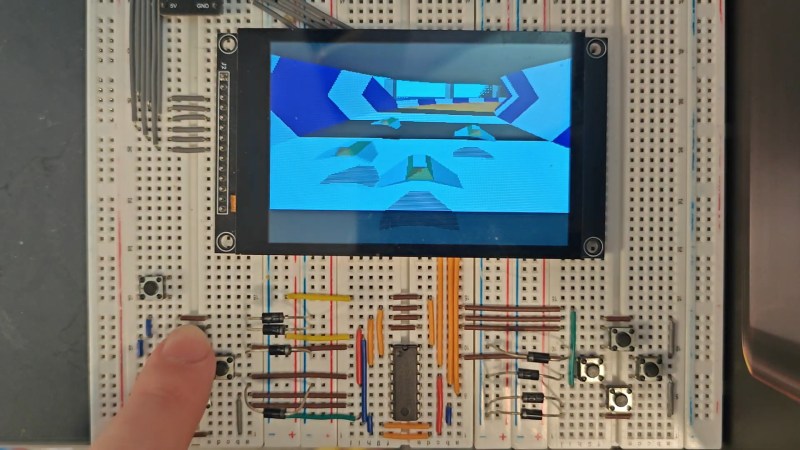
Psygnosis’s 1995 game Wipeout is remembered for two things: being one of the greatest games of all time, and taking advantage of the then-new PlayStation’s capacity for 3D graphics. The ESP32-S3 might not be your first choice to replace Sony’s iconic console, but [Michael Biggins] a.k.a. [PhonicUK] is working on doing just that, with his own clone of Wipeout on the Expressif MCU.
It’s actually not that crazy when you think about it. The PlayStation had a 32-bit RISC processor, and the ESP32-S3 is a 32-bit RISC processor. The PlayStation’s was only good for about 30 Million Instructions Per Second (MIPS) but it had a graphics co-processor to help out with the polygons — the ESP32-S3 has two cores that can help each other, which combine to about 300 MIPS. In terms of RAM, the board in use has 8 MB of PSRAM, while the faster 512 kB on the chip is used, in effect, as video ram.
The demo is very impressive, especially considering he’s fit in three computer players. He’s also got it blasting out 60 frames per second, which is probably double what the original Wipeout ran on the PS1. Part of that is the two cores in action: he’s got them working together on the interlaced video output, one sending while the other finishes the second half of the frame. Each half of the video gets dedicated space in the internal memory. Using a 480×320 pixel display doesn’t hurt for speed, either. Sure, it’s paltry by modern standards, but the original Wipeout got by with even fewer pixels — and it didn’t run on a microcontroller. Granted it’s a beefy micro, but we really love how [Michael] is pushing its limits here.
Right now there’s just the Reddit thread and the demo video below. [Michael] is considering sharing the source code for his underlying 3D engine under an open license. We do hope he shares the code, as there are surely tricks in there some of us here could learn from. If it’s all old hat to you, perhaps you’d rather spend a weekend learning raytracing.












descent 2 is near ;-)
i see prince of persia moving to one program without emulator (or with emulator inside) and working on small cpu.
CYD is good idea but too small processor. pity
Descent will always be up there as one of my favorites. I got more invested in those titles than I ever did any RPG.
8,5mb ram for wipeout, nexthack made doom, Duke and quake run on 256 to 276kb so there is still room for improvements
That’s just what the board has, it doesn’t actually use all of that ;) 480x320x16bpp = 307KB just for the framebuffer vs 64K for 320x200x8bpp to do Doom.
It was a good racing game but a GREAT soundtrack. Still have it on CD from best buy back in the day lol. All the electronica big hitters from the era are on it. Surprised this wasn’t mentioned heavily throughout the whole blurb lol. Game was pretty cool but the music was great. F-Zero is still better imho.
Wipeout is what brought all the “electronica big hitters” to the mainstream.
Another big thing was (and still is) the amazingly good visual design by Designers Republic. There’s a whole book about that.
That is a mighty neat breadboard. I can’t believe that I’ve been geeking with electronics for 50+ years without ever using one bigger than 2×2 inches. Either I did perbboard, wire wrap or home made PCB’s.
It’s 3 breadboards in a trenchcoat.
This defo needs game sound/music
Conclusion: The situation in 2026 is less about immediate bankruptcy and more about structural, long-term risks where, for the first time, the “physical layer” (data centers/power) threatens to drag down the immense profitability of the software layer.