
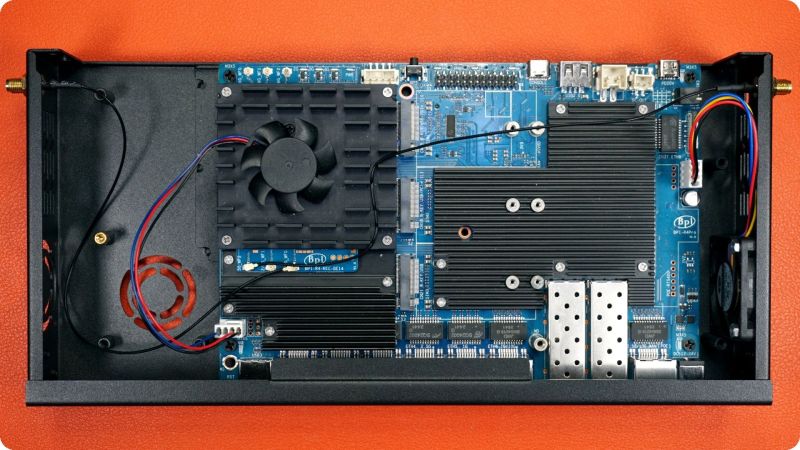
As fun as ARM and RISC-V single-board computers (SBCs) are, all too often getting the most out of the hardware requires the use of an unofficial firmware image. So too with the Banana Pi BPI-R4 Pro router SBC that has been out for a while, as OpenWRT support for it still very much unofficial. This is where [Interfacing Linux] goes on a bit of a rant while assembling one of these puppies into a sleek metal enclosure.
The first rule of OpenWRT Club is of course that you never run an unofficial image on any hardware that’s part of any network you care about. This is somewhat upsetting, as the testing shown in the video below reveals that performance is great when running it.
Currently OpenWRT support is painfully working its way through development, per the OpenWRT PR thread, so there’s hope that official support will appear at some point. As with all of such SBCs the question is always whether official support appears before the hardware has been rendered firmly obsolete. Until then the community Debian 13 image might actually be safer.












So, before a direct competitor gets better official support, right?
i don’t understand why you would want openwrt on the bpi-r4. that board is a monster compared to the cheapo routers that openwrt is designed for. just use debian. i think it is kind of wild that people seem to think linux can’t route packets if your OS doesn’t say “router” anywhere on its shrinkwrap.
At risk of feeding a troll…
-> ease of use & familiarity
OpenWRT is a working router out of the box. Sure you can configure every Linux to be a router, but if you want a router it’s just easier to pick a distribution that comes with batteries included.
You can even run openWRT on a i9 class CPU, or even higher. It’s the familiar user interface and the out of the box experience users prefer.
Similar to how people install OPNsense / pfsense on desktop or workstation class systems, despite that network appliances would be enough to do routing and firewalling.
I would even say if you are fluent at configuring OPNsense and openWRT you can ditch any other routing / networking platform and stick to those two.
Yeah, look I’ve run all kinds of stuff for my network, from dedicated enterprise firewalls to everything within Proxmox. After all these years, I still ended up settling for running openWRT directly on an older, low-power i5, especially since the latest versions get apk, and modern kernels let you do everything else you want in containers.
It’s really hard to beat what openWRT has to offer in terms of simplicity, despite its offering some heavy hitter features.
but that’s exactly what i don’t understand! if you just want a router, go to best buy and buy a router. who buys a BPI-R4 because they want a turn-key solution?
One could say the RPI 3 and 4 are also overpowered, too, at $50-$70 (I’m not going to price in the ethernet on a usb stick or any of the other stuff. Let’s just say it’s competitive with the cheapest home wifi routers) . There’s also ongoing electricity costs, which makes both SBCs and the stuff labelled “Router” more desirable than old PCs, and greener. The article also doesn’t mention the previous board has official status as the “OpenWRT One”, idk what’s changed except WIFI 7, maybe it’s in the video. I guess 8MB is standard (but that’s also an option for the One). The subject depresses me too much to read, why couldn’t the BBC have put out a wifi router that sets the standards, especially security standards for a basic, affordable router? -that’s a rhetorical question, btw.
“Currently OpenWRT support is painfull”
Yea that sentence just about covers it.