
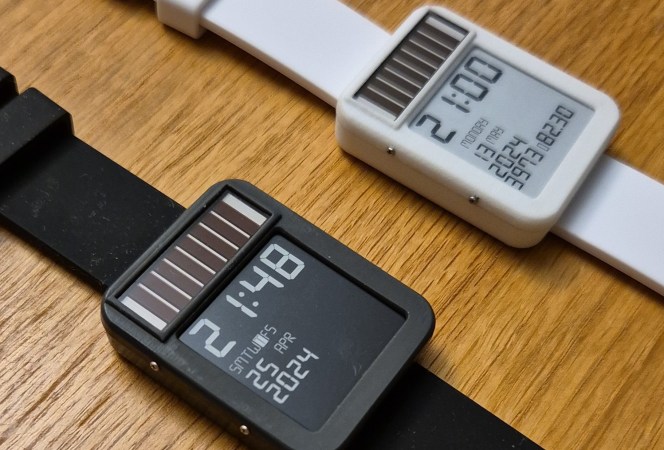
LightInk, A Solar Powered ESP32 Smartwatch

There’s something about the ESP32 family of microcontrollers and timekeeping. We probably see it in clocks as often as we do anything else; we also probably see more clocks with one as the beating heart than any of the many other possible timekeeping options.

[Daniel Ansorregui]’s LightInk watch is no different in that regard — but it is very different in one important detail, because unlike most other smartwatch designs, you won’t have to worry about battery life. Outside of gloomiest Gotham, its built-in solar panel should be able to keep it charged.

That’s for a few reasons. The obvious one is the e-ink display, which only takes a sip of power during updates. That’s hardly unique to [Daniel]’s projec t– he quite explicitly calls out the Watchy project, which we featured previously, as where he got the idea of putting e-ink and an ESP32-PICO together on his wrist. What is unique is the delightful hack [Daniel] is using to minimize power usage, which is our favorite part.

Continue reading “LightInk, A Solar Powered ESP32 Smartwatch”
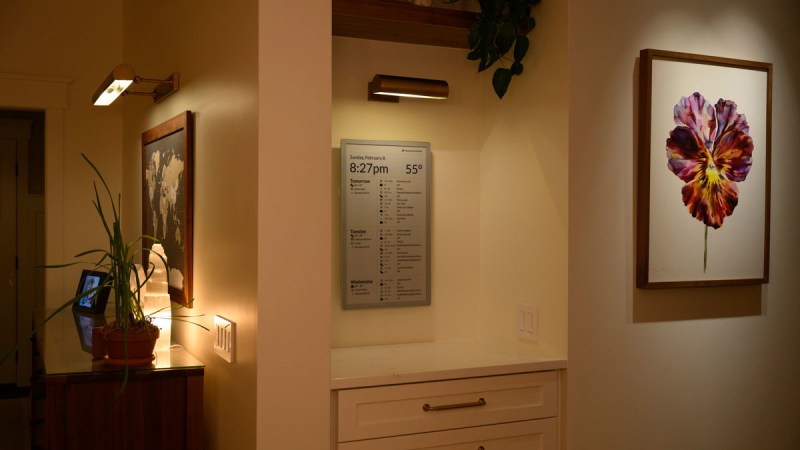
E-paper Dashboard Reimagines Smart Home’s Connection With Technology

When [Joel Hawksley] and his partner got married, they had a goal to create a home with a healthy relationship to technology, which largely means avoiding smartphone use. Smartphones aren’t without their benefits, though, like being clocks and calendars, so [Joel] started looking for other options to replace these capabilities. At first he went with a “magic mirror” solution, but quickly pivoted to a wall-mounted e-paper solution he calls Timeframe which has evolved into a respectable overview for his home and life.

E-paper has a number of advantages over LCD and LED displays, one of which being that its resemblance to real paper makes it feel more organic. The first e-paper iterations of Timeframe used multiple displays in wooden frames, and [Joel] had a few different ones stationed around the house. They received their data from a custom-built Rails backend which sent pictures to the devices. This made the refresh rate possible fairly low, but a new 23.5″ display from Boox eventually enabled an acceptably high resolution and refresh rate which could support more traditional display uses. But this display required that [Joel] rewrite the entire back-end, an effort that took quite a bit of time but resulted in an impressive final product.

Like any custom-built project like this, [Joel] still has plans for improvements including those around further integration with his Home Assistant and reducing costs for future platforms. E-paper displays are popular pieces of technology for home dashboards like this, in the past we’ve seen similar, smaller builds which coincidentally have the same name.









