
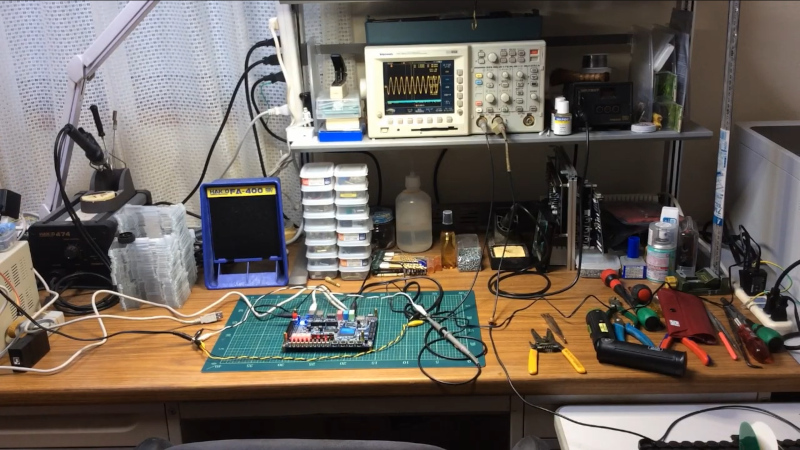
There are all manner of musical synthesis techniques, from the early electromechanical instruments through analogue tape systhesis, the all-electronic waveform synthesisers of the 1960s onwards, and Yamaha’s FM systhesis of the 1980s, to name but a few. One of the attributes of such a machine lies in how many voices it has, or in simple terms, how many notes it can play simultaneously. Electronic complexity limited those early synths, but what happens on an FPGA where vast numbers of circuits can be made with little extra cost? [Tsuneo.Ohnaka] is pushing the envelope a little, by cramming 10240 individually controllable oscillators onto a Terasic DE10-nano FPGA board.
While this thing can in theory generate 10240 different notes at once, in practice that doesn’t mean it has 10240 voices. Instead he calls it a spectrum engine, in that with such a large number of oscillators all with individually controllable frequency, phase, and amplitude, he’s made the part of all those Fourier transform maths where all the different frequencies are combined, in hardware. It’s as though you had a sound card which wasn’t based around a DAC fed with samples, instead all those spectrum points you’d derive from a Fourier transform. Because it’s a massive parallel array of real oscillators it all happens concurrently, instantaneously in real time, and is not held back by the processing constraints of a microprocessor. Think of it as something akin to a software defined radio transmitter, but for the world of audio synthesis.
In that light, it can emulate all those other forms of audio synthesis driven by software, but without the software overhead of generating the waveforms. It’s certainly a different approach to generating audio from a computer, and he’s posted a cacophonic demo video below of it as an 80-voice polyphonic synthesiser. We like it.












The project is impressive, especially the mathematical rigour behind it. But…Ack. Why are synth “technology” demos so musically awful? Also, I didn’t really hear sounds that can’t already be created in existing technologies.
I can certainly see this as a way of generating complex-harmonic sounds at high bandwidth. But unless there are dynamics similarly distributed, it stops there. Most of the interesting parts of synthesis come from dynamic shifting of pitch, volume, and timbre… Which is part of why there has been a renewal of interest in modular synthesis; it’s a lot easier and more intuitive to expose deep decisions as intuitively performable parameters.
Some of that could be implemented as post processing of this chip, of course. Or as additional layers of processing within the chip. But I’m not seeing a way to fold it all the way back to the individual subfrequency sources that wouldn’t break this architecture.
If really independent this is good for pipe organ emulation, ranks of oscillators just like the real thing. You will just need multi channel outputs the more the better, mono or 2 channel is not enough.
Add esp32 server to it and you could be saving and sending sound to any device
Thanks for the Article and the Comments
Thank you so much for featuring my project in your magazine! This is the most honorable event of the last ten years of my life.
But what makes me happiest is not the honor itself — it is the fact that Jenny List read my project so carefully and understood its essence completely.
“This is an SDR for the world of acoustics.”
For me and for this project, those words are the highest compliment and the greatest encouragement I could possibly receive.
The comments from four friends were also each meaningful and substantive — every one of them a signpost that precisely illuminates what I despaired of five years ago, why I have risen again, and what I am trying to do now.
As a token of my gratitude to Jenny List, who read my project so carefully and wrote the article, and to all of you who left comments, I have written a kind of comedy as a build log titled:
“The Despair of a 300-Meter-Long Hammond Organ”
https://hackaday.io/project/205582-fpga-spectrum-engine/log/248059-the-despair-of-a-300-meter-long-hammond-organ
I would be truly delighted if you came to read it. It also contains my previously unannounced “ambition” — a response to your concerns and your expectations. I do hope you will give it a read.
Thank you again, from the bottom of my heart!