
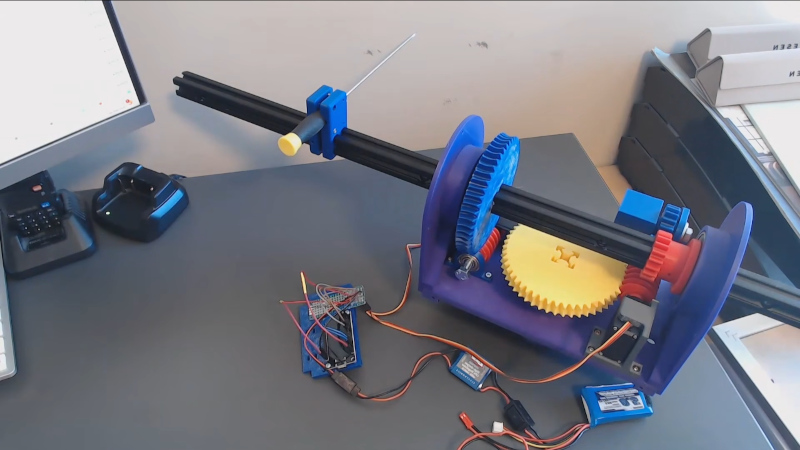
Communication with satellites often involves the use of high-gain directional antennas coupled with careful positioning to find and track the target. With a geostationary satellite the mount is either fixed or a single-axis polar mount, but when the craft is moving in a different orbit it becomes more of a challenge to stay locked on. An azimuth-elevation mount is needed to cover the whole sky, and [Ham Radio Passion] has one as a work in progress. It’s 3D printed and looks straightforward, making it a project to watch.
An az-el mount has two parts, the first being a turntable to set the azimuth, and the second being a horizontal rotating axis to set the elevation. He’s mounting the antenna to a piece of aluminium extrusion and driving it through a set of 3D printed gears driven from a 360 degree servo with a worm drive. He explains why the servo makes more sense to him here.
The result is not yet a finished project, but it shows enough promise to make it worth keeping an eye on. It’s by no means big enough for a huge antenna array, but we can imagine antennas for higher frequencies would be well within its capabilities. Meanwhile it’s certainly not the first az-el mount we’ve seen.












Alt+Az mount**
I say that to but azimuth elevation also works.
It’s funny, I work for the VLA. Always been an amateur astronomer, and got a dream job here by accident. I always call our scopes Alt-az and I always get blank looks. For some reason radio telescopes are alt-El. It might be a throwback to when radio astronomy started with things like used antiaircraft guns and radar parts
Is SatNOGS still a things? They had a low-cost AL-EZ stage for the low budget, but it was a bit more sturdy. That makes sense carrying an antenna and wind loads.
Yeah it is. I’ve actually been building a satnogs rotor for our cubesat mission. Their software and manual is a little messy and confusing, but the project is still a thing and works.
So, it’s like aiming a kinetic weapon.
i find that too often these DIY az/el units are designed in such a way where they aren’t weatherproof at all. the thing with automating satellite tracking is: you kinda want to be able to set it and forget it.
i have several winegard units i’ve hacked for sat operations (ala saveitforparts) and am dealing with a similar problem, in that i have replaced the tiny dish that comes on the rotator, but am left unable to use the radome… (so i’m currently running them from inside a tent in my yard hehe)