
This Az-El Mount Is Worth Following

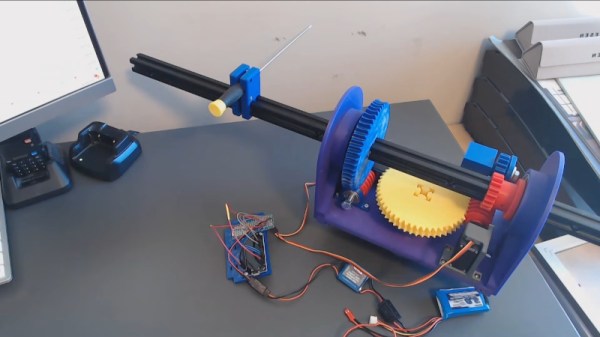
Communication with satellites often involves the use of high-gain directional antennas coupled with careful positioning to find and track the target. With a geostationary satellite the mount is either fixed or a single-axis polar mount, but when the craft is moving in a different orbit it becomes more of a challenge to stay locked on. An azimuth-elevation mount is needed to cover the whole sky, and [Ham Radio Passion] has one as a work in progress. It’s 3D printed and looks straightforward, making it a project to watch.

An az-el mount has two parts, the first being a turntable to set the azimuth, and the second being a horizontal rotating axis to set the elevation. He’s mounting the antenna to a piece of aluminium extrusion and driving it through a set of 3D printed gears driven from a 360 degree servo with a worm drive. He explains why the servo makes more sense to him here.

The result is not yet a finished project, but it shows enough promise to make it worth keeping an eye on. It’s by no means big enough for a huge antenna array, but we can imagine antennas for higher frequencies would be well within its capabilities. Meanwhile it’s certainly not the first az-el mount we’ve seen.

Continue reading “This Az-El Mount Is Worth Following”

AntRunner Is The Satellite Antenna Mount You Need To Take With You

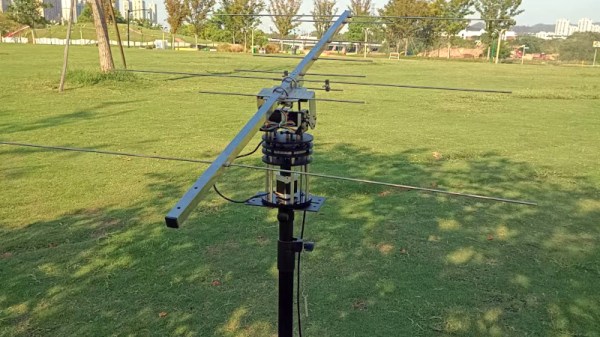
It stands to reason, that should you wish to communicate with a satellite, whatever antenna you use should point at that satellite. Some of us have done this by hand, following the bright dot of the space station in the night sky. Still, for anything more serious than trying to catch a fleeting SSTV image, a more robust solution is called for. In other words, a motorized antenna rotator, and AntRunner from [Wuxx] is just the ticket. Better still, it’s portable for those /p operating sessions off the beaten track.

The rotator itself is an az-el design with a couple of geared stepper motors. The full mechanism design has been published, but it shouldn’t be too difficult to copy. The interesting part is the controller and software, which can work with Gpredict, Hamlib, and SDR for automated satellite tracking. The controller is as straightforward as an ESP32 running the ESP port of GRBL.

So here’s a portable antenna rotator that’s accessible and widely supported, what’s not to like? As you might expect though, it’s not the first we’ve seen. In fact, the 2014 Hackaday Prize was won by SatNOGs, which includes a 3D printed antenna positioner.

Thanks [Abe Tusk] for the tip!








