
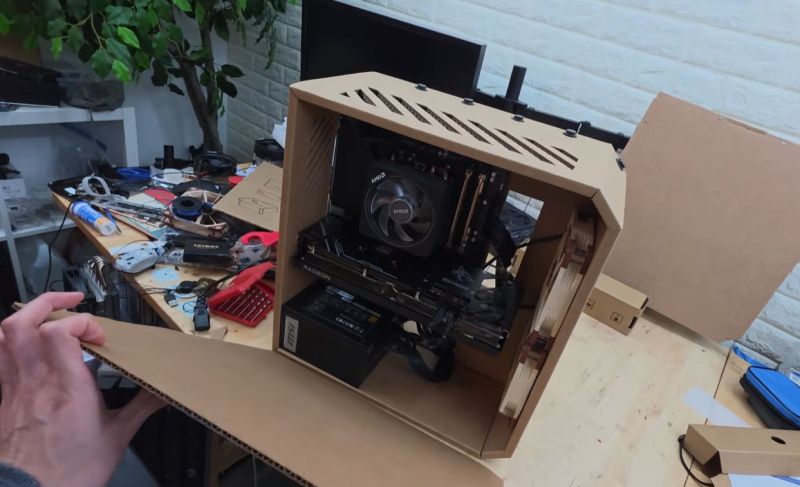
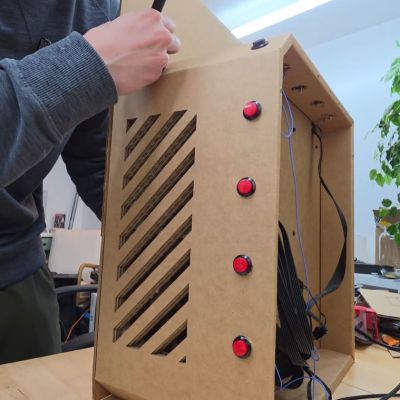
 The idea of using cardboard for a sloppy PC case isn’t new; it’s a time-honored tradition dating back to at least the 1990s. That said, with today’s CNC cutters and other advanced tooling available to hobbyists, you might be curious to see how far you can push the concept. As demonstrated in a recent video by [mryeester], the answer appears to be that good planning and a solid understanding of cardboard’s limitations are as essential as ever.
After having the PC case drawn up in CAD and cut on a professional CNC cutter by a buddy who makes commercial cardboard displays, the installation procedure for the PC components showed where a bit of foresight could have saved a lot of time and effort.
The first problem was that the GPU couldn’t be installed due to wrong measurements on where the IO bracket normally is screwed into the case. Some cardboard cutting later, the GPU slid into place, but of course, there’s no way to screw it down, putting the full weight on the PCIe slot of the mainboard. Fortunately, the mainboard was quite literally bolted into place, and the case consists of multiple layers of corrugated cardboard to add some rigidity.
Next was more carving as the PSU cut-out was designed for an SFX PSU, not an ATX one. After that ordeal, one could say that perhaps a nice thing about a cardboard case is that you get to pick where buttons are located, though this comes with its own logistical issues.
Finally, mounting side panels turned into another chore, with perhaps some engineering possible to make it work better. For example, we recently looked at making cardboard hinges that would look pretty good on a cardboard PC case. You can also waterproof cardboard and make it much stronger, turning a throwaway, temporary cardboard solution into something that will last for years, even with occasional exposure to moisture and a water-cooling leak.












When did people stop caring about EMI?
And if you are worried about the screws, use washers.
Probably around time when PCs start to have HUGE holes in the metal case covered either by large plastic fans or just plastic mesh.
Oh and i forgot about the glass panels – huge glass panels – some cases are more glass than metal.
You forgot those all-acrylic cases in the early to mid 2000’s
The ones made of plexiglas were so-called “showcases”, if memory serves me well.
I think they were “allowed” for demonstration purposes, but not actual use 24/7, because of EMI.
Speaking of: I’m afraid, the Raspberry Pi single-board computer is the embodiement of a violation of that.
It never shipped with any EMI/RFI shielding,
probably due to its nature, because it was sold as an experimental computer board.
If a Raspberry Pi was to be installed permanently as a controller somewhere in the house, though, it would have had required a metal chassis or shielding, at least.
In principle. By 20th century standards, I mean.
In practive, I’m afraid, users installed their bare Pis everywhere, careless as children would do so with their toys.
There are heatsink on everything and backplate on vgas nowadays.
You can make plastic so it absorbs some RF and knocks down emi. Keeping the noise floor down is everyone’s responsibility.
Thermaltake Tower 500 has 3 metal and 3 glass sides. As long as FCC doesn’t come knocking about noisy EM signal, I;m fine.
You do realize the FCC has these rules for a reason? Unshielded electronics raise the noise floor and hampers wireless communication.
Here in Germany it was by turn of the millennium, I guess.
There was a time when PCs, peripherals (such as modems) and other office equipment had FTZ or BZT stickers of approval.
They were our equivalent to FCC approval, basically.
But when CE sign came to European countries, no mandatory testing had been done anymore.
Instead, the manufacturer could claim that it meets the requirements and slap a CE sign on it. Done.
Soon after, China products with fake CE stickers flooded the European market.
Including poor switching-PSUs, of course. Because they’re so wonderfully cheap (and noisy).
Sure, there are still some tests done by our authorities (BNetzA, the sucessor of RegTP etc),
but they merely ban the worst offenders of products after the harm was already done, basically.
https://de.wikipedia.org/wiki/Fernmeldetechnisches_Zentralamt
https://en.wikipedia.org/wiki/Federal_Office_for_Approvals_in_Telecommunications
About shielding and EMI.. In retrospect, I think that most users except for radio amateurs didn’t get it and thought it was just lame bureaucracy without any purpose.
Many C64 owners who modded their C64 never bothered to re-install the sheet metal, for example.
So EMI concerns had been hit by feet early on, it’s not exactly new.
But year 2000 was sort of beginning of a turning point, I guess.
You are mixing things up. The FTZ was primarily a governmental agency to enforce a state monopoly and protectionism. The deregulation of the telecomms market in the early 1990s made them obsolete, since their operation was based on laws (some of them dating back to the Third Reich and even older) that were no longer acceptable in the EU.
The CE-mark is an independent development with different goals.
With multi-phase buck converters, larger ceramic capacitors and multi-layer circuit boards, are PCs that bad EMI sources or victims anymore?
Glue some allu foil in, all good.
Btw, Powerline also exists, no problem. And not to mention microwaves.
For protection, sure. But the electronics are so low-power nowadays…
I thought that was the primary use of the Microtimes (an oversized, maybe A3? ~1″ thick “magazine” consisting mostly of adverts). Plunk down a Microtimes, motherboard goes on that, and you test build from there.
Of course that might be harkening back to the era of ISA slots, but has the world changed that much?
Also I see these dirt cheap metal skeletal cases.
Still, this is clever, cardboard is easy to CNC or laser cut, and takes paint or stain or whatever coloring/surfacing well. I also have fond memories of barbecue spray paint for towers, giving a very slight textured surface, contrasting to the shiny beige boxes of the era. Ahh, when “casemod” meant spray paint…
The cutting and drilling skills are not strong with this one.
Does he not own a hobby knife? And using a drill bit without the drill is quite the thing with softer materials. Then, again, if he had those skills, he wouldn’t need a friend with a computer controlled cutting machine.
I recently used cardboard to built the mark 0 version of a slooshie machine for upto 24 600 ml cocacolas. it turned pretty nice to spot the wrong turns of the design ,even before FreeCad. I usually have a better “feeling” of the final dimmensons using cardboard that jumping right to my CAD software inmediately.
lol 24 bottles of 600 ml each.
CAD: Cardboard Aided Design.
Perfect for fan films
https://www.instagram.com/reel/DYDgmr_PYdE/
Boy howdy.
https://www.youtube.com/watch?v=i-9MbhK4tt8
maybe the best thing you learn from your first cardboard PC case is a PC case is 100% optional. it often serves no practical benefit unless you frequently relocate the machine or eat ramen directly over it, for tradeoffs of bending cables, costing money, cutting your fingers on I/O panels, making modifications more time-consuming, trapping heat, and running components hot/inefficient (and now you also need “case fans,” but it still won’t keep it as cool as the components’d be outside a case). I put motherboards bare on modular shelves (big gaps) since age of ~15, then a proper desk on top of that for keyboard/monitors/etc, have had no issues in 20 years; computer is largely hidden by the big desk on top; because the motherboard can sit flat against the shelf, the problems with graphics card weight go away. it does accumulate dust; I hit components with basketball nozzle on car tire air compressor every 2-3 years.
-BUT, my idea of room decorations is wall hooks and VESA mounts.
whistles innocently.
That’s way nicer than the cardboard case I built for my 286 back in 1997. Mine was an old moving box with holes cut in it with a utility knife. Still ran Windows 3.0
Bwah:) my first PC was 286 mainboard in cardboard shoebox:)
I’d be worried about static electricity. I pay good money for components and don’t want to fry them.