

Along with Velcro, zippers have become an integral part of every day life, being a quick and easy way to usually temporarily join fabric together. Which isn’t to say that you cannot do more with the basic zipper concept, including using them to turn floppy 2D shapes into rigid 3D ones, such as with the Y-zipper concept proposed and demonstrated by [Jiaji Li] et al.
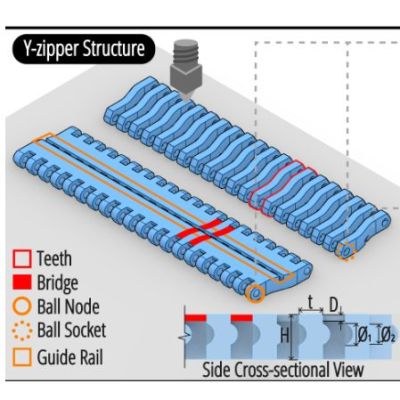
Although not a fully new idea, the Y-zipper is compared with a range of similar mechanisms that do not feature the same abilities, including the standard zipper ease of zipping up, the possibility of having curved geometry and automatic actuation.
Plus there is that the Y-zipper is designed from the start to be 3Dprinted, while still following the same basic pattern of interlocking teeth that the slider mechanism alternately pushes together or pulls apart.
By modifying the basic straight design of the flat strips, the resulting zipped-up form can take on a distinct bend, as well as turn into a coil or a screw. With a demonstrated joint design it is then possible to join multiple Y-zipper rods together, which could make for an interesting alternative to traditional pop-up tent supports, for example.
Also demonstrated is the use of TPU to create compliant bridges, as well as the direct integration of fabric, to show the versatility of the technology. With the used materials (PLA, TPU) the researchers estimate a maximum viable length of about 3 meters before the printed structures begin to disintegrate.












s/Velcro/hook and loop/g
adding some text describing that this is the funny velcro trademark protection video, just so the comment doesn’t get auto-deleted for including just a link:
https://www.youtube.com/watch?v=rRi8LptvFZY
Brilliant!
How have I missed that for the last 8 years!
This is actually super interesting! That said considering the absolutely abysmal state of 3d printed parts I’ve seen hackers on here — and elsewhere — rawdog despite the top surfaces looking like a pile of cat vomit makes me wonder if the average person could even print that.
The 3 metre issue…wonder if the print could be paused and reinforced by inserting and printing overtop of something like those 1.5mm stainless steel rods used to make unclogging tools in the 3d printing community. It’d kill flexibility but the rods are only 20cm long so it would at least allow you to have flexible ‘joints’ in a way.
If you lookup Zippermast, you’ll find this has been done for at least 17 years on youtube by a german company.
Honestly I think this is pretty amateur-friendly (or poor-quality-printing friendly, let’s say) in a way that’s a testament to the cleverness of the design.
Well, as long as you’re not trying to print a very small version or push the limits of how long/stiff an assembled piece is possible, anyway.
Aesthetically, the top printed surface (always the trickiest/ugliest) ends up being hidden in the middle of the assembled mechanism, while the smooth surface from the build plate ends up on the outside.
Structurally, the critical parts of the locking mechanism are printed in the middle of walls on the x and y axis, where the 3d printer’s positional and dimensional accuracy remains fairly consistent even if your extruder is super wobbly and your flow rate is somewhat miscalibrated. There are no long bridges, small holes, or parts requiring support, and the flexible nature of the bridge between each zipper section means that that issues with tolerance are self-correcting to a degree.
Modern printers are pretty damn good out of the box, I suspect there’s a lot of hackers who are printer tinkerers and end up with older models frankensteined with experimental upgrades that end up worse than just buying a modern one and leaving it alone.
The paper is thorough, but what are the intentions? To patent and market it? I see no 3d files to explore/iprove the system.
If one prints with nitrocellulose using collodion, the finished product can perform rapid unscheduled disassembly without user intervention!
Intriguing idea, but so far i can’t think of any real purpose it could possibly serve that isn’t already solved in ways that seem better for the task. As its just such a complex, rather delicate and tricky to print looking geometry. And unlike regular zippers attachment to anything but itself is rather tricky if you want to actually then use the zip pull to assemble the parts.
Making custom tuned shapes that flatpack like this is neat, but not that unique, so the actual places this specific option really works that something else won’t I’m not sure even exist. Still seems like it would be at least a fun idea to play with a bit. Maybe that will spark ideas of what it is really uniquely good at.
reminds me of the extendable arm of one of the mars rovers. or was that more like a measure tape thing? can’t exactly remember.
Kind man they didn’t call it a “yipper”
This feels like it could be useful in a few niche scenarios, but is otherwise just an engineering exercise.
I can see it being usedul, maybe, for rolling out rigid structures in satellites or space stations where the current curved ribbon “slap bracelet” material is unsuitable.
Most inventions are useful in a few niche scenarios… it’s been downhill since we invented the wheel, really.
It’s downwheel.
“… including using them to turn floppy 2D shapes into rigid 3D ones…”
Oh, so that’s what happens.
it’s a pity the 3D files aren’t downloadable.
Printed this in you and unable to assemble after two hours of trying to get each of the three zips to stay together. In the bin now
While I expect there is more to it than is shown in this post, I believe I have seen this in a product already. A quick search showed that a ‘zip chain mechanism’ uses two parts and can be used as very strong actuators. Some are even used in scizor lifts as an alternative to hydraulics.
These are also used as gun rammers in artillery pieces as they don’t need as much space behind the breach as a hydraulic cylinder would.