
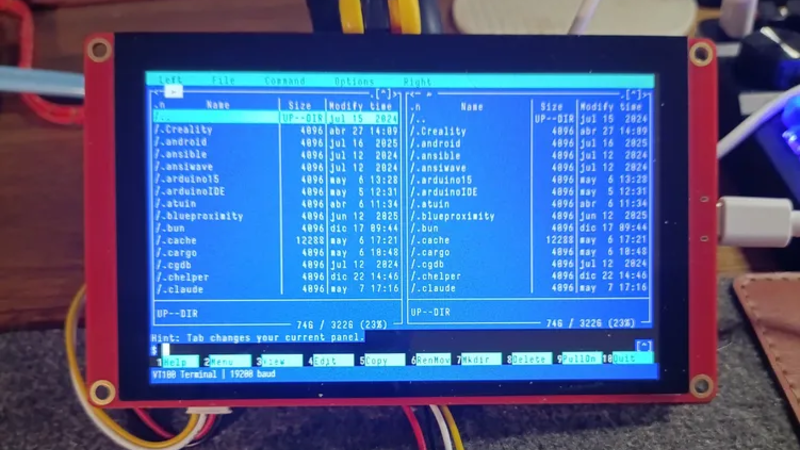
If you’re of a certain vintage, you have probably looked at some of the microcomputers on the market these days and thought “that would have been a decent workstation back in the day!”. We certianly have, and so did [Roberto Alsina]. Rather than allow himself to contemplate his age and threfore rapidly approaching mortailty, [Roberto] wrote a useful operating system called ESP-Osito for the Cheap Yellow Display, which he refers to as “the cheapest computer”. He’s not wrong, and it’s certainly a better use of time than an existential crisis.
He explains some of his reasoning behind the project in an accompanying blog post, but on the project page he compares it to a Palm Pilot– it’s on quick, apps load quick, and the API is simple enough for easy app creation in a few hundred lines of C, unlike certain pocket computers we won’t name. Sure, there’s no multitasking, but when apps jump from SD card to run in memory in microseconds, who cares? Saving the current state of the app back to SD means the experience is virtually identical from a user perspective anyway.
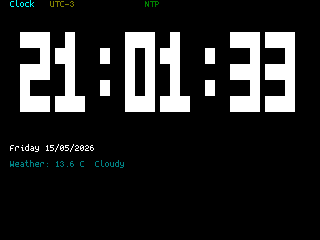
As this is a one-man show for now, the app store won’t quite rival your smart phone– but there’s everything you’d expect on the 90s-era computer this has the horsepower of: a serial terminal, a text editor, a file explorer, a calculator, a clock, but also some things that aren’t so retro. The clock app gives weather info via futuristic wireless networking, the reader app takes Markdown text, and the chat app connects to an LLM somewhere instead of your friends on IRC. The blackberry keyboard option gives it a feel of a slightly different vintage. You can also play snake, because no computer is complete without games. The OS and all its applications are released under the MIT license on GitHub, and [Roberto] is actively looking for collaborators.
If you doubt the workstation comparison at the start of this article, this CYD runs Macintosh System 3 via a 68k emulator. That’s got old-school cred, but there’s something great about having retro constraints with modern code on modern hardware. In that way, ESP-Osito is similar to the 3D graphics engine behind this Wipeout clone.












i have three CYD and have been waiting for exactly this. thanks, Mormon Allah!
Feel free to open issues if you run into any problems :-)
I can think of only two possible enhancements for this wonderful project – an app repository (assuming that people rightfully hop on creating software for this environment) and some kind of bluetooth support to allow keyboards and possibly mice.
There’s a little-tapped market for people who want distraction-free writing machines and I think they’re willing to deal with a fairly esoteric operating environment. Your project could become the go-to for converting the CYD into a cheap and pocketable writerdeck.
An app store is certainly something I want to implement, once the OS API is more frozen
Certainly. And it also raises the question, if we’d really need Gigabytes of RAM with todays powerful hardware, if not for inertia and bloated software?
Most of the RAM you’re using on a day to day basis is for cache, because both networks and disks are still way slower.
You write code for the hardware you target. Nowadays computer have gigabytes of RAM so you don’t trade off ANYTHING for RAM. Want to cache disk and use RAM? Sure. Want to cache results to save CPU and use RAM? Sure. Want to allocate 1GB so you can draw a 32bit huge pixmap? Sure. It’s there so it makes sense to use it.
Yup. And it is way, way easier from a design perspective to make RAM denser than make CPUs faster. It’s partly just math: in some sense a CPU’s speed is limited by the critical path, which drops linearly with feature size, whereas RAM increases as the square.
Excellent.
And possibly, one day, a 100% blob free personal computer.
https://github.com/esp32-open-mac/
Very cool project :) Still some time left in the day to tinker too :) Keep up the good work!
“Rapidly Approaching Mortality”
I have never see a more meaningless roach like this on an article, for no apparent reason at all.
You want to feature the work of a man, and instead of honoring him, you are subtly insulting him.
I really wonder about your achievements and age Tyler August.
Have fun growing up and your approaching existential crisis.
I have to say my mortality is approaching at a totally normal rate.