Distilling Stale Gasoline To Make It Usable Again

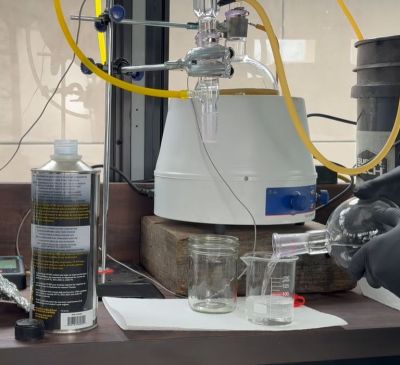
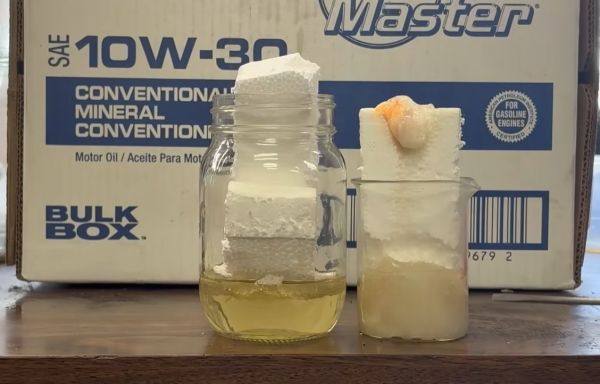
Pouring the resulting distillate for testing. (Credit: Lowered Expectations, YouTube)

The propensity of gasoline to ‘go stale’ through the process of oxidation is the reason why gasoline that has been stored for a long period of time is considered to be unusable, as it will no longer combust property. Since this process creates the sludge that you find in the bottom of an old gasoline canister, it follows that you may be able to distill out the still good gasoline. With this reasoning, [Joel] over at the [Lowered Expectations] channel set to work to try out this theory.

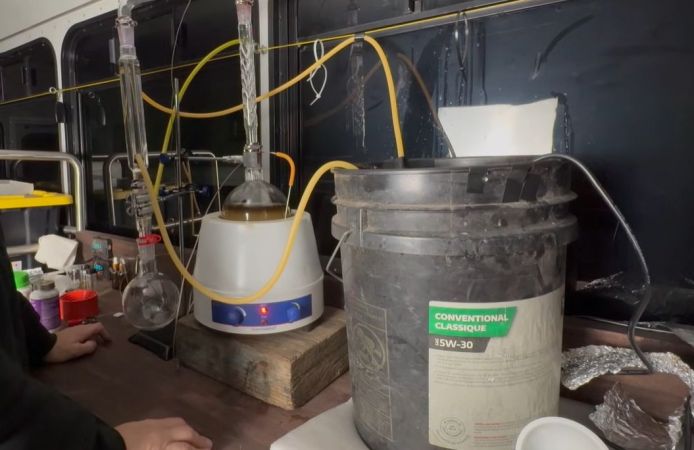
As part of his job of maintaining things like pressure washers, he got access to many grades of stale gasoline to experiment with. After a short demonstration of how poorly these grades of stale gasoline burn it’s on to the main distillation event. To the stale gasoline aluminium oxide is added as both a catalyst and to create nucleation sites that will prevent ‘bumping’ where you suddenly get a surge out of the heated flask.

Of course, that this is incredibly dangerous should be obvious, and the lack of PPE on the side of [Joel] is somewhat worrying. On the positive side, he does take it easy with ramping up the temperature on the gasoline to try and find the sweet spot where production seems sufficient. This turned out to start at 70°C in the flask when the condenser began to receive its first load of presumably clean-ish gasoline.

The goal here is of course to approximate the function of the fractionating column (‘distillation tower’) at refineries at smaller scale, which [Joel] appears to be doing correctly with what looks to be a Vigreaux column. Since the base product is gasoline with oxidized contaminants this process is of course quite different, so he goes through the different temperature ranges to see what kind of distillate he gets, up to nearly 200°C before calling it.

Ultimately 880 mL of the initial 1 L was collected, with the various distillates combined for testing. Unfortunately none of the testing is actually covered in the video, but it is mentioned at the end that a second batch of the distillate was used to power his car, so presumably it works.

Suffice it to say that ‘works’ doesn’t mean that it is safe, of course. Heating such stale gasoline produces many highly flammable and combustible substances, along with many that are just downright bad for your health to be exposed to. The plethora of very short-term to all the way to very long-term health effects this may cause should be obvious.

Continue reading “Distilling Stale Gasoline To Make It Usable Again”

The Montgomery Ward Gasoline-Powered Clothes Iron

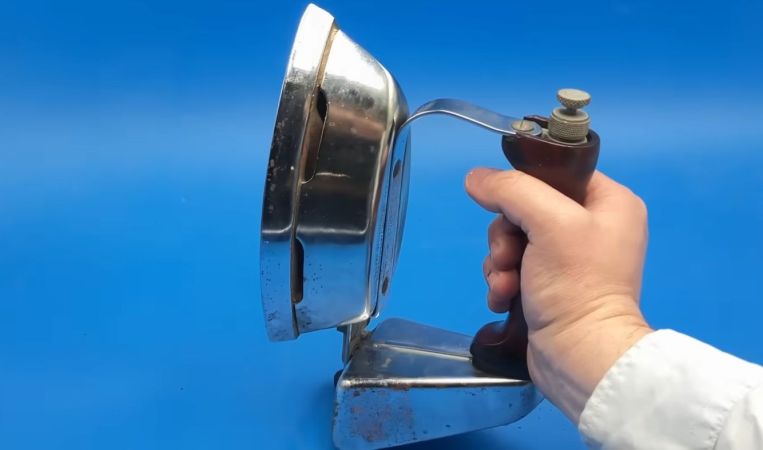
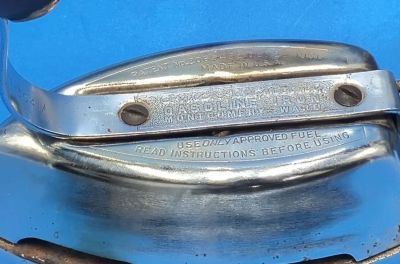
Before the advent of electricity in the home made electrically-heated clothes irons a possibility, ironing was a cumbersome process, with self-heated irons being an arguable improvement over solid (so-called sad) irons that required heating in an external heat source like a stove or fire. These self-heating irons used a variety of fuels, with the one featured on the [Our Own Devices] YouTube channel using gasoline for fuel, making it technically a gasoline-powered clothes iron.
The used gasoline form is LSR, which is commonly referred to as naphtha and is also sold as camping fuel today. In addition to the gasoline version a kerosene-powered version was also sold, so you had to better make sure you refueled your iron with the right fuel.

After pouring in fresh fuel you have to prime it by pushing the plunger a couple of times, before igniting the burner with a lit match via a hole in the side while opening the fuel valve. If you did things right, the iron will now be heating up. In a sense this makes it effectively like a camping stove, with also many of the same caveats, with such irons gaining a reputation for starting fires and causing bodily harm.

Due to decaying seals this iron in the video wasn’t fired up, but it was disassembled to show the internal components, along with a comparison of the kerosene version. Inside is a kind of crude carburetor that mixes air in with the fuel to get a combustible fuel-air mix, along with plenty of soot to attest to this iron having been regularly used.

Although electrical irons eventually removed all need for gasoline-powered irons, they were still used in mostly rural settings until the 1950s. Reading the Wikipedia entry on clothes irons makes one rather glad that these days we can iron our clothes without all the fuss and significant risk of accidents of these old irons.

Continue reading “The Montgomery Ward Gasoline-Powered Clothes Iron”

Why Leaded Fuel Is Still A Thing

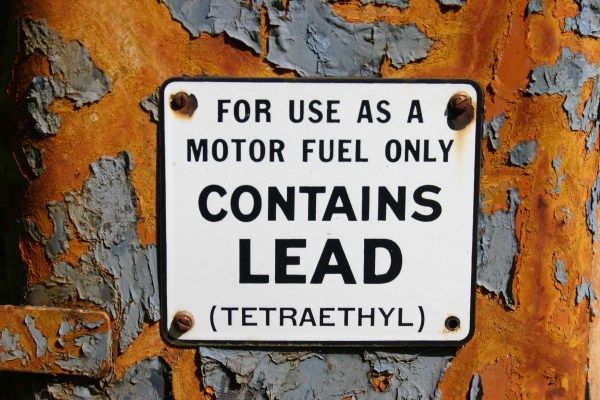
Leaded fuel is considered one of the greatest environmental failures in modern human history. Adding tetraethyl lead to gasoline reduced knock in internal combustion engines, which was widely considered a good thing. It was only later that the deleterious health effects came into view, by which point there was a massive fleet of lead-dependent automobiles and an industry reluctant to change. Still, the tide turned, and over the last 50 years, unleaded fuel has become the norm for automotive use across the world.

And yet, there remains a hold out—a world where engines still burn leaded fuels and spray their noxious fumes across the countryside. In the aviation sector, leaded fuel remains a normal part of everyday operations to this day amidst concerted efforts to eliminate it for good.

Continue reading “Why Leaded Fuel Is Still A Thing”

How Cross-Channel Plumbing Fuelled The Allied March On Berlin

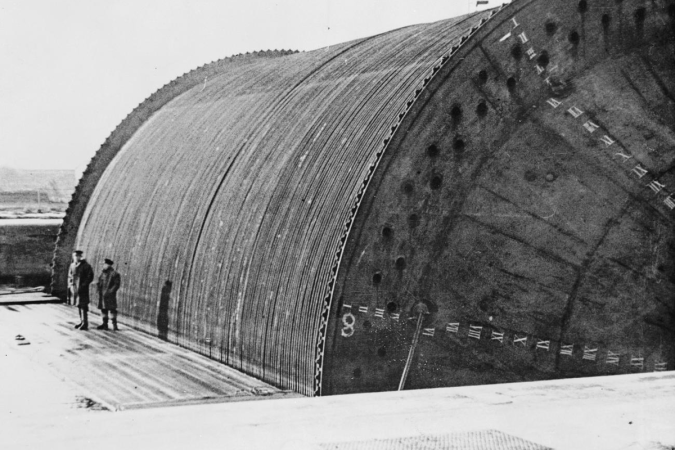
During World War II, as the Allies planned the invasion of Normandy, there was one major hurdle to overcome—logistics. In particular, planners needed to guarantee a solid supply of fuel to keep the mechanized army functional. Tanks, trucks, jeeps, and aircraft all drink petroleum at a prodigious rate. The challenge, then, was to figure out how to get fuel over to France in as great a quantity as possible.

War planners took a diverse approach. A bulk supply of fuel in jerry cans was produced to supply the initial invasion effort, while plans were made to capture port facilities that could handle deliveries from ocean-going tankers. Both had their limitations, so a third method was sought to back them up. Thus was born Operation Pluto—an innovative plan to simply lay fuel pipelines right across the English channel.

Continue reading “How Cross-Channel Plumbing Fuelled The Allied March On Berlin”

The Inside Story Of The UK’s Great CB Petrol Scam

Looking at gasoline prices today, it’s hard to believe that there was a time when 75 cents a gallon seemed outrageous. But that’s the way it was in the 70s, and when it tripped over a dollar, things got pretty dicey. Fuel theft was rampant, both from car fuel tanks — remember lockable gas caps? — and even from gas stations, where drive-offs became common, and unscrupulous employees found ways to trick the system into dispensing free gas.

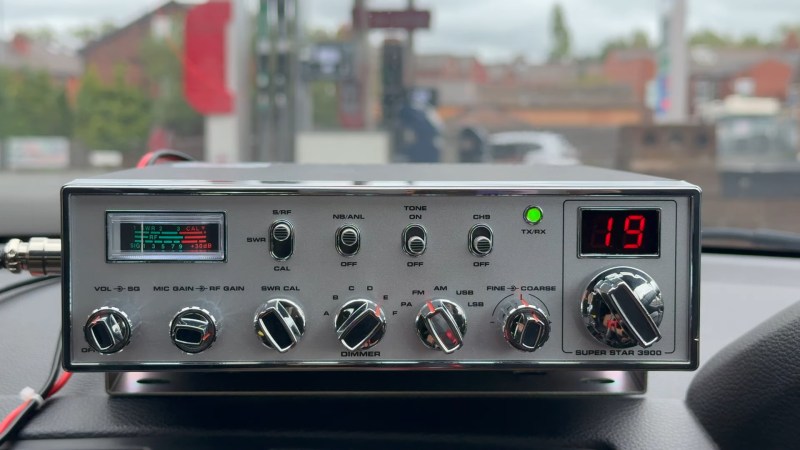
But one method of fuel theft that escaped our attention was the use of CB radios to spoof petrol pumps, which [Ringway Manchester] details in his new video. The scam happened in the early 80s, only a few years after CB became legal in the UK but quite a while since illegal use had exploded. The trick involved a CB transceiver equipped with a so-called “burner,” a high-power and highly illegal linear amplifier used to boost the radiated power of the signal. When keyed up in the vicinity of dispensers with digital controls, the dispensing rate on the display would appear to slow down markedly, while the pump itself stayed at the same speed. The result was more fuel dispensed than the amount reported to the cashier.

If this sounds apocryphal, [Ringway] assures us that it wasn’t. When the spoofing was reported, authorities up to and including Scotland Yard investigated and found that it was indeed plausible. The problem appeared to be the powerful RF signal interfering with the pulses from the flowmeter on the dispenser. The UK had both 27 MHz and 934 MHz CB at the time; [Ringway] isn’t clear which CB band was used for the exploit, but we’d guess it was the former, in which case we can see how the signals would interfere. Another thing to keep in mind is that CB radios in the UK were FM, as opposed to AM and SSB in the United States. So we wonder if the same trick would have worked here.

At the end of the day, no matter how clever you are about it, theft is theft, and things probably aren’t going to go well for you if you try to pull this off today. Besides, it’s not likely that pumps haven’t been hardened against these sorts of attacks. Still, if you want a look inside a modern pump to see if you can find any weaknesses, have at it. Just don’t tell them where you heard about it.

Continue reading “The Inside Story Of The UK’s Great CB Petrol Scam”

Big Chemistry: Fuel Ethanol

If legend is to be believed, three disparate social forces in early 20th-century America – the temperance movement, the rise of car culture, and the Scots-Irish culture of the South – collided with unexpected results. The temperance movement managed to get Prohibition written into the Constitution, which rankled the rebellious spirit of the descendants of the Scots-Irish who settled the South. In response, some of them took to the backwoods with stills and sacks of corn, creating moonshine by the barrel for personal use and profit. And to avoid the consequences of this, they used their mechanical ingenuity to modify their Fords, Chevrolets, and Dodges to provide the speed needed to outrun the law.

Though that story may be somewhat apocryphal, at least one of those threads is still woven into the American story. The moonshiner’s hotrod morphed into NASCAR, one of the nation’s most-watched spectator sports, and informed much of the car culture of the 20th century in general. Unfortunately, that led in part to our current fossil fuel predicament and its attendant environmental consequences, which are now being addressed by replacing at least some of the gasoline we burn with the same “white lightning” those old moonshiners made. The cost-benefit analysis of ethanol as a fuel is open to debate, as is the wisdom of using food for motor fuel, but one thing’s for sure: turning corn into ethanol in industrially useful quantities isn’t easy, and it requires some Big Chemistry to get it done.
Continue reading “Big Chemistry: Fuel Ethanol”

Printed Gas Can Accessories Make Refueling A Little Neater

No matter what your position is on internal combustion engines, it’s pretty safe to assume everyone is on the same page regarding wasting fossil fuels: it’s a bad thing. And nothing is as frustrating as spilling even a drop of the precious stuff before you even get a chance to burn it.

Unfortunately, the design of gas cans, at least here in North America, seems to have been optimized for fuel spillage. Not willing to settle for that, [avishekcode] came up with a 3D-printable replacement nozzle that should make dispensing gas a bit neater. It’s designed to fit one of the more popular brands of gasoline jugs available here in the States, and rather than the complicated stock nozzle, which includes a spring-operated interlock that has to be physically forced into a filler neck to open the valve, the replacement is just a slender tube with a built-in air vent. The vent keeps a vacuum from forming in the gas can and makes for a smooth, easy-to-control flow of gas and less spillage. The video below shows it in action.

The obvious issue here is chemical compatibility, since gasoline doesn’t work and play well with all plastics. [avishekcode] reports that both PLA and PETG versions of the nozzle have performed well for up to two years before cracking enough to need replacement. And then, of course, the solution is just to print another one. There may be legal issues, too — some localities have ordinances regarding gasoline storage and dispensing, so it’s best to check before you print.

Of course, one way to avoid the problems associated with storing and dispensing gasoline is to convert to electric power tools and vehicles. But as we’ve seen, that presents other problems.

Continue reading “Printed Gas Can Accessories Make Refueling A Little Neater”