
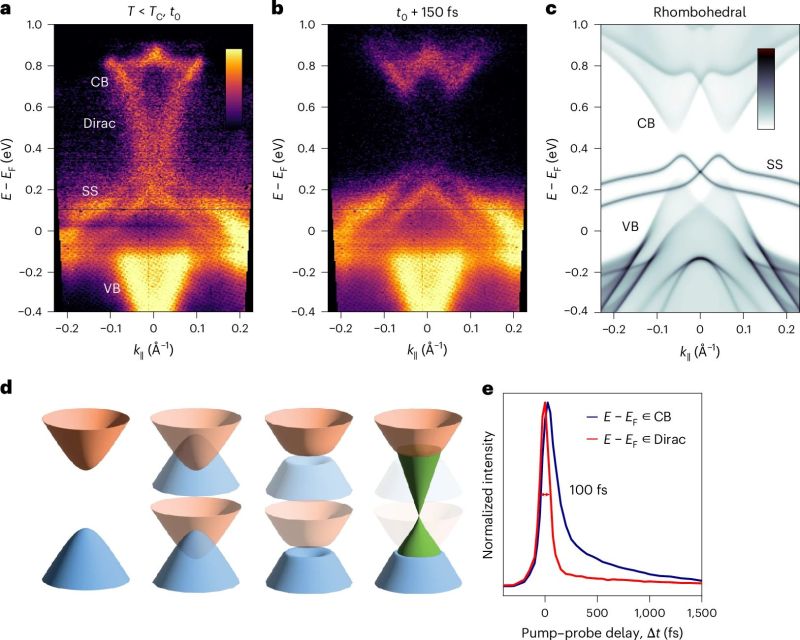
In semiconductor technology, a base material like silicon is permanently modified to induce certain electrical behavior. In comparison a topological insulator material could be used to create temporary circuits using something like light exposure. An example of this is the Floquet topological state, which has long been theorized, but is now claimed to have been demonstrated in SnTe semiconductor material, per a paper by [F. Chassot] et al. in Nature Physics.
The concept of topological insulators was first proposed in 1985, but proving their existence was hard. Recently photonic Floquet topological insulators (PFTIs) have gained interest, with experiments by [Qian Ma] et al. in 2025 as well as other teams confirming aspects of the theory.
This recent publication by [Chassot] et al. would thus confirm that optical control of topological insulators is thus possible. At the core of this effect is the band inversion that results from the light pulses, with the change in conduction being very brief, essentially for as long as the femtosecond pulses were maintained.
Although still very much in the fundamental research phase, the research on these electronic topological insulators offers an interesting look at potential new technologies, much like the field of photonic topological insulators does for photonics.












Maybe one day, rather than setting circuits at compile time, we’ll have a CPU that reconfigures itself on the fly, in a similar way that we do our of order instructions now, it’ll create dedicated circuits to speed up each combination of instructions, perhaps producing the output of an entire program all in one go. No doubt having reconfigurable processing would greatly increase the efficiency of a true artificial intelligence. Perhaps it might take some sort of machine learning just to compute the configurations in the first place. No doubt we’ll get to a point where everything we could want we’ll have an example of, if we aren’t there already. It’ll just be a case of UI changes and more efficient, probably more abstracted, ways to interact with preexisting tools.
dont we already have that if we would add a FPGA to a CPU ?
What I see here could come in handy for fast data transmission.
Exactly, I was thinking the same! Yet, maybe the time required to reconfigure the FPGA may take longer than executing the required set of instructions in a CPU to obtain the same result.
You need a sort of FPGA / RAM hybrid, so you can configure just a part of it, perhaps with some sort of genetic algorithm layer on top.
Not to mention, current FPGA seem to wear out after a while. If those sorts of problems get solved, it might be a new era of Moore’s law. increasing versatility and plasticity to push scale and speed. Although no doubt things will move further into three dimensional chips than we currently have already, when technology allows for heat dissipation not to be the limiting factor.
Maybe by moving to light based gates or perhaps using quantum tunnelling to pump heat away from deeper internal layers.
A cube shaped CPU could provide what would seem like a totally unnecessary level of processing power by today’s standards. Although I can imagine someone in the 80’s encountering an i7 or such would probably be just as in awe. With adequate heat dissipation, squeezing in as many zx spectrum’s as possible onto a server CPU die, that’s a huge amount of parallel processing power, if you can keep it from spontaneously combusting.
Do you want faster FPGA??! Because that’s how you get faster FPGA
Seems originally the F. Chassot (et al.) paper is from February-2025
So the Qian Ma (et al.) research (Sept-2025) was a continuation of it I guess, or it could be parallel research, I don’t know.
It isn’t an issue of course, I am just clarifying any confusion that a 2026 nature publication and the use of ‘recent’ by Posch might cause.