
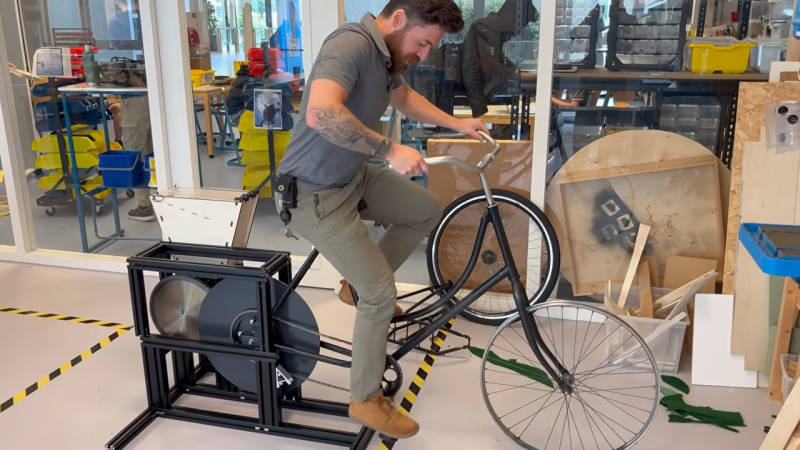
[Brogan M Pratt] and his students do a lot of 3D printing, and as such found themselves producing a lot of plastic waste. Seeing an opportunity, they built a bike-powered plastic shredder that turns a little human exercise into the power needed to transform waste plastic into small bits. Shredding plastic is a necessary first step for any sort of processing, so getting this part working reliably is as important as it is educational.

Being in the Netherlands, using a bike makes perfect sense. But it turns out there’s a lot more to making a human-powered plastic shredder than simply bolting a sprocket to a shredder, looping the bike chain over it, then climbing on and working up a sweat.
In between the bike and the shredder is a large gear reduction, a fifteen kilogram flywheel, and a heavy-duty frame to anchor everything in the face of so much mass and torque. Add some covers and safety guards and the result is a stationary bike with a hopper for waste, a bin for output, and enough rotational torque and inertia to chew through stubborn bits without stalling.
Now that the shredder works, what’s the plan for all the little plastic shreds? The goal is to turn it back into usable filament which is obviously very useful, but we’ve also seen that compression molding plastic waste can work pretty well, too.
Being an educator, [Brogan] makes it clear that a bike-powered shredder, while pretty cool, is not the only missing link in sustainability. There is currently no easy way to recycle plastic at scale. But the shredder is a critical part of demonstrating the whole process in a hands-on way, and learning why recycling plastic at scale is a genuinely difficult job.












Burning energy from food is far less sustainable than running an electric motor for 30 minutes.
No need to add additional food due to this device.
Most people have ample stores packed away from their previous feed inefficiencies to supply power for the pedals for a few years worth of scrap at least.
As always, for any HAD article, there is a corresponding XKCD; in this case it’s 1744 @ https://xkcd.com/1744/
Damn humans and their need to eat, breath, rest, make waste heat and…be inefficient!
Human brains are actually ridiculously efficient. For as much processing power they have a human only uses like 100W of power.
And yet, to compute 234553245 * 3354, they takes eons while my solar powered calculator does the computation while I’m typing the numbers.
234553245 * 3354 is near
234553245 * 3333 =
(234553245/3) *10000 =
781.000.000.000
real is
786 691 583 730
Most people pay a fortune for gym memberships just for the pleasure of sitting on a bike like this and pedaling away. I have always pondered how the excess energy could be utilised in meaningful ways instead of just heat and noise!
A fortune?
I pay $38/mo. That might be a “fortune” to someone who lives in a third world country, but its low for a sit down lunch to me.
Entropy Warriors – protecting the universe from unneeded and dangerous exercise since -13800000000 BC.
I’ll be impressed when they’ll print all those plastic back into useful models by pedaling on this bike, that is, sustaining electrical 200W for the 12 hours long the printer is running.
I’ve done it. I mean, only for an hour, and not using recycled plastic, but it is doable (though kind of a pain like you would expect). I think I also turned off the heated bed – don’t remember, it’s been a couple years and I never did it again.
https://hackaday.io/project/191731-practical-power-cycling/log/220767-3d-printing-on-pedal-power
I’ve done it. I mean, only for an hour and using fresh filament instead of recycled, but it is doable (though kind of a pain like you would expect). I think I also turned off the heated bed – don’t remember, it’s been a couple years and I never tried it again.
(2nd post attempt, I think my first got spam filtered b/c I put a link in it, so click my name)
I’ve done that, but only for an hour long print. I only had to maintain about 100 watts on a generator bicycle. I may have turned off the heated bed also. But it is possible (though not very practical, which is why I never tried to do it again).
So I’ve wondered this: part of the reason that you don’t typically use 100% recycled plastic is that the polymer chains have become too short as a result of all the shredding and processing. Instead of shredding the waste, is there (an easy) way to melt it down as-is, then run it through a series of (hot rollers?) that compress it down from whatever largest input size it can handle to filament size?
its not the shredding that shortens polymer chains. They shorten as a result of thermal degradation from multiple heat cool cycles.
Yep, unless you add more exotic stuff to glue the broken chains back together. Best thing you can do with bio-compatible bioplastics like PLA is bury them in a hole to lock up the recently harvested carbon. If they get out they biodegrade. If they stay in the hole they reduce global CO2. If you just have to do something with it, heat compress into sheets using renewable power and cut with your favourite machinery. Otherwise, in the hole it goes.