The Carrington Event was the most intense geomagnetic storm ever recorded. In September 1859, auroras were visible as close to the equator as Columbia and some telegraph stations were severely damaged by current induced in the lines. If a similar event occurred today, with a lot more more wiring to pick up current than just an embryonic telegraph network, the results would almost certainly be cataclysmic.
Various modifications to the grid have been proposed to avoid another storm of that magnitude bringing on a new dark age, but a recent paper in the journal Space Weather proposes a more radical solution: using the sun’s energy to create a massive barricade in space.
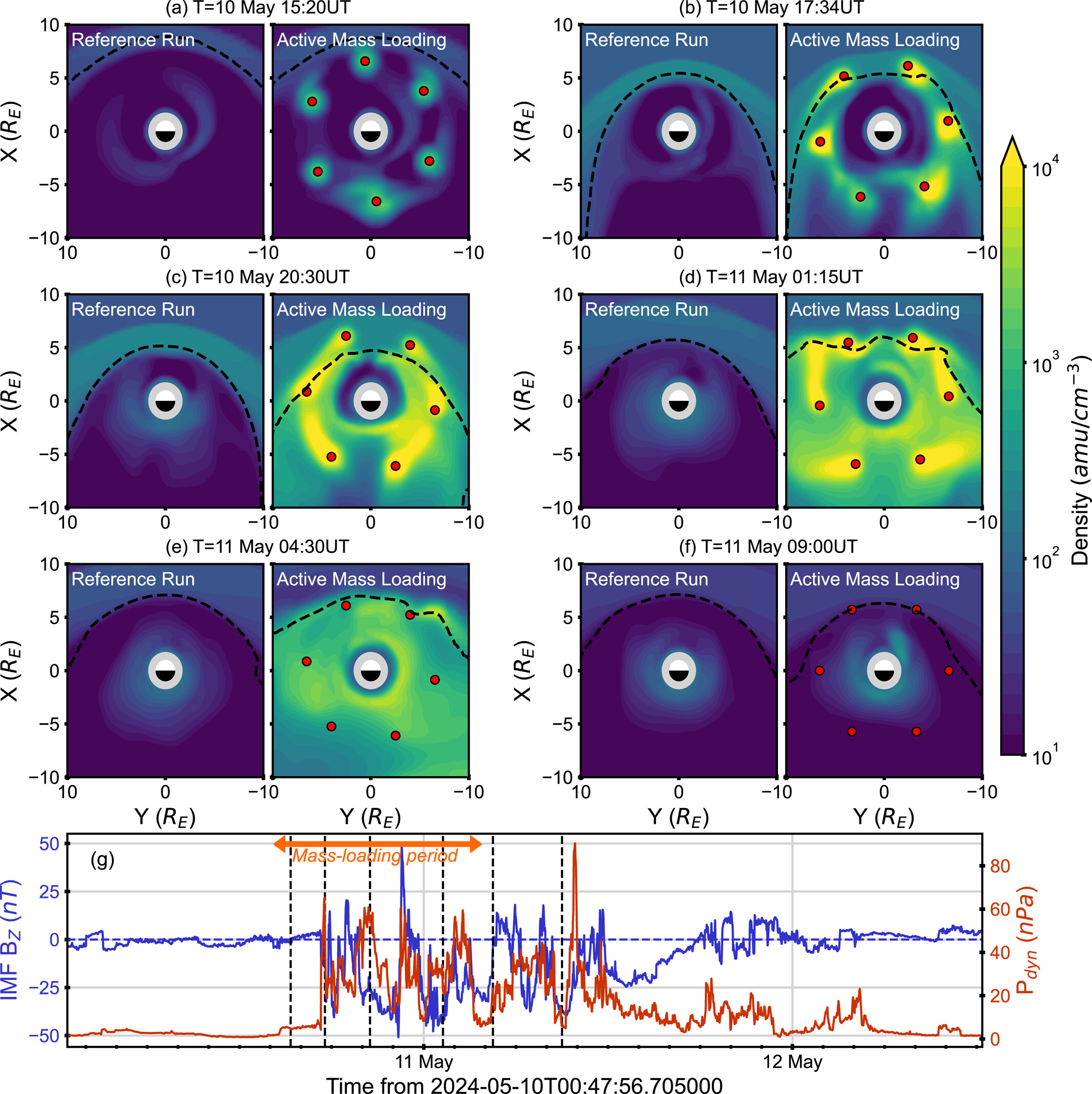
While the authors of the paper refer to this concept by the compelling name StormWall, it’s not a physical wall. It’s actually just gas, likely of alkali metal atoms, to be deployed by solar-powered satellites.
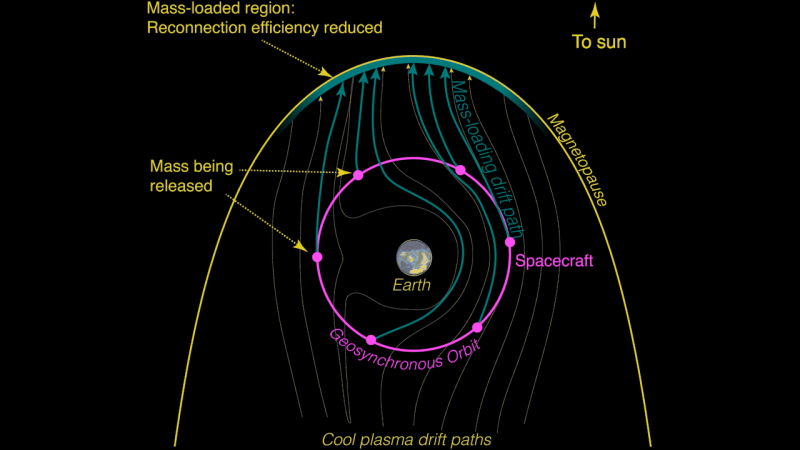
To oversimplify, the proposal is to release lots and lots of neutral gas in Geosynchronous Earth Orbit (GEO), in what the researchers call “artificial mass loading” — the neutral gas would of course be ionized by the storm, but in so doing could absorb up to 50% of the incoming energy of the geomagnetic storm, frustrating its coupling to Earth’s magnetosphere. As a bonus, it would protect not just terrestrial assets like the power grid, but everything in a lower orbit than the mass load: everything from communication satellites in GEO to the International Space Station. Assuming its hasn’t been reduced to debris laying at the bottom of Point Nemo by then, anyway.
In simulations, the StormWall required 384,048 kg of gas, which is not exactly trivial. But even accounting for tanking, the researchers estimate that would only take about six launches of SpaceX’s Starship. Though that does assume its GEO capabilities end up being roughly equivalent to the massive vehicle’s projected 100-tons-to-Mars payload capacity.
It’s certainly an interesting hack to solve a problem that has caused a lot of worry these past decades. If you’re interested in learning more about the record-setting geomagnetic storm, we have a piece about the 1859 Carrington Event that should give you plenty of anxiety about the frailty of our modern infrastructure.