
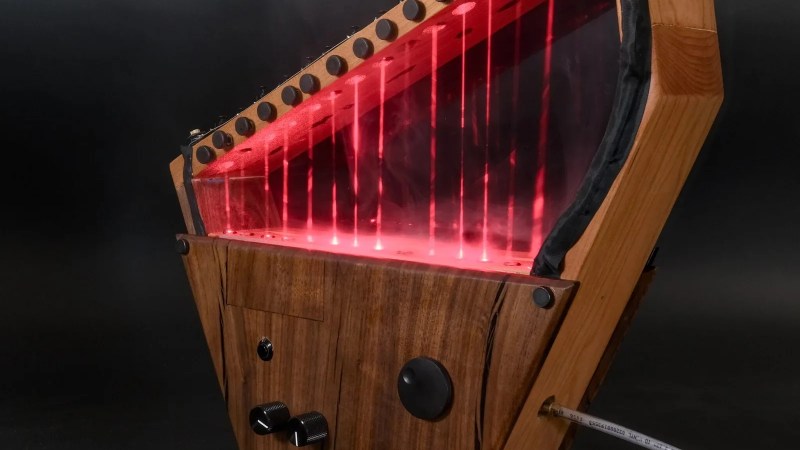
Laser harps aren’t quite a right of passage, in that not everyone builds them, but it’s likely everyone at least contemplates building one at one time or another. We’re lucky that [Derrick] a.k.a. [DJ Baja Blast] didn’t stop at contemplating, and even luckier that he put together a full write-up for his tricked out laser harp — because this is a fascinating build, with features we’ve never seen in one place before.
First of all, the harp! Lasers, photodiodes, done, right? Not here! [DJ Baja Blast] kept it analog with photoresistors so that he could measure the rise and fall of the voltage as the laser light is occluded by the player’s hands — thus you can moderate the volume via faster, louder and quieter, slower plucks. More unique is the inclusion of an accelerometer. What can you do with an accelerometer in a harp? Well, here it’s being used as a tilt sensor, with the tilt acting as a control to ‘bend’ the note as it sounds, tuning it flat or sharp or altering it any other way you choose to define in software. There’s also an ultrasonic distance sensor so you can do the same thing — or any other thing, there’s no shortage of effects to chose from — theremin-style, and an encoder wheel sits on the side, so that’s five extra inputs beyond selecting a note by blocking a laser diode. Unless you count the optional looper pedal input, or the aux in.
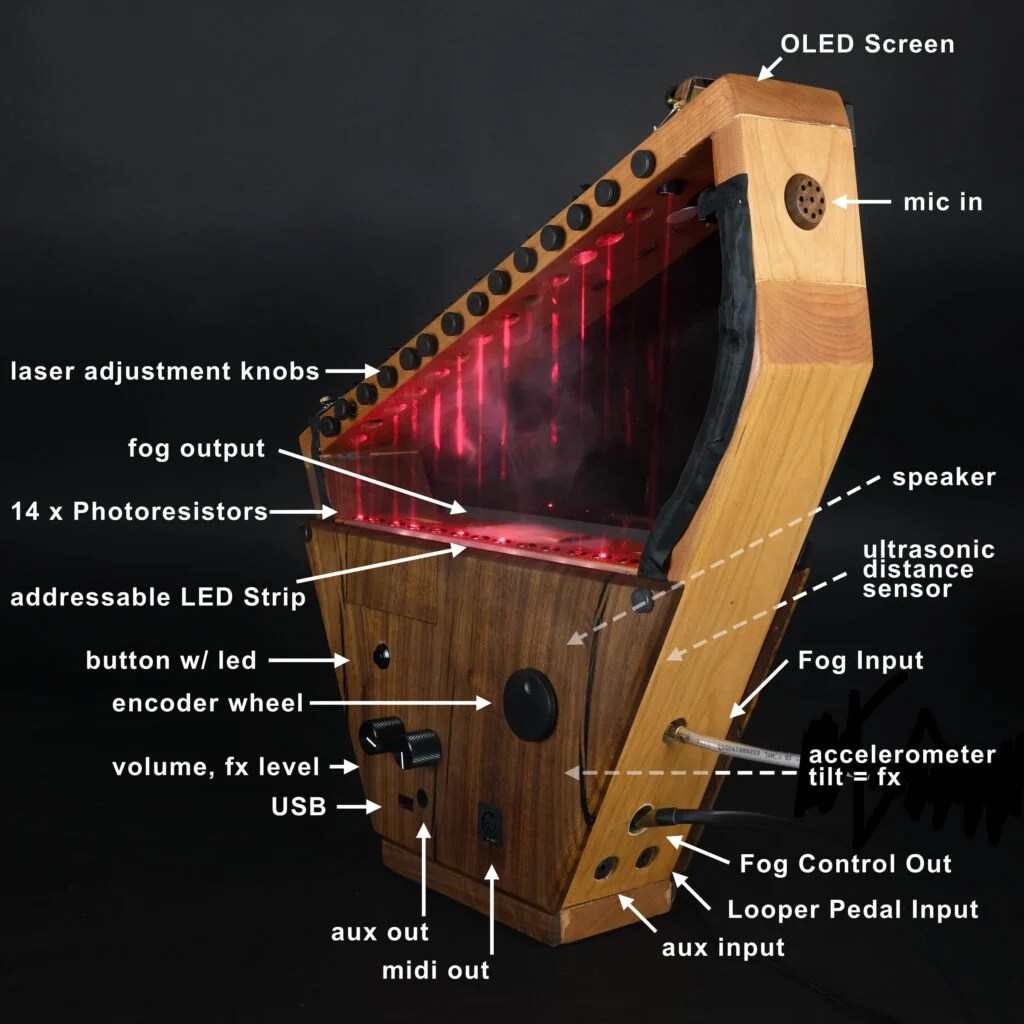
All these inputs are driving a Teensy 4.1 microcontroller, which has the grunt for just about any synthesis or sampling, though right now [DJ Baja Blast] is sticking with the Karplus-Strong string synthesis algorithm. The Teensy can drive an onboard speaker but also offers MIDI out. Eventually he does intend to add more. Last but not least, we cannot forget that he’s plumbed this instrument to hook to a fog machine. Which makes for a visually engaging performance, and probably helps a lot when you’re learning where the laser ‘strings’ are.
The whole thing is handsomely put together with cherry and walnut. Does it sound as good as it looks? Listen to it in action in the demo video below, and judge for yourself! If you want to build your own you can grab the files on GitHub.
This is hardly the first laser harp we’ve seen, or even the first to use a Teensy, but it’s certainly got the most options to spice up a performance. It’s got to be a baja blast to play.










Since it doesn’t need a lot of fog, the fog machine could be integrated by using an old vape and a tiny peristaltic pump.
An ultrasonic fog maker with a water tank might be even better since it doesn’t leave residue
It’s cool that you’re freed from the logarithmic curve (or is it something else? Somebody with better knowledge of music theory correct me) and you can just make the top of the instrument linear. I guess if you really wanted to, you could make the shape of the laser cavity whatever you wanted, freeing up a lot of interesting possibilities for ergonomics.
The frame of my stand-up piano is full of those curves. They really come to the front of your mind when you have to move the dang thing. All that cast iron for the really long strings…
Actually, every harp operates on the principle of exponential tension. The harder the string is pulled, the squieaker noise it makes. Similar principle to guitars and pianos, but with open frame.
It depends on how you say it. The notes are an exponential series, “separated by logarithmically equal distances”. What that’s saying is, the absolute difference in frequency between each note keeps increasing exponentially, but when you take the logarithm of this and say x = log_2 f then the difference in f between each note maps to equal increments in x, which grows 1,2,3….
That said, when people actually tune a piano or another instrument, the perfect fifth interval across the pure basic notes C–D–E–F–G is not exactly the same ratio as the 2^x with whole octave jumps. Stacking note after note or octave after octave follows a different base where you have to choose whether to line up the octaves in a harmonic series or match the individual notes to each other across all the octaves. Therefore the scale is intentionally tuned “wrong” as a compromise to spread the error across the whole scale to minimize it.
It’s called a “temperament” because the off-tuning causes modulation between the notes that gives character to the sound. How you “temper” the scale affects how the instrument plays. In equal temperament all the notes are 2^(1/12) apart from the next all the way up and down – in a “well tempered” piano the lowest and highest notes are shifted so the notes in those octaves would play well together.
https://www.researchgate.net/figure/Figura-1-Typical-tuning-curve-of-a-piano-figure-taken-from-3-The-plot-shows-how_fig1_221933427
this doesn’t seem playable.
A right of passage? Or a rite of passage?
Is it not my right to write the wrong rite?
No? Guess I’ll fix it then.
Why (and how) would it “be a baja blast to play”?
What it needs is different color lasers for the different strings. Check out a real harp.
Though I don’t understand how you can actually play one of these things. “Make sounds”, yes. “Play”, no.
If you mean lack of tactile feedback, the lasers simply need to be more powerful.
Jean-Michel Jarre would want one of these