
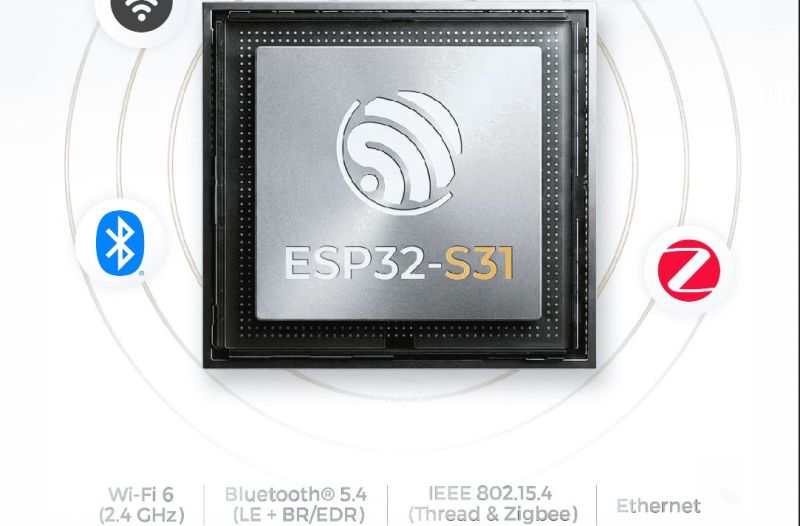
The ESP32 series of microcontrollers feature a lot on these pages, offering as they do a significantly powerful processor and in most cases, wireless connectivity. One recent member of the bewilderingly large family is the ESP32-S31, It’s a dual-core RISC-V unit with WiFi 6, and if that’s not interesting enough there’s the news that it runs Linux. Not -nommu Linux, but the full-fat version, as it has a memory management unit.
Before you imagine a superlative experience, it’s worth the reminder that the available resources will not give it much when it comes to computing power. But there’s an Espressif GitHub repository, and work on a port of a 6.x kernel, so you should be able to do something with it. A quick look on AliExpress finds dev boards at a range of prices, so the cost of experimenting shouldn’t be too high.
This moment at which the paths of microcontroller and full-fat SoC start to cross has been on the horizon for quite a while, and it’s exciting to see it finally arrive. Expect more similar chips in competition with this one, and more power too. Meanwhile see our noting the launch of the S31.












Any $5 USB LTE modem also runs Linux, so what?
A usb lte modem is not a microcontroller… if you don’t understand the difference, this probably isn’t the site for you
you’re not wrong about the modem thing, but ‘this isn’t the site for you’ came off kinda harsh. probably not how you meant it 🤷”
Nope you got to remember this is the internet so…. Pretty sure that’s the tone he meant.
Apart from them being entirely different things, that would sip 10x more power than a microcontroller would. Linux running on a microcontroller should be interesting for battery-powered devices that need Linux while not having much performance requirements.
This is the closest thing to “linux running on microcontroller”.
Let’s be more specific and check (manually, not with LLM) the power consumption from the pdf:
— Sleep modes: between 1uA and 1mA;
— Operating modes: between 13mA and 100mA (RF/peripherals disabled).
there are no $5 usb lte modems…
only 16-32 MB of ram…..so not much better than NetBSD’s 68010 port that runs on workstations from the 80’s.
and is so slow nobody’s even sure if it still works.
Not sure what “netbsd, 68010, port, slow” have in common with the topic.
A RV32IMAFC (yep, it has single-precision FP support) with 320 MHz clock where most of the instructions are executed single-cycle seems to be pretty performant on my book.
NetBSD ports their OS to many platforms, and one of those platforms is based on the 68010 CPU. It supports a maximum of 16 MB and is utterly useless.
My current linux kernel is 12MB. What are you going to do with an ESP when 75% of the memory is taken up without running anything at all?
Maybe learn the difference between RAM and ROM?
I can tell for sure what I’m not going to do – a “make allyesconfig” and expect the kernel size to be manageable.
“My current linux kernel is 12MB.” – I can’t even understand your logic of comparing a desktop pc with low-cost embedded platform.
What @sweethack said.. But also, rebuild the kernel without a LOT of stuff which you probably aren’t using on your 68010 or this article’s ESP32 anyway. It’s meant to be custom built like that. Once upon a time I had to cut a kernel down to get it to live on a Floppy along with Busybox and a few other tools. Well, I am sure the days of getting it THAT small are over but I bet one can still get it a whole lot smaller than 12MB.
@sweethack linux has to be loaded into ram to run. It doesn’t support execute in place anymore, and certainly not on this chip. Even with the most stripped down kernel, you’re looking at less than ten MB of usable space. It’s basically useless for anything except a “hello world” demo. That’s why projects like openWRT walked away from 64MB-of-ram devices years ago.
Rules says be kind and respectful. Not jealous.
Tinkererers learn here. Maybe you’re looking at the wrong web site.
I tink, terefore I am.
This is an amazing turning point not to be taken lightly.
For me the (repelling) turning point with Linux was its BDFL’s AI decision.
Sure that hurts for someone on the Linux train since the first release.
https://arstechnica.com/ai/2026/07/linus-torvalds-to-critics-of-ai-coding-in-linux-fork-it-or-just-walk-away/
A quick scan through the pdf shows no info regarding the TLB – is it unified or I/D split, what is the TLB buffer size?
I’m also quite puzzled by the following statement in the datasheet:
“External PSRAM Interface: 250 MHz 8-bit DDR PSRAM (in-package only)”
I’m starting to have a real cognitive dissonance when reading Espressif’s documentation…
They don’t have a parallel memory bus, BUT a parallel SPI bus (Octal IIRC, so 8 lines where the data flow). So at 250MHz, on eight (serialized) lines and DDR, the theorical maximum is 4Gbit/s. But since there’s SPI overhead (you need to set up the memory pointer address), I think you can expect half that. That’s no much, but it’s much cheaper than a true LP DDR interface in both routing, sourcing and designing.
Dude, I’m perfectly aware of what SPI, octal or DDR means.
What I’m not aware is how someone puts “external” and “on-chip” in one sentence.
Eh, “This moment” ??
https://en.wikipedia.org/wiki/Gumstix (disclaimer: I have no clue about mmu..)
Defunct.
I wonder if it would be used in the upcoming Flipper One
My cynical mind went: “Great, now an ESP32 takes 2 minutes to boot.”
You can still write bare-metal sw for it, or use any RV32-compatible RTOS – the usage of the MMU is not mandatory (it’s disabled at reset).
The not so new import rules from .cn to .eu remove all the fun from impulse buys…
(part: 13 €, import 10 €)
I thinks this is really cool. As a lurker, I’ll take an opportunity to point out to the few that just want to troll with snarky comments that most enthusiasts (like me) find this interesting and appreciate Jenny for the article.
I have a working Linux image for the ESP32-S31 if anyone wants to try it: https://github.com/annoyedmilk/esp32-s31-linux
Linux 7.3 with Wi-Fi, Bluetooth and SSH. About 11 MiB of RAM for Linux, so don’t expect miracles, but it’s fun.
Woah, nice job there !
OK now we have a $5 equivalent of a decent PC from 30 years ago, sweet. Well give or take some storage issues, but that is easily fixed. Add LoRa or do long range wifi (the recent firmware hacks apply?) and put a mesh of them on tailscale or zerotier so that you have a flexible system for IOT sensor/actuator networks that is secure while being upgradable and administered remotely.
Integrated Wireguard VPN solutions like Tailscale (or headscale or alternatives) on a cheap MCU like an SP sure like a very interesting propositions for homelabs and IoT fleets!
*ESP
Almost like they are two very different things…. One being small, super cheap and low power, the other being really old, power hungry and more expensive.
I don’t get the people that come in here saying “but what about a computer”
my first thought was, now I can fianlly run a proper SSHD-Server on a ESP
why are they not using 5GHz/6GHz band yet? are they reusing the same radio transceiver block since the 8266 or are they missing some sort of airwave use license?