
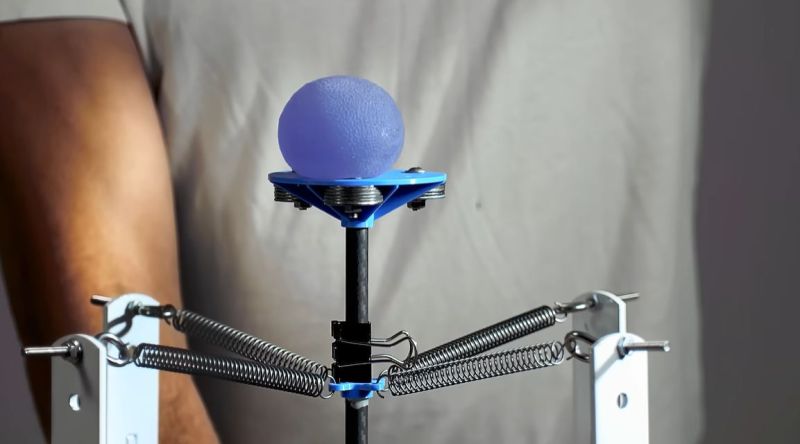
We all love a good bit of bounce now and then, with everything from trampolines to bouncy castles and bouncy balls forming the staple of a wholesome childhood for many. That said, most of our bouncy experiences in day to day life concern bouncy objects that meet immovable or rigid objects, including said child having a blast in a bouncy castle. Where the physics get arguably more interesting and less intuitive is when you combine two objects that are both bouncy, with [Steve Mould] recently taking a look at the tuning of said bounciness to even kill the bounce completely.
Understanding how to achieve this tuning means understanding how the kinetic energy is stored in each flexible material, and how to dissipate it in a way that doesn’t result in the aforementioned bounciness. In the simple physical demonstration setup the addition or removal of weights to the lower sprung platform tunes the response to the bouncy ball that is dropped on top of it.
After going through the science behind bounciness and springiness using the practical application of this science in the context of golf balls and clubs, [Steve] introduces the simulation tool that he created. This allows you to tweak the parameters of such a double spring system, which may bring back some high school physics lessons for some.
In a system like that of a golf club and the ball, having undesirable oscillations (bouncing) reduces the final kinetic energy transferred to the ball. Although ‘bouncy’ is perhaps not the first thought that comes to mind when handling a golf ball or a club, ultimately they are just as bouncy as a bouncy ball or an electric switch, just on their own scales, with their own opportunities for optimization and analysis.












Everything is, as usual, about resonance. Study your differential equations kiddos.
A polymer goods salesman dropped by my lab one day a while back. His company sold industrial damping materials. In his bag of samples he had two identical-looking polyurethane balls. Same clear color, same golf-ball size, same heft, same feel. One bounced very well when dropped on concrete. The other was absolutely dead: zero bounce. All about impedance matching and damping. A tunable parameter, the salesman said. Excellent demo for the company.
screw the exploding golf ball, that’s yesterdays joke. could this be used to make a ball that just goes…puhphuh’plup……nowhere far. that be funny as hell and a reason to go golfing with anyone that asks. or did i read that wrong?
It’s an elegant demo, as without many words you know what they can do for you. Sadly many companies lack this, and few sales people can explain in a few sentences what they sell.
Everything is a spring.
As a kid 30+ years ago I once hit a small rubber bouncy ball with a wooden baseball bat. I think it is still circling the planet in a high orbit.
Another fun one is the two-ball bounce: Place a small ball (e.g. a tennis ball) on top of a larger ball (e.g. basketball), and drop. At the floor collision the large ball imparts much of its energy to the small ball, causing the small one to bounce far higher than it was dropped from. https://www.youtube.com/watch?v=r3V8nOMGWKg
It can be stacked with three or even more balls to get even greater speed increases, but keeping them aligned is a challenge. Apparently with the correct combination of balls, you could get the top one going supersonic.