
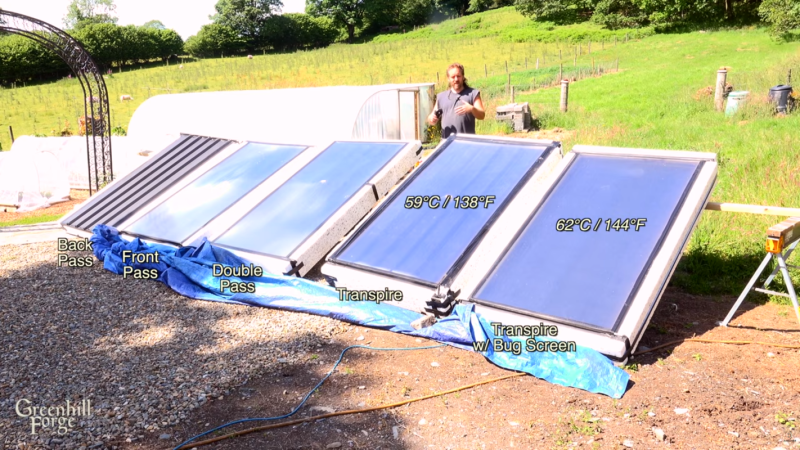
For as good as solar panels are at converting sunlight directly into usable electricity, especially for how cheap they’re becoming, they can still only gather around 20-30% of the energy that hits them. That’s fine if you have a large roof or a huge tract of land, but if you have limited space and need to do something like heat a home, there are better options available to capture more of that energy. [Greenhill Forge] has built five solar air heating panels to test this concept, and do it much more inexpensively than commercial options.
These solar heaters use sunlight to heat a fluid, in this case air, and move that heated fluid to another space. Each panel is about two square meters, insulated on all sides except the top, and configured in a way that air can flow past something that the sun has heated. The first panel, a control, does not use a glazing to help trap this heat, but the rest all have a polycarbonate window to increase the greenhouse effect of the panels. The four remaining all experiment with the way air flows around a black corrugated steel sheet to gather more of the heat, with the fifth panel using a set of black screen instead.
With the panels all set out in the sun, [Greenhill Forge] is using a set of thermocouples from a previous project to measure the efficiency of each panel. Surprisingly, he found that the panel using the layers of screen was the best at gathering energy, although he notes several times that these types of panels are extremely sensitive to changes in physical configuration, so this is not the most definitive test possible. However, at only around $100 per panel it’s quite a deal if the goal is a usable space heater that doesn’t use any fuel or grid electricity.












???
I’m kinda confused, why wouldn’t you rather use a solar water heater and then use radiators to get the heat out? Air is terrible at carrying any significant amount of heat.
I might be missing something. But it’s definitely not the fact that it’s an experimental DIY system.
Air is easier to pump around, and doesn’t freeze in the winter.
air isnt really easier to pump around than liquids are. And there are plenty of fluids that do not freeze at the temperatures of earth winters.
I think it is. Air is everywhere, so you don’t have to mind small leaks and your pump doesn’t need to be perfectly sealed or have very fine tolerances to keep pressure.
you think wrong
Not that there’s never a reason to use air, but you need a large well-insulated duct with a relatively powerful blower fan to move the same amount of heat as a hot water pipe wrapped with foam and driven by a very modest pump or possibly even “thermosiphon” as in some setups. If you don’t actually need the air, and you just need the heat, it’s not necessarily the right way to do it. Especially when any air you deliver into a house causes the existing air to leak outside, unless you have a heat exchanger in which case you could have just used the heat exchanger with a coolant loop from the solar collectors. And the air flow rate required to carry very much heat into the house without excessively high required collector temperatures isn’t likely to line up with the amount of fresh air you actually want.
Or a return air duct, though usually houses do ventilate out anyways, and if this was a low energy home you would want that HRV heat exchanger anyways. These are air-to-air units already built in to modern housing.
But here we’re talking about a dryer of some sort, which needs hot air, not necessarily a lot of air, so the complaint about volume and flow rate is besides the point.
@Dude, yes, a second big insulated duct as a return would replace a heat exchanger – but only if the purpose of this air is heat and not drying, or if you don’t mind losing any leftover heat in the exhaust air. If you expect this air to dry something, then you can’t feed the moist air back to the solar collector directly. You also can’t just “not care” about flow rate – you need a constant flow of fresh air to carry away the water and to carry in the massive amounts of heat energy needed to evaporate water.
And if you need high temperatures, you’re just compounding the heat losses at every step. You can also lose energy if your plan is for the home’s HRV/ERV to handle an imbalance – not that someone with such a tiny budget is likely to be living in expensive new housing anyway. Your efficiency might drop so much if you don’t do everything right that you get more drying done with an equal sized photovoltaic panel powering resistive heat, never mind an actual dehumidifier based on peltier or vapor compression. Equal price… well the capital cost of photovoltaic is higher, but I expect it to last longer in the weather.
In his own tests, he optimistically estimated that he collected 1400 watts in the sun, and when drying with this type of panel, of course if your temperature drops in clouds your useful efficiency can be zero despite still collecting some heat, though his remained at about 400 watts and a temperature that’s… well at least it’s mildly warm, not really useful for intense drying, but hey. We’ll see how much of that remains after a long set of ducts. I would point out that if you only want to dry clothes on a warm day, just put them on a line, don’t build a solar collector to provide mildly warm air to a machine or something.
Anyway my original response was still true – it isn’t necessarily easier to transport a certain amount of heat using air instead of water, although there’s times that you should do so.
yeah the not freezing in the winter is huge. having to add antifreeze to my solar hot water system is the biggest pain about it.
since the antifreeze makes the water non-potable it also has to be kept separate from any useful water you are trying to heat — and that requires a heat exchanger. to simplify things, i am considering a system that automatically shuts off and drains when air temperature drops to 35 degrees, but you really can’t have your microcontroller flake out on you in a system like that
Also, if you have an efficient insulated collector, it can also boil the water into steam and build up pressure until something breaks.
If your ventilation fan stops, the collector might get hot but nothing dramatic will happen.
Warping if it gets too hot.
Me, in the Uk, wondering why on earth you’d want to heat your house when it’s 35C…
I’d keep the separate system with antifreeze. My grandma had solar water heating and it was very effective even in the winter, dropped her gas usage significantly.
Drainback systems are not used anymore because they fail when you need it most. Power can go out. Valve might freeze before the system thinks it’s cold enough to initiate a drain event. Non vertical pipe with air bubble prevents complete drain. Insects or ice clogging the drain output… So many things to go wrong.
The first house I bought came with a solar hot water heater that used a drain back setup like you describe. Operation was by a thermocouple controlling a mechanical relay to run the pump when the rooftop collector was hot enough and a drain back valve that operated on the same principle as the thermostat im an automotive cooling system, except the valve opened when cold enough instead of opening when hot enough, to prevent freezing. Everything analog and mechanical, no microcontroller needed. The storage tank had a conventional heating element as backup for when solar wasn’t enough.
He says it in the video, you can use the air directly for drying grain, or for air heating with out adding complexity of heat exchangers. If you want hot air this is easier and more effecient. He is working on a similar video for solar water heating, he also has a crew videos about making super efficient wood fueled water heaters
Rocket stove? (which isn’t really the same principle like in rocket engines but anyway)
Rocket stoves are not efficient. Not by any stretch.
Rocket stoves are amazing because you can use it to cook on with relatively easy to find materials, like sticks. They are easy to operate, easy to make, easy to use. They are not efficient.
Rocket mass heaters on the other hand, are, but although both use the term rocket, that’s where the similarities end. Rocket mass heaters are a very old concept. The system was used well over a hundred years ago in places like Siberia.
Air ducts are far larger than the space needed for water pipes – here in the UK most houses have “wet” central heating with water-filled radiators and the pipes are usually 15mm diameter although there was a trend for microbore stuff for a few years where they are around 8-10mm and more flexible.
This is part of the reason retro-fitting AC or heat pumps is a real challenge here, we don’t have the infrastructure in our houses to get warm air around and older heat pumps didn’t make hot enough water for radiators to work well.
This is cool, well rather warm, but the solar heaters he built are only useful when the sun is up, and useless at night when temperatures drop.
I really like the idea of parabolic solar troughs with heat transfer fluid storage. That way you have stored heat to use when you really need it.
There are also evacuated tube solar water heaters. They take a lot less space and work fairly well even in cloudy winters.
I have them on my roof and they make our water heating bill zero. Always put a sediment filter though in their inlet thought, it’s a pain to clean individual tube otherwise.
If i understand this right, they work similiar to heat pipes in computing (vacuum to lower evaporation point, condense, flow back) to transfer the heat in a tank? Smart.
It’s not very difficult to pile up a stack of bricks and blow the hot air through that first. At night, you simply bypass the collector and keep getting hot air from the pile of bricks.
Exactly this.
An architect build Arizona dessert house with a massive concrete block for a roof. Just heats up during the day, provides warmth at night. No air heeded.
(I can’t find it.. Also had pillars for walkway, so the scorpions could not climb up. I always thought that would cause a broken leg when coming home slightly drunk…)
You’re not real smart are you. I live in Hawaii where everybody has solar water heaters. We have this because every type of fuel is super expensive here. Electricity super expensive fuel oils and gases have to be shipped in so they’re super expensive.
Your water heater tank stays hot for a very long time. You obviously don’t really know what you’re talking about. So maybe think about the things we may not know before we speak about them. If we haven’t tested them or experience them, we maybe not. Should speak about them.
You could have made your point without the nasty remarks. You obviously have experience so adding useful information without the trolling elevates the conversation but I guess your name, MF, must stand for Mother F$%^&r
If you need hot water, you would obviously heat water.
If you need hot air, you would obviously heat air.
Heating water to heat air, or heating air to heat water, would obviously add unnecessary complications unless there’s a proper reason to do that.
You’re right. As always application, application, application matters.
Water has higher thermal capacity, it’s take longer to heat up but once heated up you can extract it at a more distant time (depending on how well insulated). The water would be analogous to a battery while the air analogous to a super capacitor.
On winter days depending on latitude, your daylight hours might be wasted booting up the water system (which is fine if hot water was the goal), while the air heater quickly gets up to operating temps (and heating space for longer). If the air heater doesn’t get hot enough then it can still preheat the air for the home heating unit quite easily. If the water heater doesn’t get enough sun to warm up then first it is useless as a space heater and second it’d take some work to hook up into the (relatively high pressure) home water heater.
Also consider weight, a water system will weight more and need more structural reinforcement, so if you are on ground application and need to move it around due to buildings and trees the air system will be more practical (though building an elevated platform might be more time effective)
For a given amount of thermal storage, water weighs less than a quarter of the brick or stone needed to store the same energy. But it’s apples:oranges. The application drives the storage mechanism.
You also live in Hawaii, where you don’t have to worry about keeping your water heater from freezing for 4 months out of every year, and where sunlight is plentiful year-round. Move a couple hundred miles farther from the equator and “your water heater tank stays hot for a long time” becomes demonstrably false, and the scarcity of sunlight turns into a real problem. But, I won’t belligerently insult your intelligence just because our experiences differ. Maybe you should try the same.
My experience is that your experience is valid only in a narrow band that does not include the Greenhill Forge site.
Alright: 22% efficiency* for the PV panels vs. 70-80% efficiency* for solar thermal panels sounds good. But it’s leaving out the whole chain beyond it. Heat transfer losses may amount to way more than your electrical losses if your heat source isn’t exactly where you need the heat. And if you have a need for heat in the warmer months you can use a heat pump which runs at about 500% that season of the year which will almost certainly get you more yield than the solar thermal approach. I get that this is cheap, simple, DIY and all. But the framing is missing the whole system aspect and quite frankly sounds quite ridiculous.
Long gone are the days when one would just build the thing for fun and tinker with it (which I think this video should’ve been). Now, (and I get it) in order to soothe the YouTube algorithmic overlords, everything has to be framed in such a ridiculous way.
The panels are all neat. But if your system delivers depends on all components and how they interact. I guess for your Jalapeño greenhouse this is great and that’s what the framing should’ve been.
*) And for the “efficiency” bit: That’s conversion efficiency from free sunlight. So it’s more of a yield than an efficiency in the classical sense.
How about replacing the black corrugated sheet with a solar panel, making a system that collects thermal and ev energy?
And exactly this.
Solar panels like to be cool. If the temperature goes up to 50-60 C the panel becomes less efficient and degrades faster.
Example:
https://www.semanticscholar.org/paper/The-Effect-of-Temperature-on-Photovoltaic-Cell-Fesharaki-Dehghani/4eb139ee8e2cc5d722b14ced834f35a8183b1188
Yes, there are systems that back-cool solar panels. It’s not super efficient for commercial use (if you want electricity, heat isn’t very useful), but for small sites, you might actually have a use for both.
But that works much better with liquid loops and small pumps on the back. Often, if you’re careful, the power consumed by driving a small pump is more than compensated for by the increased efficiency, especially in hot climates. And a hot desert climate often means that it’s beneficial to store the heat somewhere to reduce the nighttime temperature variance of your payload, whatever that is.
The payoff is often limited to narrow circumstances, but given the moderate effort needed to run the numbers, it’s worth checking out. When it works, it can make a project much less of a pain. And when it’s not going to be helpful, running the math first isn’t that hard and saves a lot of wasted effort.
Use the panels heat as source for the heat pump (or cool the panels with the cold air from the heat pump). Anyway you don’t get the panel hotter when collecting the heat off it than when just placing them in the sun.
You do. Solar PV is usually installed on risers to keep it off the roof or other platform and allow wind under the panels to cool them down. A heat collector boxes them in and raises the temperature from 30-40 C to 50-70 C because you want the temperature higher to actually use it. Water heaters need to be kept above 55 C to prevent bacterial growth, and lukewarm air isn’t effective for space heating because you need to ventilate too much for it to have an effect.
If they say they don’t let the panels get hotter, that’s their choice, not yours. Now the impacts you mention are things that can happen as a result of their choice, but the part of their comment you deliberately skipped is that a heat pump sucking heat out of the panels would make them cooler than they would otherwise be, not hotter.
go big or go home? https://en.wikipedia.org/wiki/Crescent_Dunes_Solar_Energy_Project
‘filed for bankruptcy twice’ that figures. Started construction in 2011 and by 2026 had their lunch eaten by cheap solar panels and cheap batteries. Maybe we shouldn’t go big, maybe we should go medium sized and numerous to minimise risk.
“Build it small, see if it works out like you thought, then scale up”, yeah, that’s sane pragmatism for most things. Only a very few things truly behave different enough at small scale than large scale to require testing-at-scale.
And in many cases, small and medium scale designs better fit the circumstances outright.
In grid environments, smal/numerous/distributed generation can both seriously de-stress the existing grid and effectively add much more capacity to the system than their raw power would seem to indicate. Grid loss is real, and climbs quadratically with load and linearly with distance (~ load**2 * distance ).
Increased producer->consumer locality has a dramatic effect on grid power loss. Every watt not lost to current-squared * resistance in the grid is a watt you “earned back”. In many cases, the reduction of grid stress is worth much more than the cost of the solar array.
If the load is distributed, not concentrated, you get the most effect from distributing the generation, rather than concentrating it. And it has the most effect when you have long distances, lots of sun, and high summertime temperatures. And the single best example is residential HVAC.
When most of the US grid was designed and implemented, there were few things in a home that could draw significant power for long periods of time, so there was not much need to worry about line losses. Power generation was sited near industrial demand, and residential feeders were often long-distance runs. Without much potential for power demand, there was not much potential for line loss, either. Later, as HVAC became a common residential draw, this created a strong distortion of the grid-engineering assumptions.
This is one reason that Texas has been using so much solar lately. Texas has lots of space suitable for small solar sites that are also short distances from residential zones.
Five to ten acre lots are easy to find in close proximity to many residential zones, and every KWh they provide is a KWh that doesn’t have to flow down a long feeder from a generator on the other side of the county. And with land availability and cheap solar fabrication, adding solar near residential is both effective and economical. Plus, a factor that is amplified in Texas and other hot zones: ambient heat increases the line losses and the equipment strain. Slight reductions in grid losses can have outsized effects on grid reliability, even if you don’t consider that distributed power production reduces the probability of large-area blackouts.
There’s no such thing as a one-size-fits-all solution, but when you have the right problem, this is a pretty obvious pragmatic win. And, you wouldn’t get the same benefit from a huge centrally-located solar power producer.
I wonder if you could get the benefits of the peak heat provided by the bug screen transpire one but also make it less sensitive to cloud passover by adding the sheet metal for some thermal mass.
Instead of painting the insulation black as he did with the bug screen one, lay a piece of the painted sheet metal down and put the vent through it as with the front pass one. Basically adding the two layers of bug screen for the transpire effect on top of the front pass design.
Very nice interesting I can see this being useful for MVHR system just pump the warm air into the system in the winter for some cheap heat. The air system will be better in the winter than my water system as it takes a lot of solar energy to heat the water to anything useful during the winter months.
I just saw “Huge tracts of land” and stared snickering
https://www.youtube.com/watch?v=GPX-mW4l1rU
I wonder if that was an intentional reference?
This far down the thread…
‘Am disappoint.’
(.)(.)
Can the heat in summer be used to heat something else (soil ?) to be used for winter ?
no.
your asking waaay too much.
Storing heat for months is beyond reason.
It has been done, and it works well.
https://en.wikipedia.org/wiki/Drake_Landing_Solar_Community
Couldnt work that well given that
“In 2024, a decommissioning process for the Drake Landing Solar Community began, where the majority of the 52 homes were converted to natural gas-fired furnaces”
It worked for 17 years, but then the usual happened where nobody wanted to pay any money to maintain the system to keep it running, so they simply waited until it became too expensive to repair.
The story of all American infrastructure projects.
The article also gives the main reason: there were too few houses connected to the system. The optimal community size would have been 200-300 homes or more.
District heating systems are usually built to serve more customers to spread the cost.
District heating works better in high-local-density environments. It doesn’t work too well when population concentrations are widely distributed, as is common in much of the US.
There’s no such thing as a one-size-fits-all solution, and a brilliant solution for one environment can be a crappy solution in some other environment.
Many solutions with bad reputations are the result of hype and cargo-culting: copying someone else’s homework only works well if they’re dealing with the same problems you are.
Yet, district heating is used in places like Scandinavia where the population density is ridiculously low, yet around half the homes are heated by thermal plants burning wood chips and other stuff. Of course most of the use is in the cities, but even small towns use it.
The economic limit for heat transmission is about 15 kilometers, 30-40 kilometers for high temperature pressurized systems, theoretically up to 85 km at the limit of feasibility. The heat losses in these systems is on the order of 10%. That can cover a lot of ground.
https://www.sciencedirect.com/science/article/pii/S0306261918302058
Judging from Fig1. in the paper, a small scale district heating system is typically around 20 MW.
A quick back of the envelope calculation: if the plant is operating for 1500 hours per year, that’s 30,000 MWh. If a single home in northern US or Canada uses 15 MWh of heat per year, that corresponds to approximately 2,000 homes distributed in communities within 15 kilometers of the thermal plant. This describes a small town with around 8,000-10,000 residents with approximately half using district heat.
From the same paper, the lower limit for commercial operation looks to be 1.5 MW within 5 km transmission distance, so that would be around 150 homes. This lines up with the estimate that you need around 200-300 homes for a Drake Landing style system to work economically.
It’s not “beyond reason” as it’s what ground exchange heat pumps do—transfer heat into the ground in summer and transfer heat out of the ground in winter.
What is unreasonable is the cost of drilling the holes for the ground exchange.
It’s really funny to see this idea being thought about again. In the 70s & 80s, The Mother Earth News Magazine did all the work and testing to provide plans for reproducible results using solar hot air collectors. At there Ecovillage, they put it in practice to dry and sterilize the contents of an outhouse serving a couple hundred people a day.
We have to get away from the one way of doing something if we want to make a difference in our ecology. Photovoltaics are great for somethings but not others; all the rest are the same.
We also have to get away from the 70’s mode of thinking that we can all happily live in “earth ships” in little dispersed ecovillages, taking up land with inefficient hobby farming while commuting to the cities by car to do our actual business.
There were less than half the number of people in the world then. What about when there’s 10 billion of us?
I’d rather use PV modules and a heat pump if any kind than this. Way more flexibility, you can pump overcapacity into the grid ( and you will have a lot ob overcapacity in the hot moths) and in case it’s to hot, you just use the system to cool your space down. 20% pv efficiency times a cop of 3 also hits 60%… and you can do a lot of other stuff with that energy, too. With heat you are quite limited to… heating
So, how effective will that be, if your budget is around $200?
The question is rhetorical, but not snark: resource and budget limits are also things that any engineering solution has to solve for. Otherwise, we should just all use antimatter ;)
A reasonable question, though I’d argue that at any budget/demand level but giant or really really tiny direct electric generation is going to be a better choice for your budget now – so much easier to use that energy for whatever you will need so that investment is puling rather more duties – which will give you effectively more money to spend on this system. However storing electricity for later just for heating is probably the biggest budget issue as it is more expensive than the buckets of sand (etc). Though batteries are easier to scale as you can afford it years later, being more energy dense that you can just add anther to the stack most likely for no real space loss, and again flexible in what you use them for which can help offset that extra expense…
For $200 you probably are in low enough price budget that the best you can do is lots of black pipes in the sun and a pump to push the heat where you want it type approach, as that is a very low budget. Though not sure what the local markets to you would be like, for $200 I’d think it possible you could get a reasonable if still relatively small scale solar PV setup with some shopping around second hand sources (not that uncommon around here to have free panels if you can come collect them even), but also getting the heatpump and significant battery capacity not very likely at all.
Could still possibly be effective. Won’t be a proper heat pump for that price and I’d recommend borrowing some money and paying it back with the savings on your monthly heating bill instead, but if you’re wanting to diWhy it with high effort and almost no budget like this, you can probably find icemakers or old freezers or something that people are giving away, and pipe the cold to the outdoors so the heat from the appliance warms the room. The cheapest panels are under $0.25/watt now, although the cheapest inverters are pretty suspect. You might be able to salvage a UPS that someone threw away due to a dead lead acid battery – it happens a lot – and that could give you a few hundred watts.
If you’d rather something a bit less junky, maybe you could score enough peltier modules from salvaging electric ice chests to go that route, but your efficiency would be pretty limited at lower outdoor temperatures. There’s also electric ice chests with a 60 watt refrigeration compressor that runs in the 12 volt range, which might be decent if you don’t mind only producing 120-180 watts of heat for your money – although if you can get multiples then it wouldn’t take a lot of panels to power and might be a good option. I don’t think there’s any window units which produce sub-freezing output air, nor would you be certain to get an inverter and panels into that budget, although if you were a hvac tech you might be able to modify one to do it, and then you’d just need to reverse it in your window.
You might find for the lowest cost, highest reliability, you actually get better results for home comfort by sealing drafts instead of causing them – after all, any air these panels make has to blow into the house replacing air that was already there or else you have to make a heat exchanger and could have just used a coolant loop and radiators to save on drafts. Also using solar panels to power incandescent light bulbs or electric blankets to warm you up directly is very reasonable; it’ll boost comfort more per watt making up for not having a COP>1.
Also cheap to do it that way, so your budget would be almost entirely panels, so if you can get them at the rate I got some last (about a quarter per watt) then you’re looking at several hundred watts of heat, same as these black panels probably give before you account for drafts. And you could always collect a little heat from the solar panels too if you like, just don’t insulate them as it would hurt the efficiency. Maybe you’d have a hard time getting that rate unless you can do local pickup, as any shipping would instantly put you over budget. But even in small quantities now, it’s not an absurd price.