
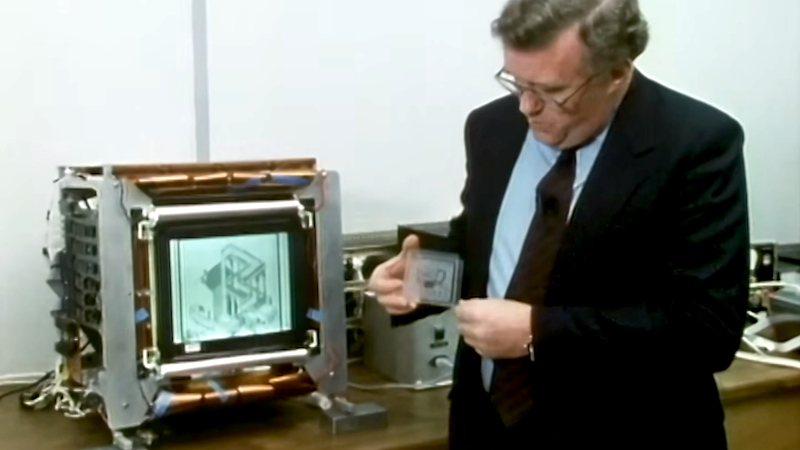
We all know the e-ink persistent displays, as they’re cheap and plentiful enough to have become ubiquitous in applications such as supermarket price labels. But we don’t often see some of the other technologies that almost did the same thing. The BBC Archive has a report from 1986 showing one of them, a prototype display from STC.
E-ink relies on flipping the arrangement of black and white particles in its pixels, while this one has a fluid in which the molecules are aligned to let light through, or dispersed randomly, at which point they block light. Frustratingly, we aren’t told what the liquid is, but we are given what might be the reason that we’ve never seen one. The activation voltage is rather high at 200 volts. It’s still a fascinating glimpse of something we might have had, with some tasty early-PC-era portables along the way.
The BBC archive has served up quite a bit of retro goodness over time, and we’ve certainly featured one or two of them over time. A recent one was this demonstration of email via a flight to Amsterdam, from the same year as today’s display.












200 volts in itself shouldn’t have been such a huge obstacle though. Nixie tubes used 170 volts, and wristwatches were made using them.
Yeah but the marketing
Backlit LCDs used fluorescent tubes until LEDs took over. Those also needed hundreds of volts.
Watches also had/have electroluminescent aka “indiglo” faces which are fairly high voltage. They use piezoelectric transformers, because not that much current is required.
Back when e-ink was starting to crop up in the late 90s, it had a drive voltage in the hundreds of volts as well. They were not pixel displays but more like segments for characters. But they worked!
Good Ole BBC… managed to film several seconds of blank plasma display milliseconds after it cleared the screen
And also yes proto e-ink took a good amount of voltage back in the day … its been ready for use since the mid 80’s the magical part that put it in the hands of just about everyone was the fact they made it work with much less current (along with el lighting even when that got good it still produced a piss warm glow at best plugged directly into mains)
So an e-ink VFD huh, probably best we never went with that lol
My father worked at STL (where he developed the first plasma etcher). I recall him talking about the liquid crystal display developments going on in another team.
I presume this was some kind of bistable LCD such as a Cholesteric Liquid Crystal Display.
I remember my father saying that they had hosted a visit from a team in Japan also developing LCDs, who had declared that the STL team was at least a couple of years ahead (they even had an early colour display around this time). But just like Charles Kao’s fibre optics (and my father’s plasma etcher), the leadership of the company had squandered the lead and failed to commercialize the technology.
The STC display in the Micro Live clip is apparently a ‘Smectic A’ LCD display.
And according to the April 30, 1987 issue of “Electronics”, is based on cyano-biphenyls, whatever that means.
https://www.worldradiohistory.com/Archive-Electronics/80s/87/Electronics-1987-04-30.pdf#search=%22stc%20lcd%22
Page 32.
I find it on page 39, but thanks tons for the tip!
The problem here was that it couldn’t do video and STC – standard telephones and cables were massively outspent by LCD makers in Japan. The company was in trouble because of the deregulation of the British phone market, but they were amazing. They were optical fibre pioneers and they made telephone exchange equipment.
This one is accidentally hilarious, like a Monty Python sketch, but it’s serious. Michael Rodd from BBC Tomorrow’s World, in the middle of a wood, whips out a curly-cord handset with rotary dial from his jacket pocket and starts dialing…
https://youtube.com/watch?v=vix6TMnj9vY
That’s a little odd. That demo happened a full six years after Cooper’s famous first public cellular telephone call (by Motorola). And that radio looks suspiciously like an ordinary handheld transceiver of the era. I wonder what the backstory is here.
Granted, it took another 11 years before the average (rather well-heeled) Joe could get his grubby mitts on a Motorola Dynatac.
You could get radio telephones in the 60’s just not cellular
Yes, like the video mentions.
I used a VHF radiotelephone well into the eighties. I even did email over it in the bush, 40 miles from the nearest paved road, with a TI Silent 700 terminal on my truck’s passenger seat and the radiotelephone handset jammed into its acoustic coupler.
The connection was made the conventional way (via a human operator dialing the number for the radiotelephone user, me), which required a bit of explanation, and the PTT was a pain to juggle while typing. Horribly slow and impractical, but it worked.
Yep, wireless email, 40 years ago.
I quit that job and left the area in ’87, but it’s remote enough that I’ll bet modern cell phones still don’t work there. The field grunts would be on Iridium now.
So can Brits that don’t pay a TV licence watch this according to the UK government?
You might consider using a proxy of some sorts if you are a Brit avoiding the licence.
As long as proxies are not a terrorist offense in the UK yet that is.