
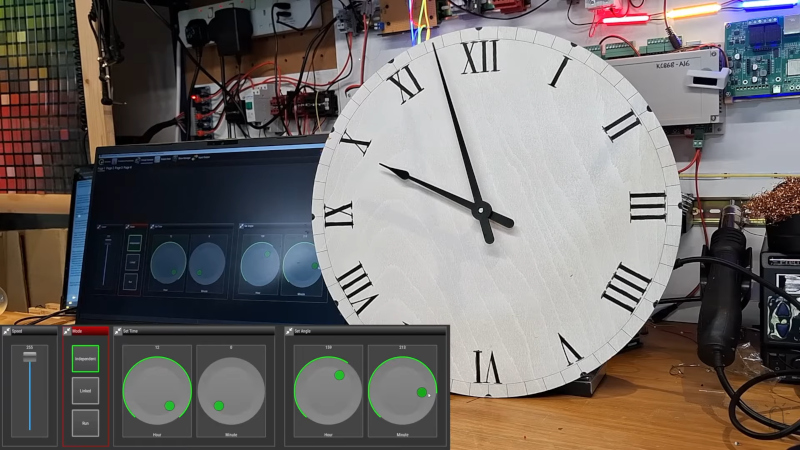
A clock is by its very nature a device for measuring time, and thus it moves forward at a constant rate. But how about in a theatrical setting, where time runs at the whim of the director? For the stage, a clock with more flexibility is required. To this endeavor [Playful Technology] has you covered, with a larger than life stage clock whose hands are independently controllable by DMX.
Behind the clock is a very unusual part, not the modified clock mechanism one might expect, but a dual stepper motor with a concentric shaft. This is driven by an Arduino with a stepper driver shield more familiar from the world of 3D printers, and an RS485 interface for DMX interfacing. The hands are built in OpenSCAD, and 3D printed to be an interference fit on the shafts. The DMX controller software has a handy rotating knob style interface, allowing easy hand manipulation.
You can see the results in the video below, complete with an exhaustive dissection of the Arduino code. Meanwhile DMX is itself a fascinating subject, and in the past we’ve taken a deep dive into RS485.












Some things are suitable for video. Some, things not so much.
For the love of all that is holy, a one-minute video and a git repo would be useful here. Or even just a dump of info in the video description. But nada.
Almost like they don’t want to transfer any useful information at all, just doin’ it for the clicks.
That slop adds zero information to what any rational reader could infer and reasonably assume directly from the thumbnail and the existing description. It adds no value.
At least the thumbnail gives you the manufacturer of the vitamin part: The Hanpose motor, which the AIdiot didn’t pick up on.
About the only thing you can get from this is a neat idea, and the shill’s pointer to their Patreon. Which is, of course, the whole point.
This video is not for you.
What is an ‘interference find’?
Argh! ‘interference fit’?
When you cram the piece into a tight enough gap that friction holds it there and you don’t need glue or fasteners. Violin tuning peg.
I don’t understand why violins today still use this system. Trying to figure out how to tune my kid’s violin was on ordeal, and I can play 8 or 10 different instruments. Why not geared tuners like a guitar? It’s like stuck in the 16th century for the sake of…tradition?
(And the same goes for Roman numerals! I mean, we’re really still using a counting system from some pre-common-era nerds who didn’t even know zero was a thing?? /s)
I’ll bite on this, but I am cursed with actual knowledge here:
a) weight. The friction pegs are about as light as it gets, and any extra weight at the headstock is undesirable. Balance shifts out, and handling the instrument becomes more fatiguing. A real issue when the only support is the fingering hand.
b) There ARE geared tuners for violins, of various styles and quality. None are inexpensive, so you won’t find them on a student instrument, and probably don’t want to spent the money to add them. The money is better spent on a higher grade instrument, or, for a young student, put aside for the next upgrade.
I just put geared pegs into my Yamaha silent violin and don’t really notice the increased weight at all.. that said, i am not much of a violin player. At least the damn thing stays in tune!
[stella] I’m not much of a player either. What geared pegs did you use?
I was specifically referring to the guitar style tuner, which are massier than plain pegs, and require more space, requiring a larger headstock, possibly of different design to allow for mounting.
To me, on a 450g instrument, supported by my chin and outstretched fingering hand, another 30g for a larger head and wormscrew tuners would be a fair much extra.
INterference fit: When the hole is a tad smaller than the shaft that goes into it. The easiest is a press fit, so that it can be forced in without too much trouble with a mechanical press, but locks in place without fasteners. A shrink fit requires heat and/or cooling to expand the outer part and/or contract the inner.
COntrast to sliding fit, where the part slides on freely, but has little play (one or two degrees of freedom typical, such as sliding and rotational), Loose, where the parts go together and may have more degrees of freedom (think a 12mm bolt in a 14mm hole), or transition, where the parts don’t require special help to go together, but when assembled tend to stay in place
THere are more precise definitions, and several subclasses along the way, but this is the gist.
You know, you could just type “interference fit” into your search engine of choice, and it should find an explanation for you. Saves you having to ask, and fix typos, and come back to the site to see if anyone has posted a sensible answer.
Try it now!
no that’s boring. asked and answered parts of the comments are the absolute authority in my book. and type’ohs are what sepurate us from them pesky robits!
It feels as though those concentric stepper motors should be useful for a robotics project, but somewhat difficult to think of a real reason to try to incorporate them. Maybe some sort of cable driven manipulator for a confined space. No doubt these are available in various sizes. A hand where each digit was driven by a was screw could be interesting, if these could be found say the size of the steppers usually salvaged from old floppy drives. I’m curious about the possibility of three, or more, stacked steppers, although no doubt lack of torque becomes an issue the smaller they get, unless you could find a long pencil thin stepper.
how is DMX even doing all this? i mean… i thought he was… uh.. in jail in heaven?
X gonna give it to ya