
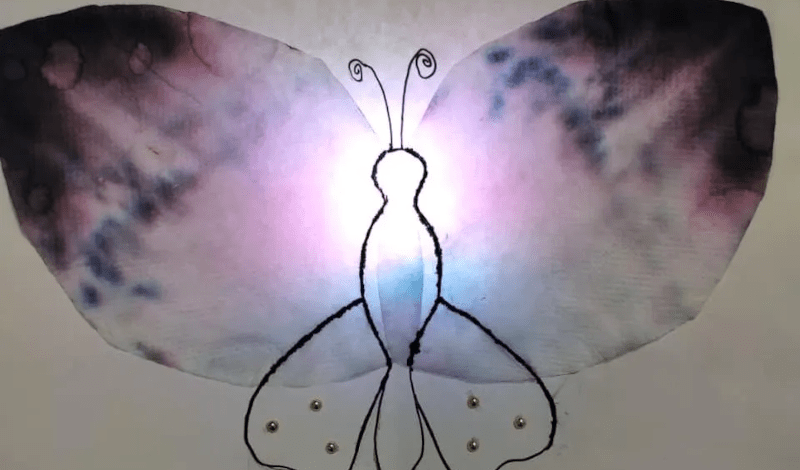
You may or may not remember in some ancient chemistry class studying or even performing chromatography. The short definition is using media like paper or powder to separate a mixture. It is an old technique, but [Suchir2004] is using it as an art form.
Chromatography works because the parts of the liquid mixture travel through the media at different speeds. While experimenting, [Suchir2004] noted that black ink and water perfused into constituent pigments. A butterfly ensued.
Is it art? Yes! Is it science? Well, sort of. Especially since the post does talk about how the effect works and even does some simple tests to start. This would be an excellent project for a class where some students are more motivated by art and others by science. Even with an individual kid, it might show you where their interests lie.
There’s nothing particularly difficult. A sketch pen, some paper, a coffee filter, a glue stick, and a few other household items are all you really need to get started.
Want something more practical? How about measuring caffeine content?










I was motivated by art as a child until my mother screamed at me for making a mess with the paint :(
Never painted again
Oh dear, I am so sorry to hear that. It reminds me of Picasso’s quote, “Every child is an artist. The problem is how to remain an artist when he grows up.”
I could have been the next Neil Pert.
But mom would hide the empty oatmeal drums.
I had to catch her in the act to get a one.
But then, fun for hours!
‘Just want to bang on the drum all day!’
On the upside, Art is a lottery ticket.
1 in a million get rich, the rest say: ‘Do you want fries with that’.
Listening to Picasso is like listening to lottery winner telling you to ‘never give up your dreams’.
He should have been called an A-hole.
About 25 years back when I was teaching chemistry, we’d bring in elementary or middle school kids and make “chromatography flowers.” Cut a thin radial strip in a coffee filter, leaving it attached at the center. Inks on the center, dip the end of the strip in water. You got concentric circles of color as the water traveled up the strip, then radially on the coffee filter.
I remember doing chromatography in my highschool biology class, to separate the different pigments in leaves, not so long ago. 2020, I think.
I run samples through a cyclograph from time to time.
A cyclograph is a spinning rotor that is used to separate samples into its individual compnents by washing them through the rotor until they run out one layer at a time.
Its basically the advanced version of the filter paper art we did as kids. I know its silly but even after 20+ years I find it exciting to watch
https://youtu.be/fOOtUIppdJw?si=DOivEbz0Mo8L5Dfn&t=117