
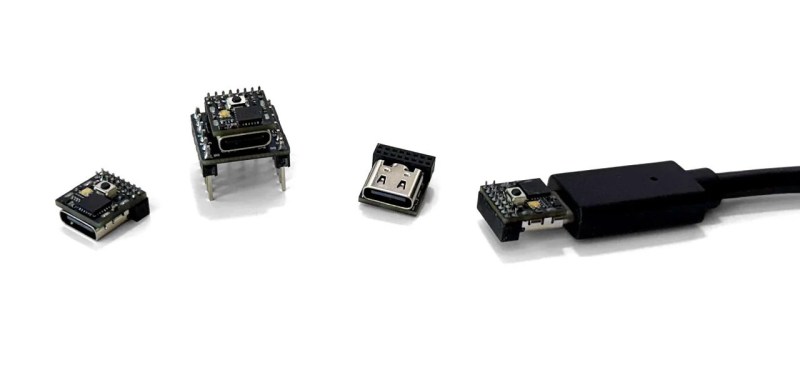
Compared to the Arduino Uno of old, modern microcontrollers are absolutely tiny — especially for the amount of processing power and I/O you get. But if you need something really small, like fits-on-the-tip-of-your-finger small, most of the turn-key development boards on the market are still a bit too big.
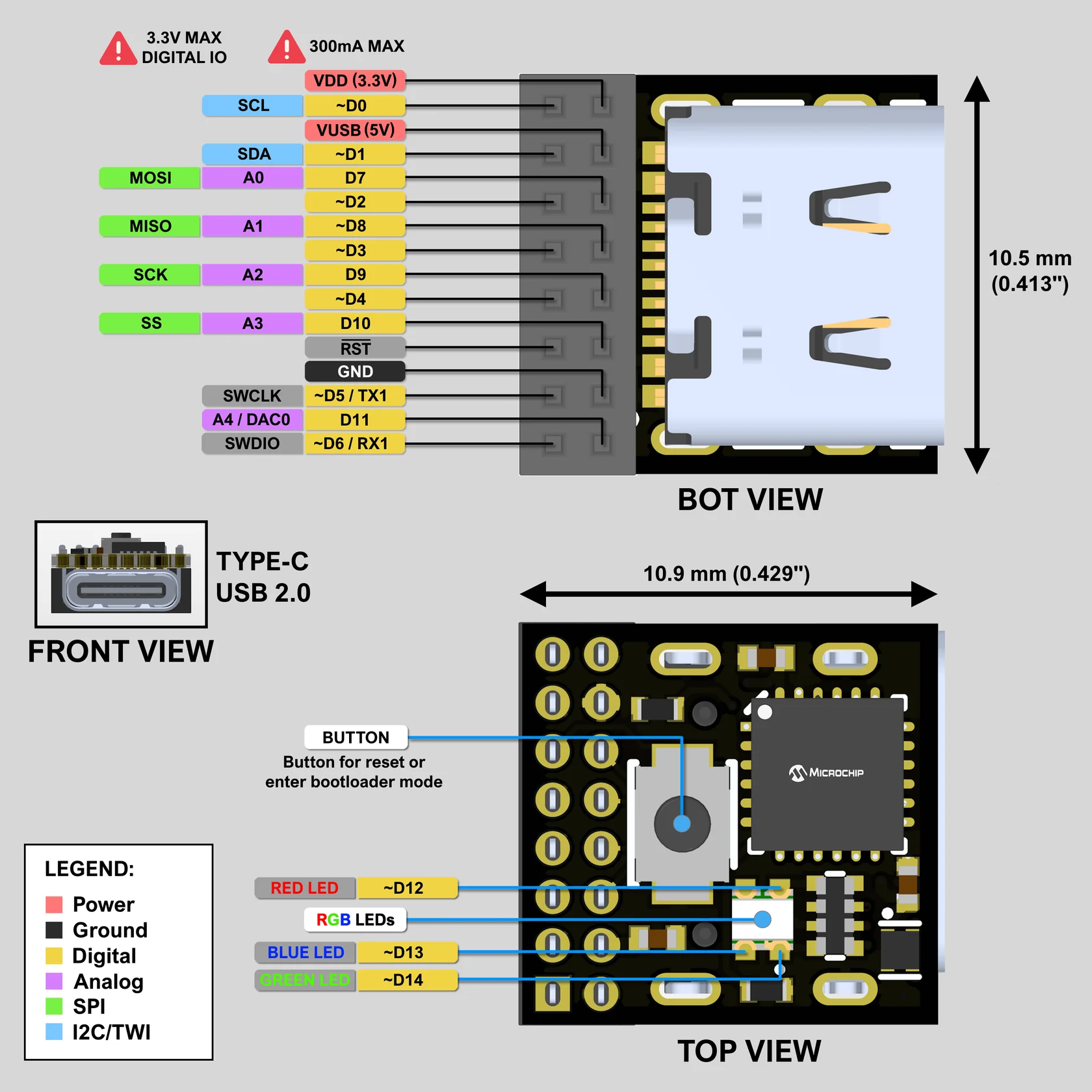 Enter the pinch from moddo, which they advertise as “The World’s Smallest 32-Bit Arduino-
Compatible Board.” We can’t vouch for its world-record status, but we certainly can’t think of a smaller one. At least not a complete solution like this, which offers native USB and 15 GPIO pins in addition to the usual suspects like SPI, I2C, PWM, and UART. In fact, it’s so small that it even includes a breakout board to make prototyping a bit easier.
Coming from something like an ESP32, the biggest adjustment will probably be working around the relatively limited specs of the SAMD11. The ARM Cortex-M0+ under the hood tops out at 48 MHz, and there’s only 4 KB SRAM and 16 KB flash (of which the bootloader eats up 4 KB). Still, not bad for something that occupies roughly the same surface area as a female USB-C connector.
We’re told the team is in the final stages of testing and production of the pinch, and you can currently pre-order the $16 board ahead of its planned September ship date. A circuit schematic and STEP 3D model are already available, and it looks like board design files aren’t far behind.












Arduino for ants?
Good, But it’s needs a remote button, Larger MCU and castellated stamp breakouts for more GPIO on the edges.
I think it should come with a disposal bag and an instruction for recycling, too.
Sorry for being so negative about it. I’m tired of all this e-waste, simply.
Art projects are fine, sure, but miniaturization just because of miniaturization.. I don’t like that, I don’t see the point.
In my opinion, let’s either try to do something right or let it be.
But that’s just my two cents, of course. And that’s not important.
With just a few changes, Like i said…. the UTILITY of it makes it becoming E-waste far less likely if it works with hyper utility.
{USB and 15 GPIO }
But with a better MCU, More storage and GPIO enhancement enabled by adding the castellated edges, It would be worth the minor real estate increase to make the board an actual stamp.
Honestly at the Sub 20 price and the utility of having say 24 GPIO, more analog ports…
You could make a case that it would be hard to E-waste the thing.
With a 3D printed case.. you could use it in so many ways… it could get to be a a new go to option for quick MCU/low power things.
I really like this arrangement.
I see, thanks. I liked the BASIC Stamps, back then, btw. 😃
One other thing…. i think a Neopixel is a better display using one GPIO on the same real estate.
There’s an entire ecosystem of samd21 boards doing exactly like you want for less than a fiver
more pins would be nice but i can just use port expanders for that.
I feel like the OS community could use more stamps/modules so makers can put together circuit boards like legos.
We could have little power modules, connectivity modules and all-in-ones like you suggest so you can slap an isolated brain on a project with minimal effort.
smaller devices are less ewaste. were talking a board the size of your pinky nail. also if you want to make a dent on ewaste, you are attacking the wrong people. this things will likely save more things from the scrap heap by weight than they contribute to it. yet companies still mass produce throw away products that are garbage the second they come out of the package.
This👆 I don’t understand the bizarre obsession with tiny boards
And pretty useless, IMO. The Uno R3 with the ATMega328 was the standard Arduino
that was backwards compatible to it predecessors and was what the majority on projects rely on.
The R4 and Q are completely different boards.
The ATMega168 and ATMega328 were the reference, the very heart of Arduino,
just like the PIC16F84A used to be the #1 PIC microcontroller.
an esp32 in this form factor would probably be cheaper, though of course the antenna would have to be a separate add-on, which is fine
Antenna? Why does a microcontroller need a antenna? Especially if it sits on a USB Connector.
Because then it has WiFi. Having a microcontroller with no external pins and no external interfaces except for USB and a single RGB LED kinda limits its use. At least with WiFi/Bluetooth you can have some utility from it.
Not saying it isn’t a cool achievement, I just don’t see the use case, and I love my things to be tiny. SuperMini boards aren’t that big, nor is a RP2040-Zero. And then you get a whole bunch of GPIOs to play with for just a few bucks. And if you want more old-school, a digispark also goes for cheap and can fill that role with a few pins and a small form factor.
Because.. because. Everything nowadays has W-LAN or Bluetooth and is a potential security and privacy risk.
Even if chip designers apparently have no clue about RF, antenna design or impedance matching.
They use fractal antennas, at best. Those little spirals and other funny looking figures on drawn on PCB..
Shut up and take my Money! Would try to build something to replace my inputstick.
im using pro micros for all my controllers. they are convenient but a little slow. i dont need a lot of pins either, since everything is either on spi (2x AS5048A for axes) or i2c (the attiny84 in the grip for buttons and analog trigger, though i might use a TCA6424A and another contactless pot for the trigger). so this is kind of good for that.
im pushing so much resolution from my controls that i need more cpu power to reduce latency. so a little board like this seems to be the perfect fit. do a little carrier board thats also a hub for the 2 or 3 wiring harnesses.
What about the rp2040/2050?. I mean, is cheap enough, and had a lot of power.
i figure the debate in the comments here so far ignores the question, which is, what’s it for? that’ll decide whether it’s e-waste, whether you need a bigger mcu or more i/o or what-have-you. i don’t have any needs off the top of my head — for the kind of projects i pursue i’m a raspberry pico loyalist — but i wouldn’t be surprised if there is one.
Looks like a fun board to demonstrate Rubber Ducky style USB HID attacks
why are so many people being mean about this? There are so many times I just need a little board with usb and a couple gpio or a uart or something, and making it tiny is nice! more than a few times I’ve had a whole arduino or pi pico or esp32 wedged into simple and space constrained because that’s all I had on hand. Yeah it’s not a professional dev board for testing fourty peripherals at once, but that’s a tiny fraction of projects that need that. This is cool!
Could not find the schematic or step file