
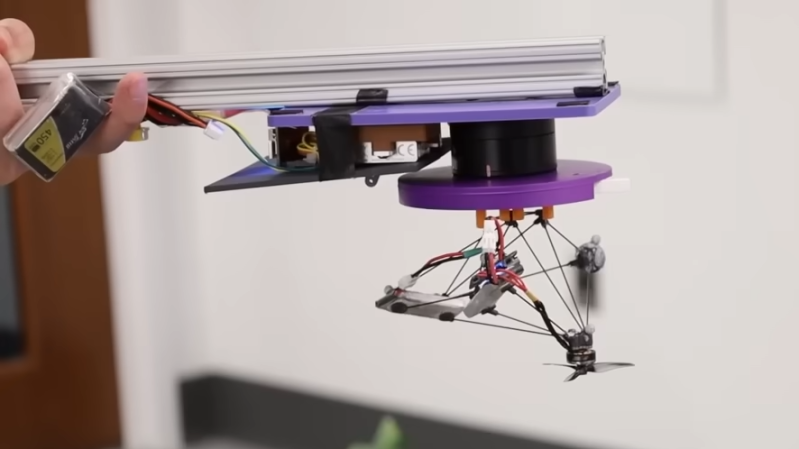
Researchers demonstrate that something interesting happens when a small drone with a spindly airframe spins at a high speed: it very nearly turns invisible. The spidery device is shown mounted in its launcher in the image above. The dark blur at the rightmost side is an outlet on the wall behind the drone, not motion blur from a moving part.

It’s called the Phantom Twist, and while we’ve seen single-motor drones that spin around a central axis before, they have always incorporated a wing-like structure or cleverly leverage the magnus effect to generate lift.
There’s not a lot of detail about the Phantom Twist’s hardware design but it appears to use a downward-angled motor for lift, relying on a high-speed control system to maneuver and maintain altitude.
This does away with the need for a wing, at the cost of only being stable while rotating at a high speed. We imagine it is also a touchy design that depends greatly on being balanced just so.
A hand launcher spins the device up before releasing it for flight. The visual effect once it is up and running is pretty striking; see for yourself in the short video, embedded just below.












If one dreams of invisible copters. Silly thinking.
Think twice.
The rotation of the blades of th main rotor creates a typical RADAR siganture anyway, called micro doppler signature.
The most invisible drone would probably be a clear helium balloon made of radar-transparent plastic.
Or it would just fly under the altitude where standard radar is useful, as most drones already do
Ok… now it’s time to add a persistence of vision system to that!!!! Floating holograms anyone?!?!?!
Nice idea, but don’t try to touch those “holograms” ;)
This is safer
https://techxplore.com/news/2026-07-scientists-interactive-screens-demand.html
Now I see this drone deal being filmed as “orbs” by the usual suspects in the “paranormal” world.
Sapm barf we have known this for a decade at this point
The celler spider [ Pholcus phalangioides ] uses this as a defence mechanism. Unlike these drones, the hydraulic nature of spider legs makes that movement essentially silent for humans.
With further work/even faster rotation I wonder if the pitch of the noise could be made too high for humans to hear?
Does that work? If you spin a propeller fast enough (and somehow keep it from flying apart), does the entire range of sound coming from it increase past 10khz?
Or are there harmonics that always muddle it up and make it sound like turbocharged bees?
And by 10khz I of course mean 20khz
I’m curious…. how does it land?
It doesn’t land; it air.
(Sorry.)
foam pit?
On a high-speed turntable, exactly in the center
So the movie Lucy got it right?
I was also thinking it kind of reminds me of the special effects from the original Star Trek series. Needed an alien on a budget? Just put some floating smudge screened onto the film plate. It’s a being of puuuuuure energyyyy wooOOOooo
With transparent materials such as Plexiglas, for example, invisibility should be improved
Someone discovered how camouflage works.
Now hide that flying object over a black floor with the same lighting conditions.
Okay so our meat eyes perceive differently from a camera, would we see it as more opaque or transparent?
Usually less imprint is made the faster it rotates. You have no information about the camera that was used for the “demo”. It’s clear that the drone “synchronize” with the camera (in the beginning of the flight), so I’d expect a global shutter camera here, thus the angular speed of the drone is exactly a multiple of the camera’s exposure period. Your eyes don’t work like a camera. Your center of vision is very slow (like in 40 to 100ms period sensitive), but your peripheral vision is very fast (less than 16ms period sensitive). This means that there’s no angular speed where this device could sync with. In short, when you look at it, it appears like a blur (but not invisible, more like smoke), but if you happen to look on the left of it, it’ll suddenly be more visible, just like the blades of a ceiling fan.
I bet it gives really good, fingerprintable, ambient WiFi reflections.
(From the Video) “Called the “Phantom Twist,” new drone spins up to 25 times per second , which is too fast for the human eye to see it clearly.”
I love a university press office’s breathless “latest thing” (usually with a lot of “in future” and “someday”, particularly when they omit the definite article. It’s a neat piece of dynamics, and I wish they didn’t have to do stuff like this to justify the hard work that likely went into it.
Let’s see:
Of course you can detect something spinning at 1500 RPM, though you may not be able to resolve what it is. Start with an aircraft propeller or a desk fan.
25 revolutions/second and 25 frames per second video sound like a match made in heaven to me.
Has this been rated to survive feline encounters? Most of the ones I’ve ever known would take this down just because they could. So much for “The work eventually* could lead to drones that monitor wildlife… ”
*There it is
Sorry I don’t have any references, this was borderline pre-web, but in the late nineties I remember reading an article about a surveillance aircraft that we’d now call a drone, with an L shaped body with rotors at the ends of the L, and the L itself was an airfoil that spun because of the rotor torque. Its novelty was precisely that it was quite hard to see as there was no mass at the center of rotation. It also wasn’t very useful as there wasn’t the bandwidth to stream video from it and it didn’t have the computational capacity to unrotate the video it was producing, so it had to be recovered and the video downloaded and processed.
Anything they show you is a prototype as proof of concept. More advanced systems are much further along and not public. Remember any new tech that they show is already almost obsolete.
Wear your tinfoil hat. The TLA agencies in black drone helicopters are out to get you.
This thing will look like a UFO.
Now, I understand pure light can lift very lightweight structures
https://en.wikipedia.org/wiki/Photophoresis
Now, could two beams of light pantograph a “sky cursor” at high altitudes?
Now, sonic flight
https://techxplore.com/news/2026-08-helmholtz-resonance-powers-miniature-boats.html