
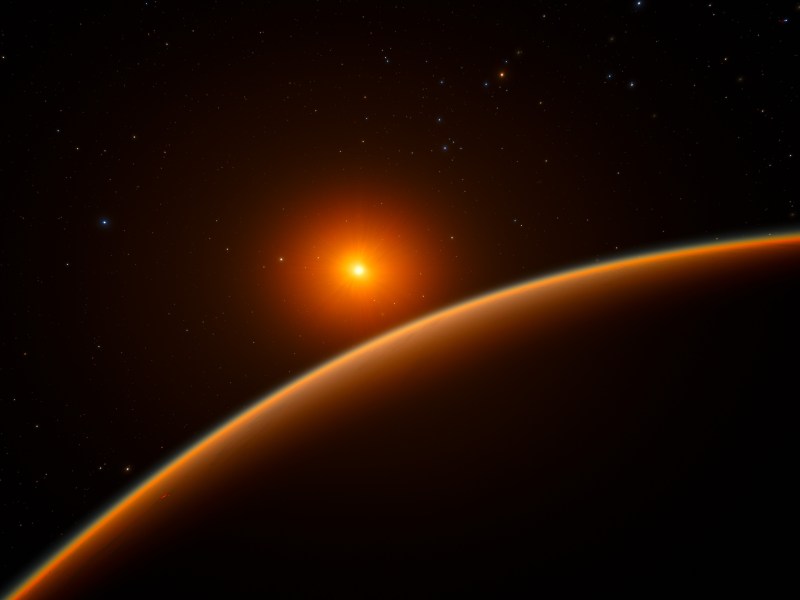
Finding another planet outside of our solar system that can comfortably be called ‘Earth-like’ is one of those discoveries that — if confirmed — would be a major event. The complication here is that with every exoplanet that we discover through observations, determining the type of planet is hard enough, never mind figuring out whether it has an atmosphere, much less what’s in that atmosphere. This makes a recent report on LHS 1140 b rather exciting, as it strongly suggests that this super-Earth may have something close to an Earth-like atmosphere.
In the paper by [Collin Cherubim] and others in Science, the findings of helium occasionally escaping from its atmosphere have led to considerable excitement, as this time-variable atmospheric escape of helium suggests a helium-rich upper atmosphere that’s further depleted in hydrogen.
It should be noted, of course, that these assumptions are based on observations from roughly 49 light-years away, so there’s always some room for later adjustments. Even if confirmed, the star that LHS 1140b orbits is a red dwarf, with a nearly 25-day orbital period and light levels less than half of what Earth receives from the Sun. This would make the surface of LHS 1140b with its proposed oceans rather dim, even if it’s conceivably at temperatures well within the comfort range of us Earth-based mammals.
At 49 light-years distance, it’s also not close enough that — barring an FTL drive — we could do direct observations or visitations, but if these results hold, it’d be on the short list along with a number of other plausibly habitable exoplanets to check out once we build that first warp drive-powered starship.












Here on earth natural accumulations of helium are the result of radioactive decay. Maybe we shouldn’t focus our planet search on those planets that have so much of it that you can detect it from here.
No, on Earth it’s because that’s all that’s left over: the early atmosphere has lost all its helium (the hydrogen bonded, the helium just escapes).
This is a much more massive planet (5.6x Earth and 1.7x radius so about 50-60% higher surface gravity) so the helium retention time would be much longer.
And it’s not that there’s a lot of helium, but because helium escapes, it’s easier to detect since it’s over a larger area. The key isn’t the helium, it’s that there’s an atmosphere at all.
I’ve always been amazed at the pull-a-rabbit-out-of-a-hat nature of these long distance astronomical measurements. I’d dare brand it “1D astronomy,” where essentially you are trying to glean profound data from a single pixel over a long period of time.
It’s actually not “single pixel” – this spectrograph used an echelle grating (like many/most) where the incoming light is split basically into wavelengths spread over 2D using multiple diffraction gratings, and then you image the spectrum, so you get a lot of data. Obviously when you’re focusing on a small portion of the spectrum it’s a little more like “single pixel”, but part of the confidence you have in saying something like this is that absorption lines are pretty wide and you can fit them to various parameters to ensure it makes sense.
Spectrometry’s amazing. There’s this poem from Robert Frost in 1916 called “Choose Something Like a Star” where he laments as to how inscrutable stars are (“Say something! And it says, “I burn.” // But say with what degree of heat. // Talk Fahrenheit, talk Centigrade. // Use language we can comprehend. // Tell us what elements you blend. // It gives us strangely little aid”). It always struck me that Frost’s poem was just before the point where it was common knowledge that we could know all of those things from stars – even by the time it was written, we were doing it, but it was very new. (For reference, the poem isn’t actually about actual stars, but in reference to other poets being so difficult for people to understand).
Good point. I’ve put some effort into imagining the colonization of an “earthlike” planet, and it always seems like a stretch unless first you “terraform” before sending humans. A resource as seemingly simple as soil is complex enough to keep PhDs busy studying its mystery her at home. If you can’t do agriculture, I’d hardly call it habitable.
We’re not even able as a species to safeguard our living here and mitigate the effects of climate change so terra forming anything that is so far and such a long-term goal is clearly out of reach.
I really don’t think the various forms of that argument are very logical.
It’s like saying you shouldn’t be attempting a repair job on some piece of common rubbish until you have mastered caring for this priceless artifact.
Not saying we actually CAN even start to attempt such a huge project. Just that the ‘take care of Earth first’ argument is backwards. Obviously 49 l/y away is out of reach. And even if we wanted to start ‘playing with mars’… that would take tremendous resources beyond anything we have ever produced as a species.
It’s a sci-fi dream.
But if we could… our inability to take care of Earth would be a reason to practice elsewhere, not a reason to stay home.
“so terra forming anything that is so far and such a long-term goal is clearly out of reach.”
No, it really isn’t. It’s just slow. We know we can grow plants in the regolith of other planetary bodies, and there’s research into modifying plants to thrive better in those environments. Once you’ve got that, it’s just a question of slowly building out enclosed environments and transforming the landscape and changing the atmosphere.
Something like Mars is a lot harder than “random Earth-size planet in habitable zone” (other than the distance issue) just because Mars is resource-poor because of its size. We could definitely speed-run the natural terraforming process just because the majority of the time it took nature to do it was building up the chemical library.
We know of planets that rain glass. Athmospheres on exoplanets are not new.
Realistically it’s mostly about “how much power do we have available” and “how much is the planet going to try to murder us physically.” Stuff like soil is easier to develop than you think – it’s basically about giving bacteria and plants resources and energy and letting them go wild.
The idea of trying to somehow openly colonize a planet never made sense to me. We’re humans. We can build things. We have structures that can sustain humans in space. And in subfreezing weather. And under the ocean. You just start out by building a closed (like, physically enclosed) ecology and expand it, and all the while letting Earth organisms do the terraforming for you outside. The only thing you need is enough power and resources (so, like, Mars actually makes it difficult because it isn’t great for either) and not murder conditions (e.g. Venus).
The thing is, unless the planet is already teeming with life, Earth life is going to just flat out decimate it. Because the reason why Earth life can survive everywhere is that what evolution provides is a chemical library that grows over time, and life on Earth is so old at this point that our library is huge. The idea of “oh maybe there’s some virus or protein or something on some basic place that Earth life can’t deal with” is nuts – yeah, it might be toxic to humans for a while, but Earth bacteria will figure that crap out fast.
“A resource as seemingly simple as soil is complex enough”
We’ve already grown plants using material from a lifeless body, both using lunar regolith simulants and actual lunar soil samples. Growing plants in Mars soil simulants has actually had spottier results, but certain varieties have worked. I don’t have any doubt that by the time humans can actually get to distant planets, actually growing plants from the resources there won’t be hard.
this tells us something about the state of the art of long distance imaging and interpretation but i’d be surprised if it tells us anything about a specific planet.
If our world was in a better place, I feel we’d be sending probes all over even if it was expected for them to take decades or centuries to teach us anything.
I’d love to see us regularly putting our state-of-the-art into work to see how much farther we can fly, how much farther we can communicate and how much faster we can do it.