

Since the first V2 rocket sailed above the Kármán line back in 1944 and right up until the modern era, the trajectory of most space-bound rockets was more or less the same: after expending their propellants they would either crash into some desolate steppe or plunge into the ocean. In either event, the rocket was disposable. The important bit up top might go on to explore the stars or send a human crew off on their mission, but the booster rocket that lifted the spacecraft out of the atmosphere was always going to be sacrificed for the cause.
 But in the 1970s NASA had a wild idea: what if we didn’t smash a brand-new rocket valued at millions of dollars into the ocean every time we wanted to put something in orbit? Instead, they would build a hybrid space vehicle that blended the vertical takeoff and raw power of a rocket with the capabilities of an airplane, allowing it and whatever it was carrying to make a gentle runway landing at the end of its mission. As such, the Space Shuttle was born.
With the benefit of hindsight, we now know the Shuttle wasn’t quite the spaceflight revolution that NASA had hoped for. The age of reusable rockets didn’t truly begin until 2015, when SpaceX landed the first stage of their Falcon 9. To date they’ve repeated the feat nearly 600 times, all the while increasing the reliability and speed of their operations. Today the Falcon 9 is the most prolific launch vehicle in history, and nearly every other rocket in active development is being designed to include some element of reusability.
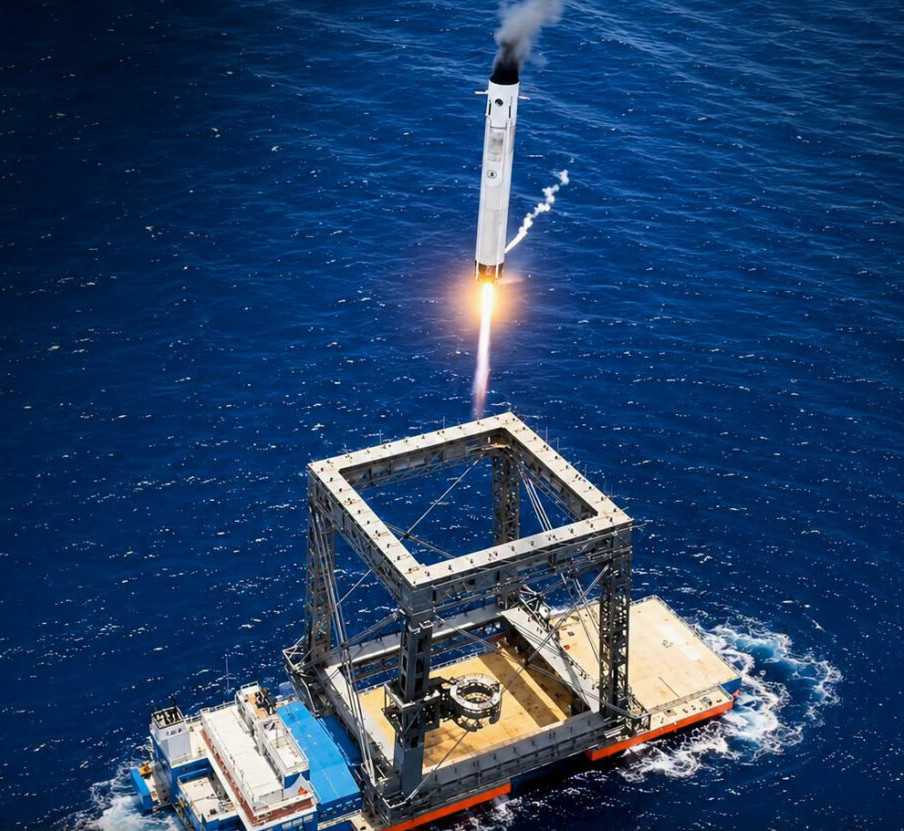
Most recently, China demonstrated that they could recover their Long March 10B rocket by gently bringing it down into what amounts to a giant butterfly net. While it might seem a bit quaint compared to rockets that land on their tails like something out of a 1950s sci-fi movie, the idea offers considerable promise.
There and Back Again
But why did it take 70+ years before we were able to regularly refly orbital-class rockets? It’s not that there’s anything inherently complex about reusing a spent rocket. Sure, there’s a case to be made that material science improvements have made the engines robust enough for repeated use. But even if you had to rebuild the engines after each flight it would still be better than slamming the whole vehicle into the ocean. Similarly, there’s nothing particularly unique about the structure of the Falcon 9 that enables it to fly multiple times — it’s a big metal tube with tanks inside of it, just like essentially every rocket that has flown before it.
The revolutionary technology demonstrated by SpaceX in 2015 didn’t have anything to do with making their rocket go up, it was that they were able to safely bring it back without damaging or physically altering it. The Falcon 9 first stage that came back to Earth was in the same condition it was when it left the launch pad eight minutes or so earlier, albeit with empty propellant tanks and a layer of soot on the outside.
As such, most of the variability we see when comparing the reuse of past, present, and future rockets comes not from how the vehicle ascends, but how it ultimately comes to rest back down on Earth.
Splashdown is Easy, But Rough
Without question, the easiest way to recover a rocket intact is to simply slow it down before it hits the surface of the ocean using parachutes This is how all American crewed capsules, and more applicably the Space Shuttle’s Solid Rocket Boosters (SRBs), have been recovered after their flights.
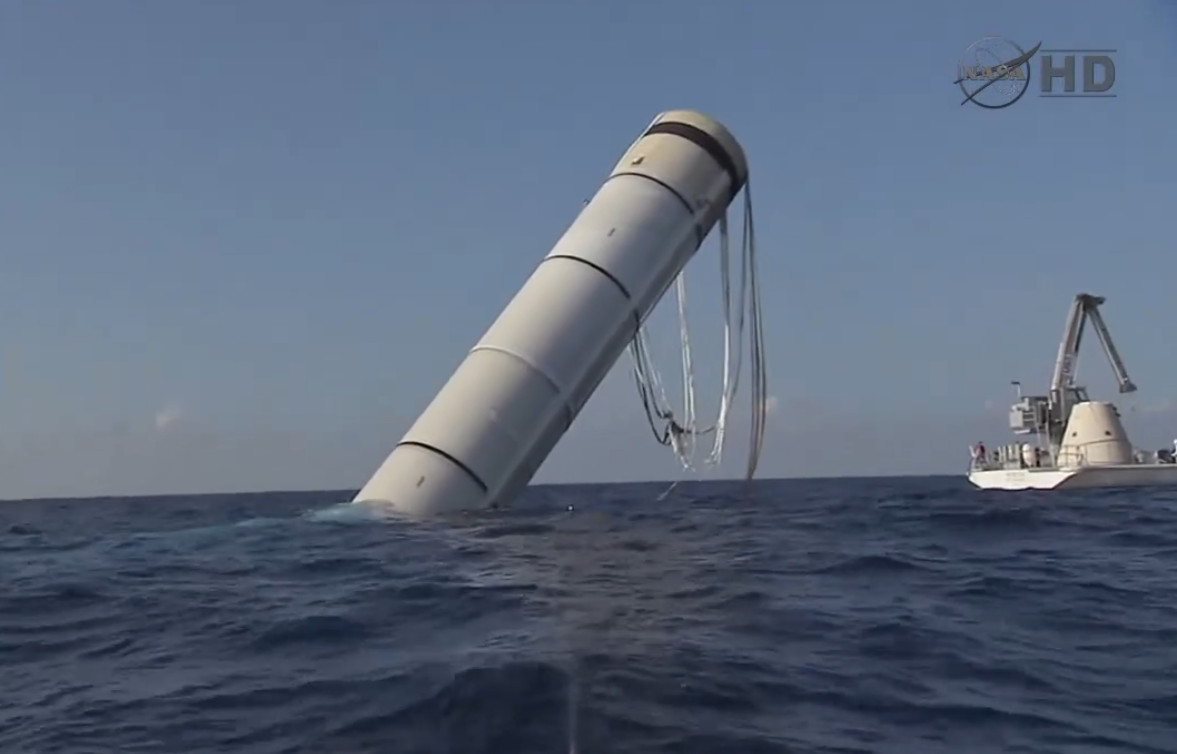
But even when descending under multiple huge parachutes, splashdown isn’t exactly a gentle event. It could probably best be described as “survivable”, in that the vehicle and crew will come through the experience in one piece, but neither is likely to be terribly happy about it.
The situation of course ends up being even worse for the rocket, as its structure is going to be subjected to the brunt of the impact force. Additionally, a complex aerospace vehicle getting partially submerged in salt water is a recipe for corrosion and electrical issues, to say nothing of the thermal shock the hot engines will experience when getting dunked.
One could argue that the only reason this method of recovery worked for the Shuttle SRBs is because of their relative simplicity when compared to a liquid-fueled rocket capable of independent flight. At the risk of oversimplifying the structure of the SRB, at splashdown it was effectively a hollow tube with minimal avionics and thrust vector control (TVC) hardware that could simply be replaced before the next flight.
Still, the NASA document Solid Rocket Booster (SRB) Refurbishment Practices goes over the considerable work required to bring each booster back to flight status after coming down in the ocean. Given the challenges of refurbishing the boosters, it’s perhaps unsurprising that NASA elected to forgo their reuse on the Space Launch System despite its SRBs being largely identical to their Shuttle predecessors.
Teaching Rockets New Tricks
In the very early days, while they were still trying to reach orbit with the Falcon 1, SpaceX had actually considered a Shuttle SRB-style recovery procedure. But in the end they decided to outfit the Falcon 9 with deployable landing legs and the rest, as they say, is history.

Landing legs allow a rocket to come down on effectively any flat surface, be it a concrete pad next to the launch facility or a floating platform. But there are some fairly serious drawbacks to this approach. For one thing, the requirement for precise terminal guidance means parachutes are out of the question. The rocket needs fins, attitude thrusters, or other control surfaces to come down on the center of the pad.
It also means the rocket needs to perform a propulsive landing. That is, use its own primary engines to bring its velocity on touchdown to as close to zero as possible. This in turn requires engines that can not only restart in flight — a capability that has not traditionally been required by first stage boosters — but are able to throttle down low enough to control the rocket’s descent without simply pushing it back upwards. It’s difficult to overstate how unnatural a state of operation this is for a rocket. Indeed, it’s the antithesis of how nearly every rocket has operated since the Song Dynasty started experimenting with gunpowder in the 10th century.
Even if you can accomplish all that, the true cost of landing a rocket is in the extra mass. Although the legs will be stowed away and unused for 99.8% of the rocket’s flight time, it still has to lug all that weight uphill. If that wasn’t bad enough, there’s also the extra weight of whatever control mechanism is in place to guide the rocket’s descent trajectory as well as the propellant that needs to be kept in reserve for the landing burn.
All told, landing a rocket on legs comes with a massive payload penalty. In the case of the Falcon 9, the rocket’s maximum capacity to Low Earth Orbit (LEO) in its expendable configuration is approximately 22,800 kg (50,300 lb). But when outfitted with the hardware necessary to land, that number is reduced by nearly 25% to 17,500 kg (38,600 lb).
Dropping the Dead Weight
There was a time, not so very long ago, when critics doubted the financial viability of recovering and reusing rockets like the Falcon 9. But today, reuse has gone from theoretical to standard operating procedure. Outside of a few Old Space holdouts, it’s top of mind for every launch provider and critical for remaining competitive in a fast-moving commercial market. In November, Blue Origin even managed to land their New Glenn heavy-lift rocket on only its second flight.
So at this point the question isn’t whether or not future rockets will be reusable, but rather, what is the most efficient way to achieve that reusability?
With that in mind, it’s easy to see the appeal of China’s net recovery. While the rocket must still perform a propulsive descent — although in theory the necessary positional accuracy, and therefore the technical challenge, is somewhat reduced — it doesn’t need to have landing legs installed. This mass savings increases the vehicle’s useful payload capacity, which in turn makes it more profitable to operate. Achieving the same end goal while being easier and cheaper is an improvement in anyone’s book.
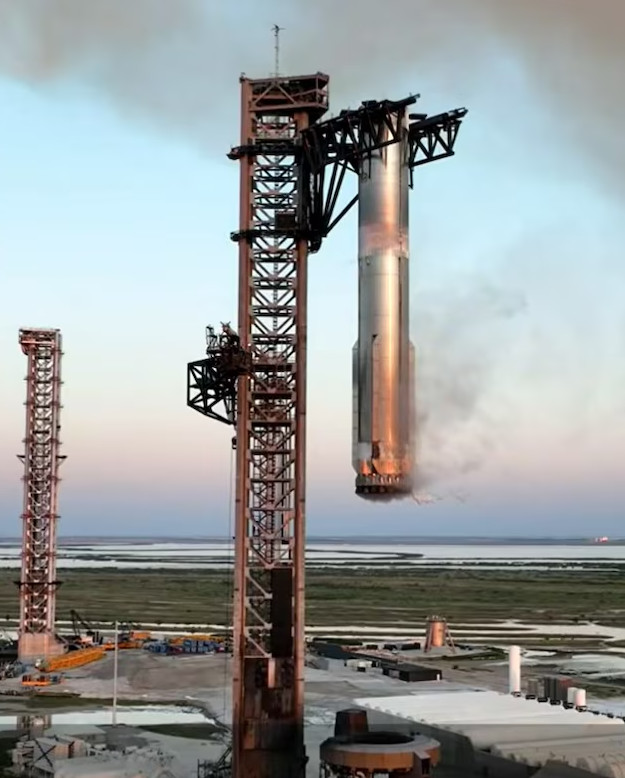
Admittedly, having the rocket come down in a huge net adds a certain amount of whimsy to the whole endeavor, but the overall logic is sound enough. It should also be said that SpaceX, for all the success they’ve had with landing their Falcon 9 on a set of deployable legs, are themselves planning on catching both the first and second stages of their next-generation Starship vehicle. Instead of a net, their goal is to pluck the rocket out of the air with a huge robotic pincer mechanism.
One is reminded of the old joke about how the Americans and Russians approached the problem of writing in space: NASA spent millions of dollars developing a pen that would work in microgravity, while their Russian counterparts simply used pencils. If China can demonstrate the ability to reuse a rocket they snagged in their net, the more elaborate methods of recovery employed by American rockets may one day look like a similarly overengineered solution.












Back to reading SciFi, invent automated/robotic asteroid mining/refining factories that will be making all the stuffs needed at the lagrangian point between Earth and Moon, so most, if not all the stuffs would be available already, rocket, fuel, etc, and only humans, food, essentials would need to be lifted or returned.
Bureaucrats at NASA never read 1960s SciFi, or 1970s, not sure. They seem to be stuck in the permanent “one solution” loop unable to see the forest behind one tree. If we’d have engineers reading scifi things would be remarkably different. We need engineers back at the helm, the likes of Chris Kraft, no less. Many Chris Krafts, to be exact.
What’s double-weird that now we HAVE the means/technology to make it happen, send AI data center to the Moon, if one must, solar/nuclear powered, let it sift the details there, etc etc. Make it self-sustaining, ie, mining it own fuel, fixing, etc etc.
Having said that, I am quite sure chinese are already at it, planning and building and trying futuristic things, while we are stuck in a permanent loop of self-denial (whether minuscule NASA budget – compared with other major spenders – is a waste of taxpayer dollars).
Bureaucrats at NASA never read 1960s SciFi, or 1970s…
This is hilarious. Since pretty much its inception, plenty of NASA people were SF fans.
For one, back then they would never use “SciFi” as shorthand for science fiction. If they did, Harlan Ellison would have personally throttled them.
There were plenty of studies dating back to the 1950s for single stage to orbit craft(SSTO) and many of them were reusable. They never went far because the problem they were to solve, which is to cheaply put large amounts of materials into space cheaply, never appeared. And using the materials of the day meant any craft would likely be big. As a result, they would be expensive to build.
Now it could be argued that if the capability existed then a market for that capability would develop rapidly. But Congress is rarely in the mood for “build it and they will come”. So they never coughed up the money.
Google Sea Dragon. Two stages, fully reusable. Early 1960s. The closest it ever came to realization was season 2 of “For All Mankind”, when it did the whole Star Wars intro thing where you see a tiny capsule bobbing in the waves. It launches and keeps going, getting bigger and bigger until this truly massive rocket, complete with verniers rises into the sky. Granted, Truax was not a NASA employee, but he worked for one of their contractors. Who was one of the designers of NASA’s rockets anyway.
NASA is wholly dependent on funding from Congress. So everything is subordinate to their wishes. For reasons that would require another text wall, Congress never was really interested in reusable rockets that couldn’t be funneled through companies located in Alabama…
NASA budget has been small compared to other agencies. This is some populist marketing bullshit pulling your strings. NASA manage to get things to mars to man onto the moon, probes to the outer planets. The private guys can’t even get their crap to obit after 10 years of “rapid development”, back of the napkin calculation said it’ll never amount to anything. All I see now is a bunch of young people cheering their ass of for another failure, for 10 years in the row. It’s terrible. And you cheer for these guys as if they have accomplished anything other than marketing.
So much wrong here in this post, I don’t know where to even start…
You sound like a boomer who either doesn’t realize, or more likely want to realize what a company like SpaceX has accomplished.
I’m no fan of Musk and I don’t try to follow news about SpaceX, but even I’ve seen news reports about their vehicles having docked with ISS and that they’ve put up quite a lot of satellites for Starlink. I’ve even seen some chart of how much cheaper (more than an order of magnitude) it has become to get things into space due to the reusable rockets.
Yes, they have crashed a few rockets, but which rocket program hasn’t?
I am cheering at 1950/1960 ScifI. We need to start inventing and implementing things we need.
I don’t buy into the so-called “rapid-fire model” at all and I really REALLY hated when speedily-created-slop was sold as “new model of writing software”. I even remember the corporate propaganda book I was given for free and was FORCED to read and memorize, something like “built to last”, forgot the exact title, I threw it out the same day it was given to me. Speed slop, here we are now, AI speed slop instead of human-written speed-slop back then, same difference.
Slow and steady, too, was the NASA approach while it had von Braun as one of it lead engineers, but then whatever internal politics had happened, it gradually veered off course (accomplishments-wise), etc.
Regardless, NASA still seem to pull off amazing things on a slashed budget, and I still give them credit for that, but we could have had Other Things by now, and we don’t, so there, SciFi ideas went ignored at large.
I want to see the towers and cables that can catch a SuperHeavy booster. Besides instead of one tower you need 4 and instead of 2 arms you need 8 moving cable sleds … besides the super heavy booster is 70x9m while the hole long march 10b rocket with faring is 70x5m (could not find the booster size).
Recall that the original proposals that became the Shuttle had no external boosters or fuel tanks. Instead of the external tanks there was a much larger flyable booster intended to return and land on an air strip and intended to be able to turn around for a new mission in a week. This ambitious project was trimmed step by step to the clapped together very complicated and disposable/expensive Shuttle system with uncontrollable solid boosters. Today with NASA, the bidding system and hundreds of special requirements and restrictions make the SpaceX style “Fail Fast” process impossible. (The same is likely true for all governments.) https://www.thedrive.com/news/this-ambitious-space-shuttle-concept-was-a-post-apollo-pipe-dream-we-never-got
Love the cover artwork!
Pencil pen in space story is a myth
Article calls it a joke.
“Once the rockets are up, who cares where they come down?
That’s not my department,” says Wernher von Braun.
All you need is a big pit filled with foam balls.
You could, but you’d have to source some from kids’ ball pits and well…. godspeed with that.
Boostback means you have to ignite engines twice.
Now, I would like to see winged kerolox stages with self ferry jets so they don’t have to land dead-stick like shuttle. Remember–jets burn kerosene too.
Launch winged TSTOs, and the winged stages can land at airports…be refueled, then fly back to the launch site.
LOX and payload put on board with the vehicles erected on the pad, VTOHL style.
One launch site, but numerous airports to return to.
https://www.thedrive.com/news/this-ambitious-space-shuttle-concept-was-a-post-apollo-pipe-dream-we-never-got
Parallel staging is what Elon should have gone for in that it might have helped test cross-feeding, and the stages peel off to the side….lots of side slip.
Parallel staging and side-payload mount (Energia/Buran) means all engines are at pad level out in the open.
One megaproject I would like to see is a non-ramp ramp
Let me explain.
Imagine a perfectly flat ramp that extends just a bit over the curvature of the Earth…this would cut across a peninsula (Hurricane Andrew’s path would have been a good place).
At either end, this flat structure appears to rise at a shallow angle pointed out to sea…elevated aqueduct style. The bubble on a level would even be “fooled.”
In the middle, this flat sled sits in a wide trench below grade.
But stand at either end of this structure and shine a laser at a target at the other end–and you see the structure is perfectly level.
You might have to aim the laser up just a tad such that the lower part of the fire-hose cone is parallel.
This structure need not be as expensive as NEOM or as long, but would serve two purposes:
1.) To prove the Earth is NOT flat
2.) To serve as a sled for an RLV
A train or a road could run along this to where a person sees what looks like a ramp at either coast, without traveling far.
Phil Bono was going to have a ramp for his non-winged Hyperion, but that would have had a kink in it. (Hazegray has a video).
The rails would point down, then rise up a mountain–but my proposal would be dead-straight, and lend itself to other uses… educational and otherwise.
I’d point it up. People who won’t be convinced by shining a laser from 1 20 foot tower to another 20 foot tower 10 miles away aren’t gonna be convinced by “it’s actually flat even though it looks like it’s going up”
Caveman best. Use.