

Sometimes that retro gaming itch strikes, and you just have to source components for a Pentium 4 build, like [Computer Retro Bus] did recently. Unfortunately, along the way he learned that you can actually get counterfeit mainboards. Case in point the purported ‘Asrock P4i45GV’ that was purchased as the core of this Pentium 4 build, which turned out to have many issues that included a fake AGP slot.
The mainboard was bought off Facebook Marketplace, with the first sign of trouble being spotty GPU support for the AGP slot, and an inability to install a driver for a card that seemed to work. Following this, issues with the installed Soundblaster soundcard popped up, with the use of Windows ME as OS being of course a factor, but even ME is generally not this sketchy.
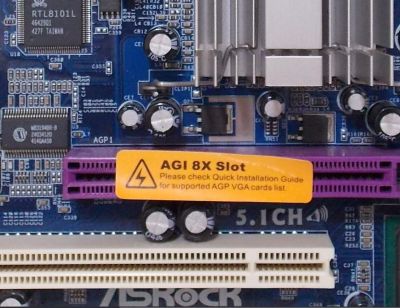
At some point he decided to actually dig into this Socket 478 mainboard that he had purchased, only to find out that there was a reason why there were no real markings on it. After an image search it turned out to be a clone of the aforementioned Asrock mainboard, including the original’s ‘feature’ of connecting the ‘AGP’ slot to the PCI bus. This explained why only the AGP GPUs that are compatible with PCI worked with this mainboard, as it’s actually Asrock’s ‘AGI’ slot.
Effectively just a way to scam buyers into believing that they bought a mainboard with an AGP slot when it was just a regular PCI slot cosplaying as an AGP slot. This doesn’t just mean lower speeds and spotty support with AGP cards, but also also potentially dead GPUs, as this mainboard inherited the same 3.3V-only card support.
Unlike PCI slots that are keyed for 3.3/5V voltage support, AGP slots are keyed for either 3.3V or 1.5V, or no key for universal support. These ‘AGI’ slots are sadly keyed for 1.5V AGP cards and thus will expose 1.5V-only AGP cards to potentially fatal voltages.
On the bright side, these are at least genuinely old mainboards, using the same AGP-less Intel chipsets, made back in the day to sell to unsuspecting buyers. Clearly the pain that these fake boards as well as genuine Asrock boards that these ripped off caused back in the day continues in 2026. Caveat Emptor, as they say.












“Fake motherboard with fake AGP slot” is bit harsh; it’s a period-appropriate clone mobo that matches the functionality of the ASRock unit, i.e. a PCI bus that exposes an AGP slot, relying on the fact that the AGP standard had a fallback for PCI communication.
As good as a mobo with native AGP? No. Better than a mobo that has only PCI? Slightly.
The worst is that, as far as I can tell from Wikipedia, there are 3 different “standards” various motherboard makers made for this feature rugpull.
I had a P3 Compaq motherboard that could use a stick of ( of course, Compaq-specifiq ) memory on the AGP slot
I have seen this on other Pentium III systems as well. The i810 and/or i815 north bridge have an IGP that normally uses system RAM for the framebuffer. By installing this memory module, the IGP would repurpose the otherwise unused AGP bus as a DRAM memory interface instead, giving the IGP dedicated RAM to work with. With the limited system memory bandwidth available at the time it would improve performance, especially at higher resolutions and/or bit depth. If you were an OEM using this chipset to make application-specific motherboards that used the IGP as the only graphics option (thin clients, kiosks, ATMs, industrial PCs, etc.) you could forego an AGP socket (not much use in a thin client anyway) and put the IGP DRAM right on the motherboard. In your case the module was probably based on the Intel reference design and would likely work in any system with that chipset.
I’m going to guess that the AGP/PCI compatibility clause in the spec was for GPUs, so as a add-in card OEM you could make AGP and PCI versions of the same graphics accelerator card. I think I still have some ATI Rage 128 cards that are PCI, even though the R128 natively supports AGP. I seem to recall there is a bus voltage translator between the PCI edge contacts and the GPU.
This motherboard has it the other way around – connecting an AGP socket to the PCI bus – and I doubt this falls under the intended use of the PCI backward compatibility of AGP. Funny thing is it might have worked better had they included the bus voltage translator.
I’m sure it had two intended use cases:
A) Allow manufacturers produce AGP and PCI versions of the same card by simply altering the physical connector, no difference in chips or firmware
B) Allow customers to use a new AGP GPU in their old PCI motherboard using a cheap pci-to-agp riser (at lower bandwidth).
This motherboard was essentially giving you the second scenario out of the box.
If the AGP slot is connected to the PCI bus as on the “original” Asrock motherboard, that it just does this a “good quality” clone. The original was already built like this, no “fake AGP slot “. Just a cheap board , for people that would use cheap AGP cards on the day.
+1
PCI and AGP are related, after all.
The main difference are 66 MHz bus (vs 33 MHz) and the GART.
Someone could say that AGP is just an enhanced PCI slot with RAM access.
From a software point of view, PCI, AGP and PCIe are about same, too.
There were HDD controllers for AGP port, too.
I do remember that the PowerMac G3 B/W and G4 (Sawtooth)
had used one 66 MHz PCI slot for the graphics card instead of using AGP.
It worked just fine, because the supplied ATI graphics card was modified for Macintosh and for 66 MHz bus.
This motherboard is clearly NOT a clone of the ASRock P4i45GV. This motherboard has only 2 PCI slots vs. 3 slots on the ASRock board, the layout is different, the I/O connectors on the back are arranged differently.
So it is just a cheap Chinese motherboard based on the same Intel 845GV chipset.
The Intel 845GV chipset has integrated graphics. It was designed for embedded applications where an external graphics controller is not needed. Of course, some motherboard manufacturers wanted to cut costs, so they used this chipset. And since AGP is somewhat compatible with PCI (it started as a dedicated PCI bus for graphics cards, with some optimizations) they routed PCI signals to the “AGP” slot.
I am not sure if it’s going to fry any 1.5 V AGP cards. In addition to two possible notches that would prevent installing 1.5V card in 3.3V slot or vice versa, AGP interface has signals that are used to detect the AGP version and voltage.
Seems like making counterfeit motherboards would be a tough way to make profit. Motherboards are one of the largest but also one of the cheapest main parts in a P.C..
I think this is meant to serve the industrial market where they can’t easily upgrade the computers for whatever reason. This way they don’t have to hunt for old stock whenever a board fails.
Makes sense, but where’s the ISA slot? 😟
Is “Mainboard” a new euphemism for “Motherboard” ? The sources for this article, and all the comments, all use the word Motherboard but the title seems to make a deliberate point to NOT use that word.
It’s not an even remotely new phrase. Maybe just one you haven’t seen before.
It’s not a new phrasing, I’m pretty sure I’ve heard ‘mainboard’ used off-and-on since the 1990’s. It might depend on geography, ie in some countries ‘motherboard’ is more common, and in some it’s ‘mainboard’.
I’m a 90s kid who started their PC building career in the late 90s, and I have always seen both terms used interchangeably. There’s also Apple being ‘different’ by calling it the ‘logic board’.
I’m not sure there is a standard, so I have always used both. Mainboard is shorter to type, though :)
There are a couple of terms, most of which are old.
“Mainboard” is a classic, it’s more elegant than the equally old “Motherboard”.
The latter is more of a “gamer” term, I suppose.
Or something that the average people in a pub would use.
You know, street language. Just like saying “mouse” instead of “pointing device”. :)
In German, there’s both “Hauptplatine” (mainboard) and “Mutterbrett” (horrible germanization of motherboard).
Though in daily life, the English terms are likely used.
Because English computer terms are technical terms.
I believe we rather casually say “Compiler” instead of “Kompilierer” and “Linker” instead of “Verknüpfer”.
Oh, I nesrly forgot. A few people also used to say “Grundkarte” (basic card) to describe a mainboard.
That’s from early days of computing when Europa Cards and S-100 bus were still common, I suppose.
Most German PC users likely have never heard of it.
Last time used it must been in the 80486 mainboard days.
Just like I’ve never really heard “Systemplatine” (system board).
But of course, we all can just use approved Mac terminology and say “Logic Board”! xD
Then there’s IBM with “planar” or “planar board”, as seen in old Hardware Maintenance Manuals.
When talking PCs these days they’re generally interchangeable. Most use motherboard, manufacturers tend to use main board. Arguably main board is correct as a motherboard is (well, was) just a bunch of slots that daughter boards (CPU, memory, peripherals such as video and USB) plug into as found in industrial PCs.
Eh.
Wonder how much they paid for the mobo. Literally just threw out a P4 on an Asus mobo when I moved house a few weeks ago. It might have paid for my moving costs! Wonder if there’s a market for a Q6600 on a mobo with RAM now? 🤔
There’s always a market, the question is: is it worth it?
From a quick look on ebay you might get £30-50 for a Q6600+mobo+ram
The Q6600 was such a good value in its day. It’s up there in the pantheon of “great buys” with the Celeron 300a, Ryzen 3700x, GeForce 1070ti, and Ryzen 5800x3d.
Doesn’t mean they all have value today though 😄
wow, if people can be nostalgic for the Pentium 4 they can probably be nostalgic for being in a Turkish prison. i threw all my AGP motherboards away and am still convinced that was the right choice
fun fact, linux dropped support for AGP a while back, so on a recent kernel all AGP cards function as PCI.
Isn’t it a bit late for an April fools joke? Isn’t it? 😅
Please tell me that’s just a joke, please. 🥺
These kernel guys can’t be that unwordly.
i don’t understand the frustration…it’s a modern version of a low-quality old product. i, personally, was glad to leave that era behind…but if i went searching for it, i shouldn’t be surprised to find it, no?
like, in 1995 i got ahold of a 486 motherboard that provided both VLB and PCI, but the BIOS was bogus. It provided the headers that the kernel looked for to tell that there was a PCI BIOS, but the pointers within those headers were all wild and the kernel would crash initializing PCI. Had to build a kernel (1.2.13) without PCI support just to get it to boot up. If I went out of my way to buy a clone of a 30+ year old PCI+VLB+486 motherboard, i shouldn’t complain that it has a dodgy PCI BIOS. Should i?
Agi slots came on some i8xx p4 boards. You can only use an AGI card which gives DVI or HDMI output from the onboard graphics in the chipset. Some AGI cards had video capture too but they are rare. It’s physically the same as an AGP slot but is wired completely differently for AGI only.
well here is one found in the wild, it was a thing apparently
youtu.be/SGJ7K4HzPhM?t=820
So…. Not a Counterfeit but a clone and not a fake agp slot but a pci to agp bridge solution JUST LIKE the original