
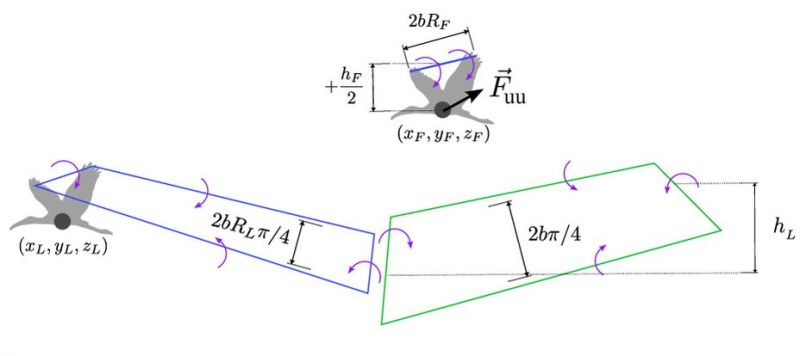
Although it’s commonly suspected that migratory birds fly in a ‘V’ formation due to this saving energy for the birds in the slipstream, understanding the exact aerodynamics behind this and how it affects the way that the birds use their wings to maintain this optimal pattern. After all, unlike airplanes and cars, our feathered avian dinosaur friends need to flap their wings if they want to have any chance of staving off plummeting back to Earth. Recent research by Brown University researchers now have provided a simulated model that answers many questions.
The major question was how this would work in the up- and down-wash zones created in this type of formation, with every bird following the lead bird dealing with the vortices created by the flapping of the wings of the bird before them. These wake vortices are quite complex, and thus required careful modelling to make sense of them.
As described in the paper by [Olivia Pomerenk] et al., the model is based on northern bald ibises, taking into account live-bird measurements for validation of the model. The main effect that can be observed is a reduced flapping amplitude, leading to an 11% energy savings for the birds in the leader’s wake.
The main advantage of having such a model is of course that it provides insight into the kinematic and aerodynamic mechanisms, meaning the ability to model virtual flocks of birds, predict the efficiency of specific in-flight configurations, and apply the lessons to swarms of drones, or whatever else we want to put in the air.












I don’t think we have put a lot of flapping things in the air yet.. would love to see flapping drones though, migrating south
The birds did a patient and awesome hack :-)
I mean it’s interesting, but I’m not sure how it’s hack related. Have we just become a news aggregator now? Genuine question, because I only came here for hacks and small projects, i see half of the other posts in my daily news feed and the duplication is annoying.
Probable future application might be with military drone swarms to extend range.
Is it time for this conversation again already?
Well you could say the birds are the ones hacking…
And do you understand why, in the V Formation, one side is Longer than the other?..
More Ducks on the Long Side..
Well, research has indicated that if one of the ducks in the left side of the v-formation farts the ducks behind it instantly change to the other side of the v-formation and stay there. So knowing this it’s easy to spot the duck that farted, it’s always the last duck on the shortest side of the v-formation.
Another reason might be that there are not enough ducks to make both side evenly sized.
It could be that the shorter side of the v-formation was simply more hits by the duck hunters.
It could be that the ducks don’t care how the v-looks like, the system works just as well (perfect shape or not).
More interesting perhaps it how the duck at pole position, has gotten there. Did the duck earn it? Did the duck loose, is it the fastest duck or is this the duck that knows where to go. Or is this duck the only duck that is not aware of the system: always fly behind another duck. So it could be like, normal ducks fly behind other ducks and follow them all the way, some crazy duck doesn’t know that and is followed by the other ducks (because that’s what ducks do), that crazy duck is called the leader.
Resources
https://techxplore.com/news/2026-07-nasa-wing-limits.html
https://techxplore.com/news/2026-07-mimicked-bird-bones-lightweight-high.html
https://techxplore.com/news/2026-07-deep-sea-sponge-geometry-metamaterials.html
https://techxplore.com/news/2026-07-nasa-subscale-aircraft-flight.html
This isn’t new I heard of the vortex effect pertaining to bird flight some years ago.
Or…. Birds that fly in “V” formations have eyes that look out at an angle, and they just keep the bird ahead centered in their field of view. The very nice paper is just a theoretical model after all.