
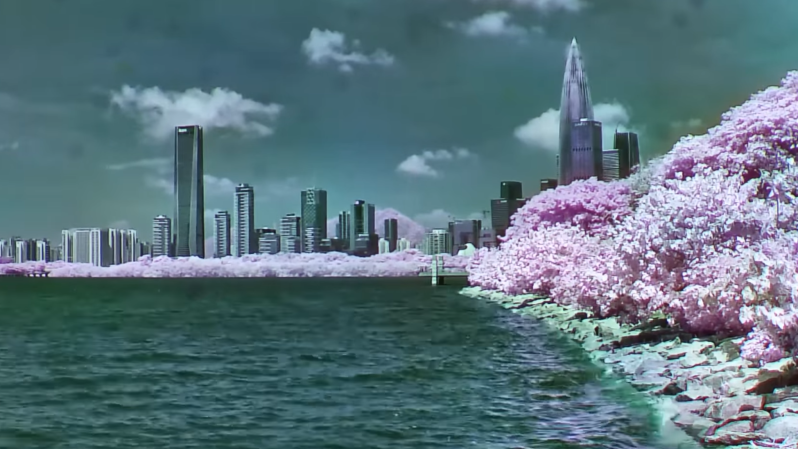
Silicon-based CMOS camera sensors are cheap and plentiful, but they’re rarely used to their full potential: they can detect a greater range of wavelengths in the infrared spectrum than they can in the visible spectrum, but in most cameras this is blocked by an IR-cut filter. [Project 326]’s infrared camera system reverses this: it records infrared images in color while blocking out visible light.
The system uses three USB webcams, each with its IR cut filter removed and replaced with a different dichroic IR band-pass filter. One filter is centered at 750 nm, one at 850 nm, and one at 940 nm. There is no band overlap; in testing, each camera only detected an infrared flashlight tuned to its own filter wavelength. The original cameras didn’t hold the sensors in a consistent position, so [Project 326] designed new housings. Using three lenses, each with distinct aberrations, introduced some difficulties in alignment. [Project 326] originally intended to use a pair of beam-splitting prisms with only one lens, but this proved too difficult to align using 3D-printed frames.
A Raspberry Pi records a separate monochromatic stream from each camera, which can then be processed into a composite color video. The first frames need to be manually aligned, but afterwards a script can apply the alignment to the rest of the video. Finally, the channels are mapped to colors, with the precise mapping being freely changeable. There were some few unexpected issues: each camera has its own, not terribly precise, local oscillator, and they drifted apart by about one or two frames per minute. Parallax error, on the other hand, was less severe than might be expected: at close range it’s noticeable, but by a distance of 35 meters, it represents less than one pixel of distortion.
The resulting images look great, and it’s easy to forget that they’re being captured without the use of any visible light. We’ve seen a similar technique (though extending into the visible range) used to recreate the surreal effect of Aerochrome film.












“TRUE-COLOR” – no
Any clarification/explanation , or just a criticism?
Colors outside the visible spectrum do not have true-color visual representations. It’s tautological. It gets mapped to a different color you can actually see.
It is by definition a false color image, however what we have here IS something pretty special, so it would be appropriate to give it a name that reflects this. Trichromatic infrared?
Spectrum shifted colour?
Would this be covered under the term multi spectral imaging?
Kodak marketed a chemical version of this process called Kodak Ektachrome Professional Infrared EIR film starting in the 1960’s. The cover photo of the Jimi Hendrix Experience’s “Are You Experienced” album was shot with this film.
the other day the song “Are You Experienced” came on the car radio (from WEXT in Amsterdam, NY) and my wife casually made the observation that Jimi died at the age of 27, and here he was at some age YOUNGER than that claiming to be experienced. but he had more claim to that than an LLM that was just telling me about its experience with calibrating multimeters
Wasn’t that stuff developed essentially to pick out camouflage from real jungle foliage in Vietnam? Pretty clever
in was thinking alignment could have been done on software minimizing need for complex mechanical or optical alignment. iirc, “stacking” software is used in astro photography so possibly no need for invention.
Then you need a filter that’s cells for each wavelength.
And/or taken over time with different filters. Motion is a problem then
Oh it’s so nice to see a write up on Project 326, that dude is a gem on the internet.
Again: No true color.
Please stop clickbaiting.
3-CAMERA ARRAY CAPTURES NIR PERFECT VIDEO
SNAPSHOT MULTISPECTRAL RIG SKIPS VIS
NIR-LY THE SAME BUT MORE THAN THREE-CCD CAN SEE
FANCY FILTERING FOILED: PESKY PARALLAX PERSISTS
I think we should make a generator for those. Either way, pick one and have a nice day.
(you’re technically correct though)
Please stop with the low effort criticism.
I disagree, they should keep a it.
It’s an interesting spin on the old “pop out the ir cut filter and take a piece of exposed negative film in its place” camera project. (Heads up, Ir can penetrate some fabrics so you might want to preview before sharing a live feed)
One thing that is not clear from the video is if they are using black and white $15 web cameras, or are they standard 1080p web cameras with Bayer filters.
with bayer filters
standard webcams with Bayer filter in place.
Outside the visible spectrum the bayer filters are likely to be either largely transparent or largely opaque. Since this is in no way a calibrated instrument, just pick the channel that works best with the IR filter that’s on it and go on your merry way.
Of course, a monochromatic camera will end up with more detail, but that entails a lot more expense or effort.
I don’t understand all the needlessly added complexity. There are already existing workflows to block visible and capture all of the IR and then map it to a false color image. You can capture them all with one camera and map/drop wavelengths in software. It’s pretty common to modify a dslr or a mirrorless to pass ir/UV and then take pictures of stars. I don’t think poorly aligned plastic lenses are going to give anything resembling that clarity.
That’s impossible if the sensor pixels cannot differentiate between wavelengths by physical filtering. It’s like taking a black and white photo and trying to infer color from brightness. You can create a false color image like that, but the mapping will be all mixed up.
A regular bayer filter in a visible light color camera may provide some separation of the IR spectrum, but there’s going to be significant overlapping because the filter is not designed for it, so it’s more or less acting like a B&W camera for the longer wavelengths that pass through all the color filters.
Well said Dude, I would argue the same but perhaps in clumsier wording.
At least I get the impression people often possibly don’t quite get my point.
Anyway, nice that you already commented what I would want to say :)
Good on you both. I would have just said “Not even wrong.” and moved on.
The process gives an otherworldly cast to photos…as if depicting a city on an alien world.
A touch of Neuromancer thrown in.
Reminds me of Gallifrey.
Whereas I was wondering why my favorite Betlegeusian educator was mucking about with a Raspberry Pi instead of talking about the shape of space like we were promised.
Infrared to color
https://techxplore.com/news/2026-08-prototype-glasses-infrared-vision.html