
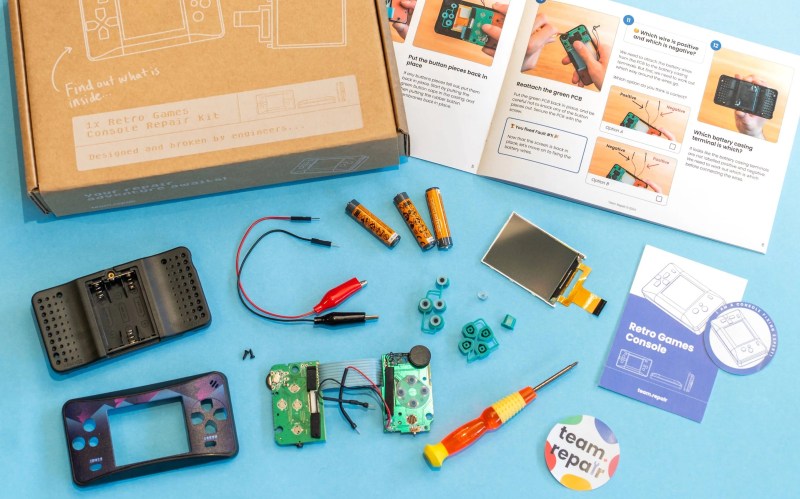
Would you buy a broken device, fix it, then return the repaired item? [Team Repair] hopes you will.
Many people would rather repair what they have than have to get a new device and deal with all the annoyances of shopping and getting used to a new item. The problem is, most people don’t have any experience fixing their broken electronics and are intimidated by the process. [Team Repair] has found that helping people through the process the first time is a big confidence boost, especially when they have a test piece to work with.
[Team Repair] started with workshops and now has a “Fixers Club” subscription box for 8-14 year olds where they will send a broken device every three months to fix. After the device is repaired, it gets sent back into Team Repair, or iFixit in the US, to be broken again and sent to the next fixer. For grownups, there is a similar smartphone repair kit, but it’s currently waitlisted. If you’re in the UK, they even have a classroom program if you want to recruit larger groups into your fixer corps.
Curious about other ways to get into repairing your own things? We don’t recommend starting with smart rings, but learning analog repairs like zippers or turning a laptop into a desktop could be good places to start?












With more than 50 years of hands‑on experience, an engineering degree, and dozens of tools, screwdrivers, measuring instruments, lubricants, adhesives, and hundreds of repairs, I still believe it’s nowhere near as easy as those TV journalists always try to make it look.
I do have to wonder, breaking a device in such a way that it’s repairable and interesting and “normal” requires manpower with knowledge and skill, unless you just smash the screen of a smartphone every time.
I just mean, that aren’t there enough broken devices to fix, so you don’t need to break repaired devices?
If you break it in a controlled way, you are sure that it can be repaired by people with little experience, limited tools, etc and you can supply the help to do that specific repair. That motivates people to try and repair other broken things and continue with random broken devices.
Currently typing this message on a computer made up of:
– $10 ebay MSI X570 motherboard, came with a bunch of cut traces & knocked-off components, and a huge gash at the edge of the PCB that went thru all 8 layers
– $20 ebay 750W Corsair power supply that was inop because of one failed 330uF capacitor
– $30 ebay Ryzen 3700X that was sold as ‘not working/no POST’ but worked the first time I tried it
– $70 ebay RTX 3070 that had a shorted GPU core, swapped the core from another board with really bad PCB damage
– $30 ebay Ballistix DDR4, 4x8GB. 2 were originally DDR4-3000 & 2 were 3200. One of each pair were inop but both worked after cleaning the contacts with pencil eraser + alcohol. Both pairs were the same PCB, with the same ICs, and all would run stable at the 3200 kit’s timings, so I edited and reflashed the SPDs so they all match now. (https://github.com/integralfx/DDR4XMPEditor)
– $12 ebay CoolerMaster AIO, sold as ‘parts only/not working’ because someone robbed the stock fans out of it, but the cooler itself had never been installed on anything
I’m staying far away from any cheap-but-dead parts that need DDR5. I’m not that stupid.
I like your style. Curious as to the stability of the entire platform — I’d bet with all that TLC it is pretty darn good.
Stability is great! Except… this MSI board is one with a famously terrible VRM design, and it WILL NOT run a 16-core 5950X at full load. The 3700X I have in it now is hard pressed to pull more than around 110W and it’s flawless with that one. I can limit and then progressively raise the 5950’s power draw, and the board starts acting up (‘clock stretching’) at about 120W. If not limited it doesn’t crash or anything, it just dumps the clock speed into the toilet until the load is removed, and then goes back to normal.
I’ll probably never know if that’s a quirk of every X570 Gaming Edge board with this VRM, or just this specific board.
p.s. The MSI X570 Gaming Plus is the same PCB, same everything, just different cosmetics. The X570 Tomahawk is the complete opposite of both, as it has what’s thought to be one of the most capable VRMs of all the AM4 boards. I have one of those too, just not repaired yet – the VDDP voltage has gone missing so it’s a no-POST, but I will get around to fixing it one of these days.
The humble eraser never gets the credit it deserves!
Shorted GPU core repaired, you mean dwapping the GPU IC??
Yes. Stencils are available for just about any BGA chip that is worth replacing. It’s just solder. Smaller ICs like memory are generally low enough pad count that you can place the balls individually by hand, if it’s a package you don’t need to do four times every day. If it’s like your real job or something where you fix other people’s stuff for money that’s different.
Yes I inow that but reballing a modern GPU IC is a major undertaking especly not screwing it up by shorting 2 balls together.
Use the right flux; typical to use one flux for wicking/cleaning, and a different one for the actual reballing. After wicking, if some of the pads are shiny but some dull, you have to change something about your process. A wash in oxalic acid can be really helpful prep. Scrub with Barkeeper’s Friend powder and a 1″ chip brush with the bristles trimmed to about 3/8″/10mm long. After washing the parts need to be completely dry or you will get popcorning when the parts are heated for the reflow, and I have never seen a case where any amount of popcorning wasn’t 100% fatal. After washing/drying, re-tin with 63/37 and wick it again.
If a chip is especially dense, another tip is to use smaller solder balls that what it ‘should’ use. 0.35mm instead of 0.45 for instance. If you have the right flux and the right prep you shouldn’t need to do that though.
The real pros (not me) who do the high end stuff like 5090s, with extremely large ICs near double the size of my little toy 3070, they will commonly use different size balls on different sections of the chip to compensate for a less than perfectly flat PCB. That’s why they are the pros and I’m just a DIY hack goofball.
Yep you have won this round, that’s quite a Frankenstein machine
Excellent idea! Let’ project it onto larger things.
Average car comes with things broken, new ones – maybe not, but used ones are, and some cars are just plain trash with so many parts half-broken, it is not worthy bothering, yes, even those that came of rentals.
Average house, rental, owned, etc ALWAYS has something that’s broken or about to break, or half-broken but holding on, etc etc.
Plenty of things to take a closer look, economies, etc.
For that you need someone like my dad around (he’s since passed it on to me) who is always shambling around and muttering and looking for odd things to fix. The shambling muttering fix-it guy is what keeps most things together long-term, and if you get rid of him then there will be a delay of a decade or so where people are glad to not hear the muttering, but then the place rapidly falls apart at the seams.
Sounds like every major-corporation IT shop I’ve every worked at.
Btw, wouldn’t this be a viable business modell; buy a limited catalogue (you have the tooling for) of broken things for cheap off Ebay/Amazon, repair them, sell them for 90% original price? Are there companies that do this?
edit: maybe not in Europe, but especially Asia with cheap labor, instead of creating counterfeits?
The word of the day is:
“refurbished”
Amazon recently started selling certified refurb (specifically found when looking at Snowball ICE Microphones). Now, knowing Amazon and there practices, this is to make sure that either they’re selling new junk or hastily refurb’d old junk for almost the same cost, but it answers your question.
Ordered one of these for my 11-yro, we’re in the US. Got it done in 10 minutes. And I’m not seeing how we can send it back? Not worth the $30 imho