
Back in the early 1980s when 8-bit home computers became affordable educational toys for children, the traditional paper publishing industry did its best to keep up. For a few brief years, there were children’s books dedicated to the innards of a computer in meticulous detail, and courtesy of [Jason Jacques] we have a chance to look at one of the lesser-known ones.
The British publisher Ladybird made a series of four computer books, and while the first three had content for both the Sinclair Spectrum and the BBC Micro, the last in the series only featured the BBC. [Jason] took that book and re-imagined the missing Sinclair Spectrum version.
The surprise is how deep it dives into the architecture of an 8-bit computer, and it’s refreshing to see something that’s not unduly dumbed-down for kids. We’re guessing that this would have appealed to the 5% of kids who ran with their computers rather than just playing Jet Set Willy back then, and we’re sure a few grown-up 50-somethings may remember it or books like it.
If you think you may have seen Ladybird books here before, it may be because we reviewed another influential tech book of theirs for kids. Meanwhile you can take a look at the contemporary computer books from their arch-rival Usborne.












As a child I always found those block diagrams and buses drawn with thick arrows too abstract and confusing.
I guess if the concept of a computer was presented directly, as a schematic, with real chips and connections, it would be so much easier to grasp for my younger self.
Anyway, due to being born in a wrong part of the world at the wrong time my childhood books were mass produced, cheap popular science trash of the early 1990s, translated by people who didn’t care*. My clueless working class parents were of no help either.
If you’re wondering how clueless they were… here’s an anecdote. When I completed one of the first stages of Super Mario Bros for the first time on our brand new and VERY EXPENSIVE Famiclone I saw a “Thank you Mario! But our princess is in another castle!” message. Since I was a tiny child and didn’t know a single word of English, my parents tried to help. They thought exclamation mark was some sort of a lightbulb and wondered what could it mean. Seriously. Also, for a long time we were all too afraid to press “Reset” button because of a superstition that the data would disappear.
Only as an adult I finally had the chance of reading gems such as Code – The Hidden Language of Computer Hardware and Software by Charles Petzold (yes, that guy who worked on WinAPI and other big parts of Windows).
* Would you? At the time typical monthly wage of a PhD was something like $70 and it was considered upper class. Emigrate to the Netherlands to pick tubers or potatoes and you could easily earn 10x as much.
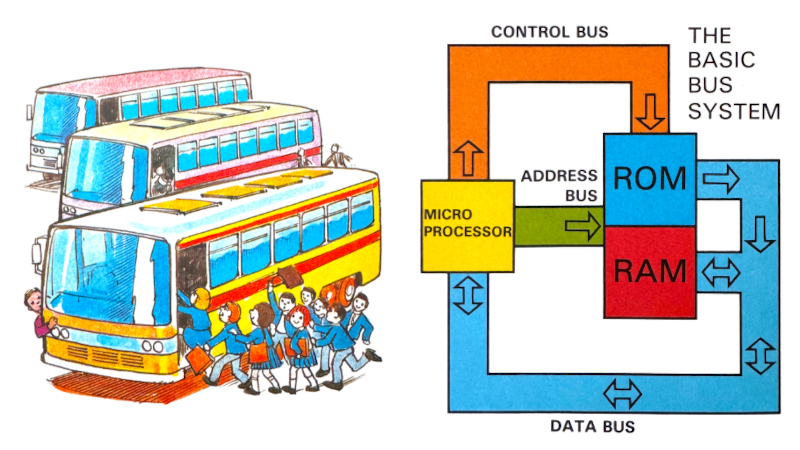
I thought the use of an actual bus image in the book was a bit odd, and I don’t think it necessarily helps explain what is going on. A slightly more detailed explanation and illustration is on the next page, 21. Though to be honest, I didn’t pay it much mind in my youth!
However, other than two 74LS157 multiplexers and an LM1889 video modulator, there really weren’t that many more chips on the first ZX Spectrum (see page 14). Even on “proper” schematics it wasn’t uncommon to use large arrows to represent bussed connections.
I also grew up in the 1990s, so these books and machines they referred to were all quite old by the time I got hold of them. None the less, at school I found myself gravitating towards the BBC computers with their strangely alluring BASIC prompt over their successors (e.g. Acorn Archimedes, RISC PC). It was only when my school got an Internet connection that I seriously took an interest in the new suite of RM PCs running Windows 95.
On reflection, it’s neat that I’ve been able to close the loop somewhat by bringing one of the books that so inspired me to the web.
Block/flow diagrams represent the relationship of the parts as a whole, as a map. They don’t explain what’s actually going on. The question is, are you explaining the concept from top down, or bottom up? The book does explain that a “bus” is a bunch of parallel wires carrying binary numbers on the next page, and that’s about as much as you need to know at this level.
The challenge is that you need to understand a lot already in order to understand the full circuit diagram, but most people are put off by having to read pages and pages of easily forgettable details until they finally reach the “big picture”. Curiously enough, people on the spectrum tend to be the opposite: they focus on the details and find them very interesting, and memorize them to the point that the system diagrams in the last pages become somewhat unnecessary because the concept is already understood.
That’s why a lot of technical documentation and educational materials written by engineers are very dry reading and not immediately informative – unless you read it in reverse order. It’s “info-dumping” and trying to cover all the bases, assuming that you want and need to understand all the details before you can fully appreciate the whole. The more “allistic” reader would prefer to zoom in rather than out, because they aren’t interested in cramming in a lot of information without knowing what they’re getting into and what part of it is relevant.
You can kinda see what sort of person composed this book as well. It spends 13 pages explaining how to count in binary, hexadecimal, etc. before finally beginning to introduce what’s actually in the computer and how it is organized. If I were to write this book for myself at a younger age, I would start with the system description first and then explain how it works, so I would know why it applies and why I should pay attention. Otherwise I would be confused by a book that claims to show how a computer works but actually launches into teaching arithmetic: “boooooring…”
As a side note, there’s also the “pedagogical” textbook version, written by trained teachers instead of technical people. They tend to replicate the structure of their education, which starts with a meta discourse about things like learning outcomes and structured engagement, goals and strategies etc. It’s supposed to let students know what they’re supposed to be doing and motivating people, but it’s actually just delaying the point and adding a lot of fluff.
Which isn’t helped by the fact that textbooks are written to sell textbooks to schoolkids, so they’re made to be pretty sparse of any actual information. That way you can split one book into twelve.
Understandable, I think.
I think that’s either a) because the authors born in an analog world themselves needed that analogy to grasp the concept or b) highly underestimate children’s mental capacity.
The latter is something that varried largely among households/patenting styles or countries, I guess.
Children surprisingly can comprehend abstract concepts if they had been raised in a way that suits them individually.
Or if they are simply being talked normally to, as if they were adults, too.
It’s surprising how quickly children develop for the better if they feel being taken seriously.
That’s how I learned about electronics, by the way.
My dad simply explained me things in a few, but clear sentences.
Without using weird, made up analogies.
That’s what the manual in my first electronic construction kit (age 6 up) did, though.
Then my father explained me what these symbolic analogies are for.
That they are made because they basically think their readers have a low IQ.
He didn’t say that literally, but reading between the lines it was obvious.
It’s easy to teach just the facts, that A is B, and when put together with C, it results in D. No analogies, no “why” only “how”. Children especially, if you can hold their attention, will soak up this sort of stuff like a sponge.
The problem with that is that it teaches a “magical mindset” where people rely on formulas and recipes and their understanding of the matter is like repeating a spell. When the facts are understood on a surface level only, the ideas about what anything means can be wildly distorted or nonsensical, but the formula works so it seems to confirm the ideas.
Nobody can directly see what electrons look like, so everyone develops their own personal intuitions about what electricity means and how it behaves. That’s why the analogies and parables exist, not because the reader is assumed to be dumb, but to fill in those blanks before they get filled with nonsense.
I’m designing a new computer, inspired by the machines we grew up with in the 80s and 90s before x86 came along and just kinda sucked.
And I’m endeavouring to really actually stick to making it work like these kinds of block diagrams.
None of that “but this is how it ACTUALLY works because blah blah the real world”
16-bit, 16 registers, 16 OpCodes and a 32-bit address space.
I’m having a lot of fun
Thanks [Jason] for all the hard work!
When I browsed the book online some of the basic listings (e.g on page 4) were cut off, on my old Firefox at least. The PDF works great though, thanks again for sharing.
I missed the Spectrum days, though my school did have a few BBC32s that introduced me to Logo and laboriously typing game listings from books. Articles like these make me trawl eBay looking for more old hardware to add to my collection…
Thanks for the feedback. Trying to keep the layout pixel perfect across all browsers was certainly a pain, and I know I didn’t quite achieve it. However, while page 4 is a bit snug, all the text just about fits on the page on Firefox 152 and 153 on my Mac.
While I certainly get a kick out of typing in the listings, and I strongly recommend having a go, I know it’s not for everyone. The web version is fully interactive. Each listing has a play button (▶) to load the emulator with the program. In addition, every page has an interactive easter-egg to find!
I also have a video walkthrough here, which also briefly discusses the background to the project: https://youtu.be/X_AbsaLh8Ws
This is so cool! Thank you for this utterly nice project! I love it!
The problem on page 4 seems to be a scaling or XY ratio problem. When you play around with page zoom the listing jumps in and out the page boundary.
if you add “line-height: 100%” to the
<
pre> of the program on page 4 it fixes the issue on Firefox for me (140.12.0esr)…
html renderers are weird :D
Thanks for the suggestion. I’ve updated this now!
You’re very welcome :)
If you change page zoom the listing can be seen in full. Strangely at 90 percent or 110%, not 100 :)
I was there in the early 1980s and computers were NOT ‘affordable educational toys’ for most people. Even a ZX80 or 81 for less than £100 was out of reach for most people, and the infinitely better BBC was 4x the price.
I have to agree that suggesting that computers were affordable toys is indeed quite of a stretch.
I was there too, as a kid, and no way that I could afford one from my birthday money. It took several birthdays, Xmas and small jobs (as far as that was allowed for a 13 year old). And by the time I had saved enough, the machine I originally wanted was already obsolete.
Only around 5% of the households in the US/Europe, even in Germany or UK, had a computer in 1980 growing to 15% in 1989. Computer ownership was actually pretty rare until the late 90’s.
Time gilds the memory and affluence clouds the judgement. People who had rich parents, went to rich schools, could freely play around with computers and grew up into adults thinking that everyone did. With their money and connections some went into media and entertainment business, and started propping up a fake nostalgia about the 80’s where everyone was mashing away on a ZX Spectrum or a C64.
Well, “owning” isn’t always a criteria.
Windows 95 was a big event in pop culture in the 90s, for example.
It was influental to users who used DOS, Windows 3.x or any other OS at the time.
In fact, it was known to people who didn’t even own or use a computer.
Sales numbers or other types of statistics are secondary here, thus.
Windows 95 was a big event in the tech culture, but I’m not so sure how much the pop culture responded. As far as I remember of being alive at the moment, I would say it was nothing at all.
It was influential to people who used computers, but in the mid 90’s that was a minority of people.
Besides, many hobbyists were not rich.
The early computer enthusiasts were rather poor, I’d say.
It was the DIY (do-it-yourself) scene that had early microcomputers.
Using a soldering iron was not uncommon among home computer users throughout the 80s.
Teenagers into computers read computer magazines such as, um, Happy Computer.
These magazines had described simple circuits and listings.
These weren’t things for the rich, I think.
Rich people wouldn’t have bothered with DIY solutions,
unless they happened to happen computer fans too.
That’s why it’s a good idea to check period-correct documents of a given time. 🙂
And there are quite a few being archived, gratefully.
Those who are sceptical can buy used magazines at eBay, Amazon etc.
Or at a garage sale, local flea market.
A national public library probably has issues in its archives, too! 🙂
DIY at the working class level is about how to save money fixing a shitty car you own because you have no money to buy a better one, so you can drive to work tomorrow. It consumes your time and energy just to get by. It’s about life’s necessities.
DIY at the middle and upper class level is about hobby projects like building a model train, making vases or learning how to paint to decorate the living room, or picking up BASIC for the ZX Spectrum.
That’s exactly the point. A poor person would never spend that much money on something that wasn’t even guaranteed to work, or have any practical application in their lives. It was a very small niche of people who had both the money and the time, and the physical and psychological energy to invest in these projects besides their actual jobs.
I’m not saying it’s a bad thing: if these people had all been merely rich then the whole thing would have gotten nowhere. It would have stayed as an esoteric hobby. What I’m saying is though, a lot of the early computing history is because people had more money and free time than actual talent or good ideas. Their success was because other people didn’t have the opportunity, so we should be more critical about the actual merits.
@Dude It fascinates me how different our point of views are. 😃
They are often the exact opposite, it seems!
I think our definitions of things do vary quite some a bit, as well.
Might be also because of cultural differences, not sure.
I was raised differently, I suppose.
Anyway, here in Germany families with financial problems did have computers, too.
It weren’t just stereotypical “rich” people, to my understanding.
Unless we use is in a context of a third-world terminology, I suppose.
Then any family that could afford a color TV, a hi-fi stereo and a car was priviliged, of course.
Btw, kids often got the old stuff or got more expensive gifts by their grandparents.
Such as old b/w TVs for their bed room or a computer/console for birthday/christmas.
Some times, siblings had to share such a gift, too.
Game cartridges were quite expensive, though, so kids had owned a small collection
and had to exchange them with friends or they had to rent them at video game rentals.
The home computers were cheaper here, because of obvious reasons..
As for the C64.. The C64 in particular was sold for a long time,
underwent several price cuts and was sold in toy stores and super markets, too.
The ALDI C64 is a popular example here, maybe.
What I would admit used to be considered a “luxury” though was the 1541 floppy drive and the matching 5,25″ floppy disks.
That’s why the datasette was the default medium for so long.
By late 80s, the 1541 and compatible FD drives were considered a standard among C64 users.
Most, err “backup copies” shared on school yard were on floppy by that time.
In the US, the datasette port was gone since the C64 SX portable already, because its relevance obviously was nolonger that high.
In Europe, by contrast, the datasette was still primary medium to many home computer users.
Sadly, I admit. My nostalgia is limited for it. 🙁
I know, and that is the most interesting part! Of course I want to set you straight according to what I understand, but that cannot be sacred without correction by what you understand.
Which was mostly a publicity stunt. The BBC put up a big show about computers so Acorn could sell them, and the government followed with subsides. I believe it was the same thing in Germany. Governments are not that hard to buy and sell, especially when it comes to minor issues like selling video game machines to kids.
About PCs.. By early 90s, the classic PC/XT systems got a big drop in price.
It was because integration of 8-Bit technology has advanced significantly and because 16-Bit software was declining.
8088 or 80286 PCs could not run latest 32-Bit software/games.
That’s when obsolete PCs became affordable on second-hand market.
So poor users had a chance of getting a learning/hobby PC/typewriter.
MS-DOS 5/6 (and Novell DOS 7) and Windows 3.x and GeoWorks still ran on dated 8088/V20/80286 computers.
Something similar happened at the end of CP/M era, I think.
By mid-late 80s, old Z80 computers still found a second life as affordable Turbo Pascal computers.
Students who needed Turbo Pascal 3 could still run the CP/M version to do their “homework”.
Here in Germany, at least. I heard about a few of such stories.
Sounds very specific at at a time when most school children would have passed their exams without ever having any knowledge of computers or programming at all.
How many students were actually involved in this?
Hi, that were poor university students.
The German term “Student” refers to an university student.
In English it seems also to be used for “pupils” (Schüler).
Sorry about not being more clear here. 😅
Turbo Pascal used to be a standard in scientific world or educational world (over herr).
It was considered good for teaching because of its clean structured design or something along these lines.
In the DOS world, TP compiled programs were common until late 90s, I think.
Good question! 🙂
Turbo Pascal 3 was a bit before my time, I’m more familiar with TP6..
I would have to ask my father about early Turbo Pascal versions.
He’s more familiar with 70s computers and CP/M era.
Hi, everything is relative. It depends on our point of view, I think.
A £100 wasn’t much money in a time a real computer used to cost £10.000 to £50.000.
Likewise, an early IBM PC as a complete set running AutoCAD (say 256 KB RAM, CGA or Hercules monitor, 5 MB HDD, 9-pin needle printer, light pen or mouse or digitizer tablet, keyboard etc) was much cheaper than a traditional CAD mini computer for £100.000.
To architects, an expensive £25.000 IBM PC was a bargain, thus. It’s all relative, I think. 🤷♂️
Also, computers were not meant to be “cheap” to begin with, I think.
Not for normies, at least. They were not supposed to have one yet.
That’s why computers were sold in kit form.
To those few weirdos such as electronic hobbyists or radio amateurs.
A broken ZX81 was comparable a broken Gameboy in 1990.
It financially did hurt, but it wasn’t financially fatal. No one had to starve because of it.
It was in price range of other hobby objects.
Such as a model railroard, an r/c car or an entry class tent used for camping.
At the time, 70s and early 80s, computers at large were tools for professionals that paid off after some time of use.
Because they helped making money, basically.
Or fulfilling duties, such as monitoring, regulating etc.
Also, the individual components of the ZX81 used to almost cost £100, I suppose.
The Z80 alone did cost £10 to £15 in 1980 in UK.
Then there’s RAM, second expensive component.
In the UK, 2x 4K-Bit DRAM chips did cost £6 to £10.
An 8K EPROM (UV erasable) did cost £15.00 to £25.00, not sure about a mask ROM.
The ZX81 used defective chips to cut cost, with the bad RAM cells the the addess space being left unused.
That worked, because EPROMs and RAM chips can be cut in half (upper or lower half) by not using all address pins.
Then, there are the proprietary ULA chips that integrated many discrete parts.
Price unknown, but it had to be made especially for Sinclair in large quantities.
With everything added up, such as chassis, keyboard foil and power brick etc. the costs were above £50, already.
That being said, I’m from Germany and not the UK, so I’m not very familiar with your British Pound.
My apologies about that. For my poor English, too! 😅
Not sure if that’s somehow reasuring, but here in W-Germany computers weren’t affordable to many average German families, either (not to say E-Germany).
The C64 was that mass phenomenom that slowly changed it, I think.
It was a pop culture icon, like Windows 95 became in the 90s.
Also, computers were much better accepted in UK and France than Germany of the time.
In the beginning, the average German citizens were afraid about computers or had an aversion against them.
They feared that they would take their jobs.
Office workers excepted, maybe. To them, electric typewriters were already known earlier.
The boring IBM PC type with Hercules/MDA monitor was quiete common, thus (Sirius 1 was first, but quickly outnumbered).
The Commodore PC 10, a near 1:1 functional clone was used at federal insitutions such as Deutsche Bahn, for example.
(Not sure about Olivetti M24, though, btw. Olivetti was popular as a typewriter company here.)
By mid-late 80s, the Schneider PC-1512 and PC1640 were the only kind of “family PC” that was common (Amstrad rebrand).
As a symbol of a family friendly “PC”, I mean. The friendly GEM user interface surely helped.
The Euro PC was another popular PC, but more aimed at home office.
In homes, “home PCs” were not as common as home computers.
The Atari ST with mono CRT was an exception maybe.
In Germany of mid-late 80s it took the role of the Macintosh, basically.
For video games, the various home computers were much more common.
Like in rest of Europe, I suppose.
The Amiga was popular among gamers over here. Especially the A500.
It was the 16-Bit C64 counterpart, basically.
(A1000 was like C128D, rather. Both atracted same user types.
The A2000 was a professional Amigamodel. Maybe the only one ever made.)
Sorry for the long comment, btw! 😅
Told you last time, it wasn’t a mass phenomenon. Only 5% of the population could have ever owned one based on the number of units sold in Germany at the time. It only seems like it was a massive thing because the ownership of computers was concentrated on a certain class who could afford them, who then later became influential people in the media and culture. It’s basically fake nostalgia as far as everyone else is concerned.
Not in your country, maybe.
But the people I have spoken to knew about the C64, even if they didn’t own one.
They had relatives or friends who owned one, saw these home computers in action.
A “Generation C64” does likely exist in Germany, no matter if we like the idea or not.
No, I was using Germany as a reference. Your memory must be tainted by your social class, because there simply weren’t enough C64 computers sold to account for the idea that many people would have gotten familiar with them.
If you were with people who had “friends or relatives” who owned one, that betrays your class because the general probability of owning one was just 1 in 20. Even if one of your relatives did own one, there would be little chance they would actually share it with you. To have a great probability of getting involved, you need to be in the class of people with enough money to purchase one for little reason.
@Dude If you think so, not sure. 🤷♂️
I grew up in a ham radio household with what I would consider a modest equipment.
An aged Sommerkamp FT 277 (Yaesu FT-101), simple wire antennas thrown out of windows, manual tuners..
Many kitchen appliances were from the 1970s, as well, I think.
The ham friends of my father of that time already had transceivers with a CAT interface and a digital frequency readout..
I built a crystal radio from a cheap kit sold in a Penny Markt when I was a few years old, I remember.
We still had a b/w TV in living room up until early 90s, I remember.
It took a while until we got an analog landline over here (’93?).
– There weren’t enough connections available in that city/part of the city.
Again, not sure how to categorize myself here. I remember we had financial issues, too.
You speak of owning particular radio sets that would not have been cheap to own in the 80’s, and my family didn’t own a color TV or a VHS recorder either, let alone any cassettes until the mid 90’s.
In retrospect, it’s interesting to note that having just one or two tapes you could play back was considered valuable at the time.
Maybe there’s a misunderstanding or a different way of defining things? 😟
I’m thinking of the C64 being popular in the contexts of its time, not by today’s standards of people using computers.
The number of computer users or computer owners among families or private people as such was different, of course.
Both procentural and absolute, I assume.
That doesn’t mean, however, that the C64 wasn’t overly popular here.
It must be seen in context of its time, I think.
Just like old prices must be seen with monetary inflation in mind, maybe.
All I can say is that among the existing home computer users at the time, it had a great user base.
And if a non-tech-savy family had to name a computer model,
for example, the C64 was among the first that came to mind.
Because it was publicly well known. TV, magazines, public ads etc.
Mail order catalogs such as Quelle or Otto or Neckermann featured it, too.
For example, in an 1985 Quelle catalog.
At the time, the C64 was still rather new and went for 600 DM (about 300€ in todays money).:
https://www.youtube.com/watch?v=Q9SEl9DexIg&t=270s
(By comparison, it did cost 700 DM in 1983 and 300 DM in 1987.)
So ordinary citizens had learned about it, too, when they went through the pages, at very least.
The predecessor, VC-20, had been adverised as Volkscomputer, even (because of V C).
A refernce to the WW2 “Volksempfänger”, maybe?😰
Irrelevant. It’s not about owning, at all. 🙂
Please stop being such a materialist, man! 😘
It’s about being a “kult” object. A symbol to a generation.
The C64 also was installed in computer clubs, computer shops and in school like enviroments. Such as youth centers.
It even was a price in Micky Maus magazine (C128, more precisely, I think) and other comic magazines.
The C64 also was popular as an example for a computer on TV.
It was shown in many 80s TV shows on ZDF.
Such as “Computerzeit” or “Computer Corner”.
https://www.youtube.com/watch?v=lf2r-TPjwu0
https://www.youtube.com/watch?v=KVbqSb3WwcE
It even was in an Episode of Sesame Street.
https://www.youtube.com/watch?v=G2c1gt4P5bM
Of course, there were many different users of various home computers.
VC 20, Atari 400, 800, ZX81, ZX Spectrum, Amstrad CPC, Sharp MZ, Apple II, Colour Genie, C128 or 16-bitters such as Amiga, Atari ST, various PCs..
Some users merely had a superficial knowledge of the C64, as well.
But that’s not the point (my point) here. 🙂
Or, as as counter argument, we could say that the denial of the C64’s status is a form of history revisionism.
As far as I’m concerned, I’d rather draw my own conclusions based on my own experience with people and old magazines/historic documents of the era.
It’s too easy to be manipulated by nowaday’s view on the matter.
For example, there are people who think that the NES was irrelevant in Germany and are angry about its place in history.
These people often grew up with C64 or any other home computer.
The truth is somewhere in-between, it seems.
The NES did exist in late 80s Germany (traded via Bienengräber) but had a smaller/different user base than C64.
It rather took off in early 90s over here, about same time when the C64 was declining and the Super NES was still new.
That’s when I played on an NES, for example.
So both is half-wrong/half-true, I think.
I forgot, construction kits for kids weren’t exactly “cheap” either.
A chemistry kit, a radio construction kit, a metal construction kit, an electronic construction kit, computer construction kit etc.
They all did cost money. Kids often needed the financial support of their parents or grandparents.
A computer learning kits of the 70s and early 80s were quite limited conputers (4-Bit).
By comparison, a ZX80 or ZX81 offered much more to a similar price.
https://retrocomputingforum.com/t/electronics-kits-training-kits-trainers-kosmos-cp1-computer/2605
For example, the KOSMOS CP-1 (1980 or 1983) was said to have costed 198 to 218 DM (roughly £45 to £50 GBP at the time).
And that’s for a calculator on sugar, basically.
Which was meant ad an add-on to Kosmos construction kits.
It had a num bad and a 7 segment display. No output for a TV set or a monitor.
The datasette interface was an extra add-on (ZX81 had it built in).
https://de.wikipedia.org/wiki/Kosmos_CP1
So yeah, it’s all relative, i think. 🤷♂️
I still remember fondly how I learned to use and program in Basic my Commodore C16+ thanks to a series of magazines structured like a course, and each one had a cassette tape with exercises to run on your computer. I still remember the excitement when I moved my first turtle across the screen. I managed to make it do that, it was incredible. I was 8 years old, can you understand what a revolution it was?