
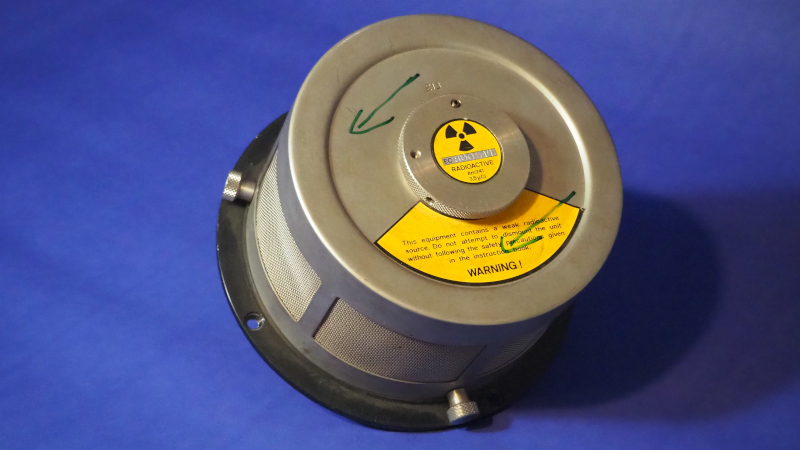
At the 2024 Electromagnetic Field event in the UK, some awkward items turned up at the swap meet: radioactive sources. Fortunately there was [Tryst] at hand, who works in the nuclear industry, so they were safely collected. At this year’s EMF he was back, with a talk about what happened next.
It seems they were an industrial version of the smoke detectors we’ll all be familiar with, containing the same Americium alpha emitters, but in greater quantity. Their path from industry to hacker camp is purposefully shrouded in mystery to avoid future incidents happening because people are scared to come forward, but it seems that but for a bit of post-Brexit regulatory chaos they would normally have been taken back by their Danish manufacturer for disposal.
We’re treated to a fascinating deep dive into radioactive source regulation and just what these sources are. In short, they’re not too dangerous as they are, but what makes them a worry is that they can easily be dismantled and their contents released. Ingestion of alpha particle emitters is a particular worry, so they must be kept safe and accounted for. Which leaves [Tryst] with a set of radioactive sources that sit in a regulatory grey area and can’t easily be disposed of. He ends by asking for suggestions as to how they might be used, of which we favor a true random number generator.
Light-hearted interludes aside, this is a cautionary tale for all of us who delight in digging through technological junk, and we are lucky that our community includes people with the expertise to do something about items like these. The full talk is below the break.












This is yet another item in a huge list of items I can’t dismantle and ingest the contents of without potential adverse effects to my health. Life is so unfair.
They make an excellent source of alpha particles for research, I have a number of these in my lab.
You would have a lot of trouble trying to hurt yourself by ingestion.
Americium is not well absorbed by the digestive system, only about 0.05% of the amount will be absorbed (nih.gov). The amount in a typical smoke detector is about 1 microcurie, which releases about 37000 events per second, so… you would get about 18.5 alpha particles per second from eating one source.
The americium is actually quite thin and embedded inside an indent in a stainless steel button, at the very least only 1/2 (one side) of the americium is exposed to digestion and it’s in an indent, so… you would get less radiation than the calculation above shows. Probably a lot less, given the size of the indent.
(You would have to tear the detector apart to get at the button which requires cutting away a considerable amount of shielding. Not difficult, but physically demanding.)
For comparison, a banana emits about 15 particles per second, and somewhere between 30 and 300 cosmic ray muons pass through your body every second (with variations in altitude and solar activity). If you live in places with a lot of granite, such as NH or Colorado, you might get 1200 particles each day from that, and your basement can collect the radon equivalent of “smoking a pack of cigarettes” each day.
Radiation can be dangerous, but we should take the time to learn about the actual risks before composing public policy. This thing about “Radiation baaaad! We must take care to dispose of these properly” is bad policy – it wastes enormous resources to mitigate a problem that largely doesn’t exist.
Although your body doesn’t readily absorb americium the reverse is true as well. It doesn’t excrete it easily. To get it out of the body you need to take a chelating agent like DTPA to convert it to something soluble in the body so that it can be excreted.
Look up “Harold McCluskey”
“what makes them a worry is that they can easily be dismantled and their contents released. Ingestion of alpha particle emitters is a particular worry”
Wait, the concern is that someone might ingest it? The test for whether something is too unsafe to allow people to have it is if you can eat it or not?
“Ingestion” in this case can also mean inhalation. Alpha emitters in your sinuses is a quick way to have a real bad day. It sounds like the person who had them did not understand what they were holding on to.
Besides, they’re still in private hands. Just trained hands that are aware of the danger and proper handling.
That’s the whole idea of the new game show called “Fatal or food!”. See you in front of your TV set!
Green potato leaves
Green rhubarb leaves
Green lettuce leaves
Choose one! (33.33% chance of making it to round two of the show)
now i want to taste potato leaves to know if they follow the rule that if it’s poison it probably tastes bad
(i know the rule because once my kid reached out and grabbed poison honeysuckle berries and tried to eat them and i didn’t know about it until the noxious taste made him instantly throw up … on my head because he was on my shoulders)
During world war one, the British mistakenly advised their citizens to boil up rhubarb leaves for soup. Many died. Then during world war two the advise leaflets were were redistributed and more people died. Granted you would need to eat quite a bit to die.
This says more about the sorry state of science education these days. There’s a lot of stuff out there that would be harmful if ingested but a reasonably educated person (not just an expert) should know if they can handle the material safely and, if so, what they can and can’t do with it. Unfortunately we’ve replaced common sense and knowledge with FUD.
there are plenty of real-life cases where radioactive sources have wound up in the hands of someone who doesn’t know what he’s got. at a scrapyard, abandoned on the side of the road, cleaning out an old building, any number of paths. they’ve been disassembled and strewn. it’s a real problem, not a hypothetical one. regulation and awareness campaigns both try to achieve something better than “dad knew not to open this box but he’s dead now and no one else knows it’s dangerous” situations.
I actually encountered one of these.
Helping out a friend who runs a recycle place, taking apart some scientific consoles he bought from a lab and inside I found two small bobs of metal to be used in the device that were hard X-ray emitters.
Fortunately these came with documentation and I was able to look them up online, and they had largely dissipated over time (half life in the tens of days, and two years standing in his scrapyard) but for a few minutes it was an exciting time.
Ingestion also means manipulating the source and having dust adhered to your hand, then eating. In nuclear reactors, the danger is even higher because activated dust is everywhere (especially the floor) and you can easily touch that and ingest it eventually. Ingestion doesn’t necessarily mean that someone will confuse the chunk of Am with a candy and chew it lol
The gender thing is a cultural issue, not scientific. That you are either trolling or apparently don’t know this suggests the sorry state of your science.
The man/woman distinction is of a linguistic nature, not a scientific one. Unless you think there’s some law of the universe that associates certain mouth movements with certain biological organisms!
‘Ingestion’ includes inhalation.
There are a LOT of people smart enough to be curious about what is inside these, who don’t have a laminar flow hood.
And you will notice by looking at that picture that the warning are all stickers.
There are plenty of situations that would destroy or remove those warnings.
Without the warnings, even a BASE level of curiosity would result in cracking one open. Something that could easily be accomplished by a child who found this in a basement or attic.
It’s unlikely to cause serious problems as-is, but if it does, the problems are severe enough to warrant a warning.
This was an interesting video. I enjoy stories (and the drama) around orphan sources. My only comment is the level of the Am source. The speaker said that it was about 1uC and was thus might higher activity than a modern smoke detector. I am pretty sure (from multiple source on internet sites) that the typical activity of a modern smoke detector is 0.8uC. If this is true then the orphans in this story were typical smoke detector values and not particularly more worrisome that an average home unit.
Still a good idea to gather them up and store them wisely.
Now if they had been old Pyronics F3 or 5 unit, that is another story. They could carry 80uC (~75uC by now).
Cheers.
Just dispose of them in your normal garbage.
It will be a boon to future archeologists seeking evidence of pre-Apocalyse man. :)
Yeah, lets worry about THAT RARE CASE of an alpha emitter in solid form in an enclosure:
Grok:
Radon gas is the leading cause of lung cancer deaths among never-smokers in the US representing an estimated 12–15% (or roughly one in seven) of lung cancer deaths.
Areas with significant uranium deposits have an issue with it:
It is common on the Colorado Plateau — The expansive region around the Four Corners (where Utah, Colorado, New Mexico, and Arizona meet). This has historically been the heart of U.S. uranium mining, with thousands of mines and significant natural uranium concentrations in the rock and soil. Wyoming — Major sandstone-hosted uranium deposits; it ranks among the top states for known reserves and past/current production.
Czech Republic (and former Czechoslovakia) — One of the historic centers of uranium mining. Key deposits include Příbram (the largest, vein-type, producing ~50,000 tonnes of uranium), Rožná (the last operating mine in Central Europe until 2017), Jáchymov (Joachimsthal, the birthplace of industrial-scale uranium mining in the 1890s), and others in Bohemia and Moravia. Czechoslovakia produced over 110,000 tonnes historically.
Eastern Germany (Saxony and Thuringia) — Extensively mined by the Soviet-East German company Wismut from 1946–1990. Major areas include the Ore Mountains (Erzgebirge) region (e.g., Schneeberg, Niederschlema-Alberoda, Johanngeorgenstadt) and Ronneburg. East Germany produced ~220,000–230,000 tonnes of uranium, making it one of the world’s top historical producers. Mining largely stopped after reunification due to environmental concerns.
Ukraine — Currently holds the largest uranium ore reserves in Europe (estimates around 107,000–187,000 tonnes depending on the source and cost category). Major deposits are in the central Kirovohrad (Kirovograd) region, including the large Novokostiantyniv mine (one of Europe’s biggest).
Was radon the main cause of death of uranium miners?
Yes — radon (specifically its short-lived decay products, often called radon daughters or progeny) was the primary cause of the excess lung cancer deaths among underground uranium miners.
It wasn’t the uranium dust which can be filtered with a mask.
This story reminds me of so-called “Goiânia accident” that happened in Brazil in the 80s. It’s a much sadier story though but certainly a lesson of how negligence and ignorance combined can be fatal. Check out the Wikipedia article: https://en.wikipedia.org/wiki/Goi%C3%A2nia_accident