
Exciting discoveries in particle physics are one of those things that it can be easy to get blase about. Some people get caught up in the obvious excitement, while others yawn: “Oh, you found the Higgs Boson, just like Higgs predicted. Call me when you have something new.” Well, if you’re in category B, prepare to yawn while the rest of us break out champagne, because it looks like we’ve finally found the glueball.
The glueball has got to be one of the oddest particles to fall out of the Standard Model. It’s not a fundamental particle, but its makeup contains no quarks– those itty bits that make up protons and neutrons– nor any leptons like electrons or muons. No, the glueball is a hadron made entirely of bosons: specifically, gluons, the force-carrying particles of the strong nuclear force. It’s also been called gluonium or a gluon-ball, but glueball is more fun.
Try and imagine a proton without any quarks. Remember that inside the proton there are three quarks, held together with force-carrying gluon particles. If you have zero quarks, but enough of those gluons tangled up in the right ways, and you get a tangible, if short lived particle. That’s the glueball, a neutral particle that will decay almost immediatly in to Pions. It works because gluons have ‘colour charge’– the strong nuclear force’s answer to electric charge.
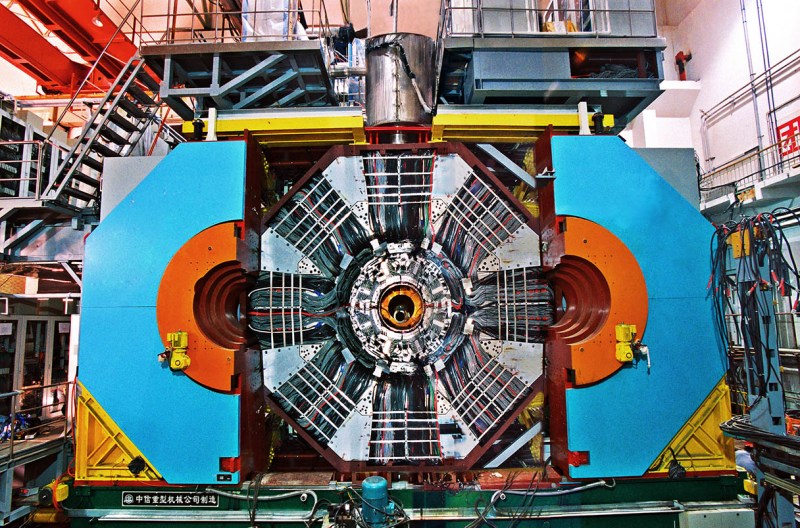
It’s also one of those things that will probably never be seen in nature: odds are, even in the hottest collisions, you’re going to get a quark or two mixed up with your gluon soup. That’s okay; the gluonic state is what we’ve been looking for. As long as the particle is mostly gluons, and behaves as the Standard Model predicts it should, physicists are inclined to call it good enough. The latest candidate to hit “good enough” is X(2370), which fell out of a collision in the Beijing Electron–Positron Collider II (BEPC II), as detected by the Beijing Spectrometer III (BES III). The paper hit ArXiv at the end of July. It’s taken the collaboration this long to make sure of what they were looking at, as they sorted through the terabytes of data an instrument like this generates.
Is this likely to affect you in any way? No. It confirms what we already thought we knew about the universe, and the particle itself is too short-lived to ever exist outside of some very extreme– mostly man-made– environments. On the other hand, it’s an excuse to celebrate scientific discovery, and we’ll take any of those we can, just like when the Muon Magnetic Moment measured in at the expected value, or neutrinos transmuted elements in exactly the way the models said they would. Besides, if we’re really lucky this result will turn out not to be a glueball, but something new and interesting. Then even the most jaded nerds will have reason to celebrate.
Header image: The Bejing III Spectrometer, BESII.












If I ever discover a new element I will name it Goatsium
Still waiting for my order of Unobtainium
its temporary out of stock. but i heard in certain cases you could replace it with voidium.
The universe is increasingly messy and gross the more you look under the hood. I’m happy for the people who find enjoyment in figuring this stuff out, but I personally find it depressing.
Discoveries like this clearly mean we have solved all the other problems, otherwise the smart people would be working on those instead. It’s good news! We’re saved!
Still waiting for some other country to send us money (USA).
Call me when it happens…
Love the explanation of gluons vs quarks—very clear. Now the real question is: how sure are we about the nature of X(2370)
Only 90%, which is hardly a slam dunk in particle physics.
China mentioned so suspect until verified by another collider. It may just be propaganda.
Isn’t that usually reserved for ‘oldest hominid’, ‘first feathered dinosaur’, etc…
Gluons are gauge bosons, not baryons.
Huh, I could have sworn I wrote boson. Write in haste, repent at leisure, I suppose. Thanks for catching that.
So the Crazy Glue particle.
What’s it’s mental state got to do with it…
and still we are naming this “particles”, while in reality these are all exitations of wave fields. when we strike the wave fields harder and harder, we will always find new resonances that we call new “particles”. Nothing groundbreaking.
Probably because it’s easier to stick with the established nomenclature than trying to convince a world full of particle physicists to refer to the phenomenon as a ‘Wave Field Resonance’.
And that’s before you consider the fact the English is a second or even third language for most of them.
The criticism isn’t completely off-base: the issue is that we don’t call hydrogen in an excited state a new atom, so why do we call particles in excited states new particles? Because that’s basically what, say, the delta-plus is: an excited proton.
But it’s not actually nomenclature: the difference is that when you excite an atom, you’re really only changing what an electron is doing. The rest of the atom stays basically the same. And that’s not true for stuff like the delta-plus: because even though particle physics says “a proton is two ups and a down” that’s only really the “leftover” part – the majority of the hadron itself (its energy) is an overall mess of strongly-interacting particles. And that content changes significantly between, say, a proton and a delta-plus.
The downside is that you end up with a basically-infinite number of particles, but hey, that’s life.
Because they are?
If you want to be pedantic (which is fine) ALL interactions are waveforms including everything we associate as “physical”.
There is no ‘stuff’ in the pure sense.
If we are going to bother defining anything as physical ‘stuff’ then we have to include all the ‘stuff like’ things.