Sometimes, a major discovery is exactly what you were hoping not to find. That’s the case with a team at Penn State who seem to have recently closed the door on any new physics stemming from a longstanding discrepency in the magnetic moment of the muon. It turns out, the model was fine, and we just needed better calculations.
The Muon is a heavier cousin to the electron. Like the electron, it has an intrinsic magnetic moment, but the traditional methods to calculate it did not quite match experiments, which was very exciting because it made us hope our models could be improved. Rather than try the traditional approximation methods for the unsolvable equations, the group at Penn State set up what you can think of as the Quantum Chromodynamic equivalent of a Finite Element Model (FEM) simulation–a grid of discrete steps in space and time. Tiny ones, of course, because the muon, like the electron, is a point-like particle with no lower size limit. In any case, according to their paper in Nature, after a decade of refinement and increasingly expensive supercomputer runs, the mystery can be put to bed. Instead of the discrepancy that so exited physicists 25 years ago when it was first found, theory and experiment now match to 11 digits, or a 0.5 sigma discrepancy, if you prefer.
Statistically, the Standard Model works– and that kind of sucks. It sucks, because it’s the gaps in the model where new physics are possible, and everyone has been pushing at those few gaps for the last 50 years to try and find what might be behind the standard model. Even [Zoltan Fodor], the principle investigator behind this project, is sad to see it work out. Sure, it’s a feather in his cap to get the calculations right at last–but ask anybody in the field, and they’d rather keep the door open to new physics than be right. We were certainly hoping it was something novel, last time the topic came up.
You might think muons are the last thing a hacker would ever encounter, but since there’s a steady rain of them from the sky in the form of cosmic rays, it’s not only easy to interact with them, you can actually put them to practical use– like muon tomography, or navigation indoors and underground.
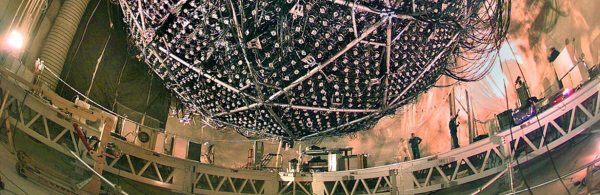
Once upon a time, transmutation of the elements was a really big deal. Alchemists drove their patrons near to bankruptcy chasing the philosopher’s stone to no avail, but at least we got chemistry out of it. Nowadays, anyone with a neutron source can do some spicy transmutation. Or, if you happen to have a twelve meter sphere of liquid scintillator two kilometers underground, you can just wait a few years and let neutrinos do it for you. That’s what apparently happened at SNO+, the experiment formally known as Sudbury Neutrino Observatory, as announced recently.
The scinillator already lights up when struck by neutrinos, much as the heavy water in the original SNO experiment did. It will also light up, with a different energy peak, if a nitrogen-13 atom happens to decay. Except there’s no nitrogen-13 in that tank — it has a half life of about 10 minutes. So whenever a the characteristic scintillation of a neutrino event is followed shortly by a N-13 decay flash, the logical conclusion is that some of the carbon-13 in the liquid scintillator has been transmuted to that particular isotope of nitrogen.
That’s not unexpected; it’s an interaction that’s accounted for in the models. We’ve just never seen it before, because, well. Neutrinos. They’re called “ghost particles” for a reason. Their interaction cross-section is absurdly low, so they are able to pass through matter completely unimpeded most of the time. That’s why the SNO was built 2 KM underground in Sudbury’s Creighton Mine: the neutrinos could reach it, but very few cosmic rays and no surface-level radiation can. “Most of the time” is key here, though: with enough liquid scintillator — SNO+ has 780 tonnes of the stuff — eventually you’re bound to have some collisions.
Capturing this interaction was made even more difficult considering that it requires C-13, not the regular C-12 that the vast majority of the carbon in the scintillator fluid is made of. The abundance of carbon-13 is about 1%, which should hold for the stuff in SNO+ as well since no effort was made to enrich the detector. It’s no wonder that this discovery has taken a few years since SNO+ started in 2022 to gain statistical significance.
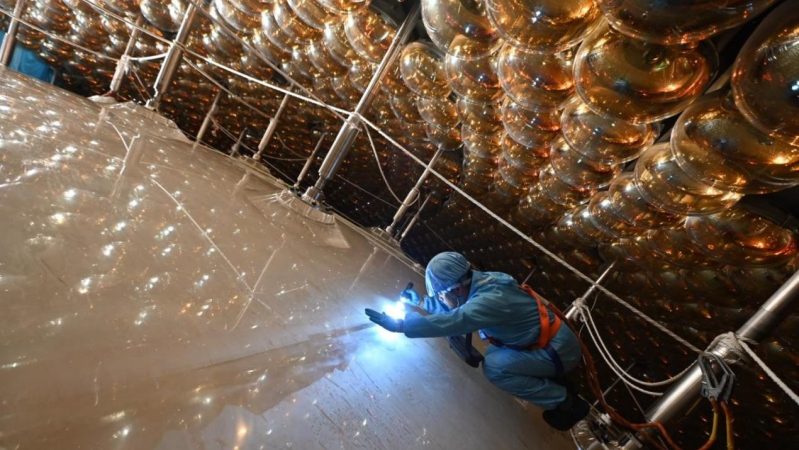
To say that neutrinos aren’t the easiest particles to study would be a bit of an understatement. Outside of dark matter, there’s not much in particle physics that is as slippery as the elusive “ghost particles” that are endlessly streaming through you and everything you own. That’s why its exciting news that JUNO is now taking data as the world’s largest detector.
First, in case you’re not a physics geek, let’s go back to basics. Neutrinos are neutral particles (the name was coined by Fermi as “little neutral one”) with very, very little mass and a propensity for slipping in between the more-common particles that make up everyday matter. The fact that neutrinos have mass is kind ofweird, in that it’s not part of the Standard Model of Particle Physics. Since the Standard Model gets just about everything else right (except for dark matter) down to quite a few decimal points, well… that’s a very interesting kind of weird, hence the worldwide race to unravel the mysteries of the so-called “ghost particle”. We have an explainer article here for anyone who wants more background.
Neutrinos are some of the most elusive particles that are well-known to science. These tiny subatomic particles have no electric charge and an extremely small mass, making them incredibly difficult to detect. They are produced in abundance by the sun, as well as by nuclear reactions on Earth and in supernovae. Despite their elusive nature, scientists are keen to detect neutrinos as they can provide valuable information about the processes that produce them.
Neutrinos interact with matter so rarely that it takes a very special kind of detector to catch them in the act. These detectors come in a few different flavors, each employing its unique method to spot these elusive particles. In this article, we’ll take a closer look at how these detectors work and some of the most notable examples of neutrino detectors in the world today.
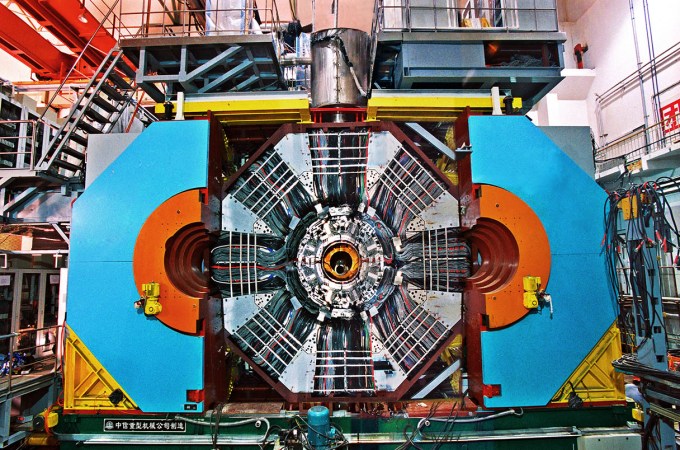
Particle physics is a field of extremes. Scales always have 10really big number associated. Some results from the Large Hadron Collider Beauty (LHCb) experiment have recently been reported that are statistically significant, and they may have profound implications for the Standard Model, but it might also just be a numbers anomaly, and we won’t get to find out for a while. Let’s dive into the basics of quantum particles, in case your elementary school education is a little rusty.
It all starts when one particle loves another particle very much and they are attracted to each other, but then things move too fast, and all of a sudden they’re going in circles in opposite directions, and then they break up catastrophically…
Can I just say that doing a links roundup article in a week that includes April Fool’s Day isn’t a fun job? Because it’s not. I mean, how can you take something like reports of X-rays flowing from Uranus seriously when they release the report on such a day? It sure looks like a legitimate story, though, and a pretty interesting one. Planets emitting X-rays isn’t really a new thing; we’ve known that Jupiter and Saturn are both powerful X-ray sources for decades. Even though Uranus is the odd child of our solar system, finding evidence for X-ray emissions buried in data captured by the Chandra observatory in 2007 was unexpected. Astronomers think the X-rays might be coming from Uranus’ rings, or they might be reflections of X-rays streaming out from the sun. Or, it might be the weird alignment of the gas giant’s magnetic field causing powerful aurorae that glow in the X-ray part of the spectrum. Whatever it is, it’s weird and beautiful, which all things considered isn’t a bad way for things to be.
Another potential jest-based story popped up this week about the seemingly impossible “EmDrive”. It seems that when you appear to be breaking the laws of physics, you’re probably doing it wrong, and careful lab tests showed that fuel-free propulsion isn’t here yet. One would think it was self-obvious that filling a closed asymmetrical chamber with microwaves would produce absolutely no thrust, but EmDrive proponents have reported small but measurable amounts of thrust from the improbable engine for years. A team at TU Dresden found otherwise, though. Even though they were able to measure a displacement of the engine, it appears to be from the test stand heating up and warping as the RF energy flowed into the drive chamber. By changing the way the engine was supported, they were able to cancel out the dimensional changes that were making it look like the EmDrive was actually working.
Want to use surface-mount parts, but don’t want to bother spinning up an SMD board? Not a problem, at least if you follow the lead of David Buchanan and perform no-surface surface-mount prototyping. We stumbled upon this on Twitter and thought it looked cool — it’s got a little bit of a circuit sculpture feeling, and we like the old-school look of plain 0.1″ perfboard. David reports that the flying leads are just enameled magnet wire; having done our share of scraping and cleaning magnet wire prior to soldering, we figured that part of the build must have been painful. We pinged David and asked if he had any shortcuts for prepping magnet wire, but alas, he says he just used a hot blob of solder and a little patience while the enamel cooked off. We still really like the style of this build, and we applaud the effort.
Speaking of stumbling across things, that’s one of the great joys of this job — falling down algorithmically generated rabbit holes as we troll about for the freshest hacks. One such serendipitous was this YouTube channel documenting a really nice jet engine build. We’ve seen plenty of jet engines before, but very few with afterburners like this one has. There’s also something deeply satisfying about the variable-throat nozzle that Praendy built for the engine — it’s a level of complexity that you don’t often see in hobbyist jet engines, and yet the mechanism is very simple and understandable.
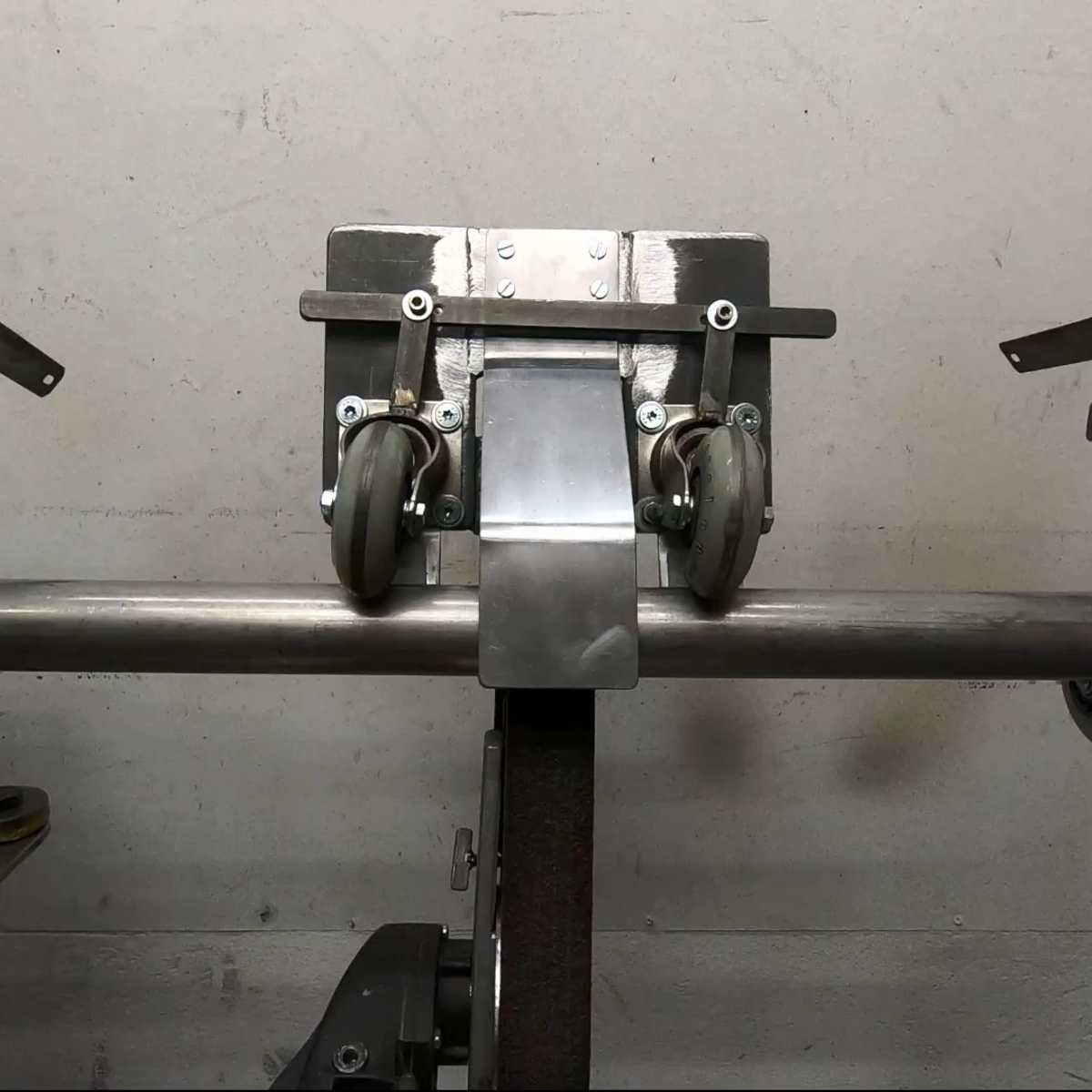
The other rabbit hole we discovered was after reporting on this cool TIG tungsten grinding tool. That took us into The Metalist’s back catalog, where we found a lot of interesting stuff. But the real treat was this automatic tube polisher (video), which we have to say kept us guessing up to the very end. If you’ve got 12 minutes and you enjoy metalworking builds at all, watch it and see if you’re not surprised by the cleverness of this tool.
And finally, we had heard of the travails of Anatoli Bugorski before, but never in the detail presented in this disturbing video. (Embedded below.)
Who is Anatoli Bugorski, you ask? He is a Russian particle physicist who, while working in an accelerator lab in 1978, managed to get his head directly in the path of a 76 GeV proton beam. Despite getting a huge dose of radiation, Bugorski not only survived the accident but managed to finish his Ph.D. and went on to a long career in nuclear physics. He also got married and had a son. He was certainly injured — facial paralysis and partial deafness, mainly — but did not suffer anything like the gruesome fates of the Chernobyl firefighters or others receiving massive radiation doses. The video goes into some detail about how the accident happened — two light bulbs are better than one, it turns out. We enjoyed the video, but couldn’t stop thinking that Bugorski was the Russian atomic-age equivalent of Phineas Gage.