
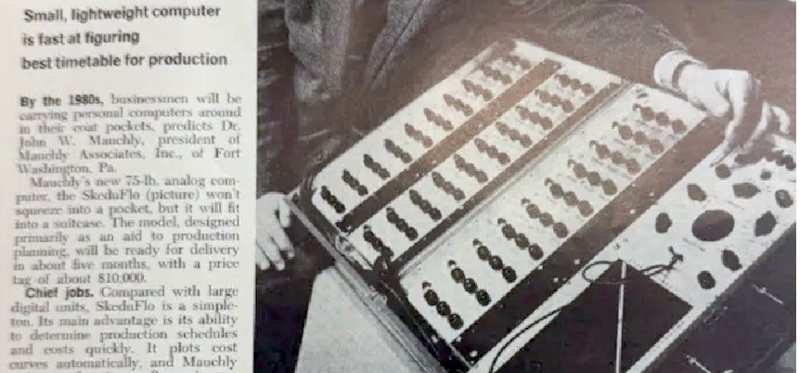
If you ask a random person who [John Mauchly] or [J. Presper Eckert] were, you’d probably get a blank stare. Ask a Hackaday reader, and you have a better shot. People who know will tell you that the two were behind the famous ENIAC, which may or may not have been the first computer, but was certainly influential in kicking off the modern computer era. They worked at Penn, and now [Holly Mengel] of Penn’s Kislak Center for Special Collections, Rare Books, and Manuscripts wants to introduce us to the other computers they worked on after ENIAC.
We will admit that we knew about EDVAC and UNIVAC. But we’ll also confess we didn’t know about BINAC or Skeduflo, a computer in a rather large suitcase. BINAC can claim to be the first digital computer that was commercialized, although you could argue that since it was fairly limited and, reportedly, never worked after it was delivered. Supposedly, the customer disassembled it, shipped it to a secure facility, and hired a freshly graduated engineer to rebuild it, which didn’t go very well.
We couldn’t find much about Skeduflo, other than that it was a 75-pound analog computer made for critical path method (CPM) analysis. You set up the problem with a patchboard and potentiometers, and the result came out on an analog plotter. Those details are from a PMI interview with [Morgan Walker] and [Jim Kelley].
It makes sense that these inventors didn’t just finish off ENIAC and retire to a tropical island. While UNIVAC had a good bit of success and EDVAC was very influential, the others are arguably fairly obscure. UNIVAC even has a Disney connection.












Although the Manchester Baby (1948) has the distinction of being the world’s first electronic stored-program computer, the Eckert-Mauchly Computer Corporation BINAC (1949) was the first machine of this type that could have been used meaningfully had it survived delivery to Northrup Corporation. The Manchester Baby used Williams Tube Memory as its main storage, a random access storage device that stored information on the faceplate of a cathode-ray tube. The BINAC used mercury delay lines for its main storage, a serial device that stored information as a series of ultrasonic pulses in mercury filled tubes.
Both storage methods were notoriously unreliable. They quickly became obsolete and were replaced by the more reliable magnetic core memory in subsequent machines.
Yes, the UK National Computer Museum (or whatever it is called; next door to Bletchly) has some great stuff about these machines. I used to correspond with Dr. Wilkes about EDSAC and always had in mind to do a faithful FPGA reproduction but never got to it. I did have a great long conversation with one of the guys at the museum who was working on getting the EDSAC replica running. They were not, though, using actual delay lines although they had one there for effect.
I misspelled Northrop, mea culpa. Some interesting BINAC references:
https://s3data.computerhistory.org/brochures/eckertmauchly.binac.1949.102646200.pdf
https://www.cs.drexel.edu/~bls96/eniac/other/binac_manual.pdf
Al Williams, for my own amusement, I’ve implemented sections of the IBM 701 in Verilog for FPGA emulation. I say emulation because FPGA’s don’t really like asynchronous logic, so I worked out a way of emulating it using synchronously clocked logic.
The newspaper article is correct, by the 1980s, businessmen were carrying “personal computers” in their pockets, assuming calculators and note-taking or similar “pocket computers” of the era counted as personal computers. Laptops running DOS were much more than a “new thing” by 1989. There was even a Mac laptop.
Why is this tagged with Penn State? Don’t you mean U. Penn ?