
When it comes to 3D printing in the FDM world, you can go a long way just relying on standard settings that ship with your 3D printer and/or slicer. If you want to push the limits, though, it pays to better understand the hardware and materials you’re working with to know what you can get away with. To that end, [Robert Samples] put together the MeltCalc database to help.
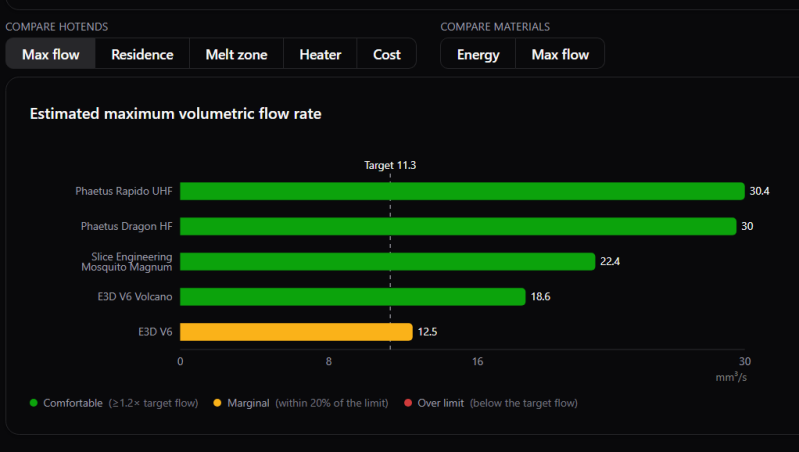
The purpose of MeltCalc is simple—it collates data on hot ends and materials regarding factors like maximum flow rate, print speeds, and heater requirements. If you’re wondering whether a given hot end can flow a given filament at a given rate, for example, this tool is a great place to start. It features 64 different hot ends and 36 polymers typically used in the 3D printing world, and can spit out maximum flow rates and print speed estimations even accounting for fancy tech like Core Heating Technology (CHT) nozzles. It’s all based on thermodynamic modelling which [Robert] put together based on his experience as a chemist who works with polymers. His aim was to provide a tool with realistic flow rates for hot ends, so that end users don’t have to just rely on often-optimistic marketing numbers.
For those eager to dive deeper into the code and modelling, the project source is available on Github. We’ve featured all kinds of other useful hacks in this space lately, too, like our recent look at how to achieve wave overhangs. If you’ve got your own nifty 3D printing tools in the works, don’t hesitate to notify the tipsline.












No J-Head MKVB on the list? What shame…
I bet you can submit data and get it added. It’s on github. Just open an issue and label it a feature request or something.
Robert (site creator) here I definitely do want people to submit hotend melt zone length measurements either by creating a PR on the github or just creating an issue and listing the base hotend specs and I can update the database with your numbers!
Was gonna make the same complaint. Another user-submutted database that only works if everyone uses it, and has no duration, so it will have a ton of duplicate and incorrect entries.
*curation
Users submit entries to my by GH issue or make a PR with a database change and I merge the new entries so it is curated and checked for accuracy
and as a note everything works based off the length of the heated portion of the heat block/melt zone so values are downstream of an objective numbler and the flow rates are extrapolated using a thermodynamic model of each material
Stop the presses:
“Novel Plastic Turns Into A Gas When Heated, Then Reforms Once Cooled”
https://phys.org/news/2026-08-plastic-gas-reforms-cooled.html
Wow, no need to be so rude. Neither the database developer, the author of this article, who both try to contribute something to the community and for free to boot, deserve such low effort, non-constructive feedback.
I just ask AI to create me a custom JSON for whatever filament and machine I’m using.
Curious how convergent with real world experience this modelled approach will end up – the filaments are full of unknown additives, the nozzles less than perfectly made/worn/contaminated, the thermal regulation of hotend/bed/chamber etc, its a complex problem to really get right from calculations alone. Don’t get me wrong though I like the idea behind the project and it should at least be a reasonable sanity check so that first print hopefully works well enough.
Thanks for the thoughts! Long reply with some of the technical details-
I’ve found it to be pretty convergent with expectations but you are correct additives and filament brand will change quite a bit. The flow calculations will also change a bit per hotend based on how well they couple the heater to the filament path. Another big factor is the extruder, with a powerful extruder you can still push semi-molten material out but it will have poor layer adhesion. I have only really considered vanilla base polymers, once you get into stuff like HF-PLA you get weird additives starting to come into play. PC is also hard because a large fraction of the stuff on the market undergoes semi- or undisclosed- blending with PETG or ABS (sometimes you can get hints as to how much from the MSDS).
In practice wear on the nozzle and contamination of previous filament wont affect much as most material is scoured from the melt zone quite effectively and heat transfer within the polymer tends to dominate so doubling the thermal conductivity of heat block (eg going from aluminum to copper) only nets you a small increase in flow.
The chamber bed etc are somewhat independent of the hotend the model assumes the use of a sock and sufficiently powerful hotend heater however there is one caveat where this applies. The place it does affect things is on high temp crystalline polymers where the cooling speed and layerbonding bottlenecks you so I give the theoretical melt capacity of the hotend in addition to a derated reasonable value when you are looking at something like PPS for example. The theoretical value should be close to what the hotend is actually capable of doing based on the thermodynamics and energy required, but its not something anyone should actually print at unless you are doing something crazy like using an industrial pellet extruder.
TBH in my mind its not really a substitute for doing a max flow rate test and temp tower on a new material, I see a lot of the value in understanding comparatively what the top end on different materials is roughly, and also in understanding which hotend to buy. Its very hard to parse what the real price/performance difference will be when you only have the marketing numbers. Like microswiss advertises 50 cubic flow on their flowtech hotends but they are very short printing perspective did a video with real testing and showed layer adhesion drops at 21.4 cubic for the flowtech CHT with failure somewhere above that. My model still overestimates flowtech a bit but its much closer to when it would actually fail relative to his numbers, but its still than the advertised number. Giving the consumer more complete info to answer the “Is this thing really work $85 to me” question is what I’m hoping for.
Excellent answer, and at informing the consumer the marketing is/isn’t BS this should be more than adequate.
Though I think you overestimate just how quickly a nozzle can be cleaned of containments – its certainly not a never happens (baring the nozzle getting blocked in a way you can’t actually clear), but between the multi filament mixers and folks doing lots of a short print with this, then a short print with that all through the same extrusion path I’d suspect contamination lingers enough to matter for quite a while fairly often in the real world. The only real hint to how long I’ve got personally is how crazily long it took to purge one of the dyes fully to then print an actually white rather than tinted part once (I’m generally the sort to just print in whatever colour usually ABS I already had loaded till the spool is empty, so I don’t change filaments much, and that experience didn’t make me feel like I wanted to).
But if a mk1 eyeball can still see the contamination remains… Really have no idea what was in that filament or why it just refused to purge quickly, the best guess I could come up with at the time was the different base polymer (can’t remember which) meant the white didn’t really stick to and was too free flowing at the needed temperature to actually pick up the coloured residues clinging to the walls easily.
I agree any contamination likely won’t make a huge difference to the results of interest, but with the wide range of base polymer and fillers in play some that may not mix well… Still a decent rationally calculated baseline to work back from, or if like me you tend to be lazy/patient enough stay well away from for a reliable print without having to put in that much effort getting the settings right for this combination..
Oh for sure- I know usually to completely clear the old polymer for the purposes of layer adhesion and color bleed you need to push something on the order of tens of grams. This is why I tell people doing zero interface support gaps with PLA and PETG is not a serious option without a toolchanger or IDEX, the purge volume required to not have issues is prohibitively large with an AMS and single hotend.
But “no contamation film affecting surface adhesion and polymer chain migration between fresh layers” is much more demanding in terms of cleanness than “sufficiently small that the bulk thermal conductivity and viscosity measurements are not perturbed meaningfully” That’s more when you are looking at maybe putting 10g through. One note is that sometimes you can get chunks of a previous filament showing up sporadically on a print much later, but this tends to be contamination on the outer surface of the nozzle being dislodged which isn’t really relevant to the actual melt zone flow dynamics.
100% agree, tuning 20 different materials is a total pain, I stick to a small handful
The question is when you have that contamination film that messes up your print what is the condition inside the nozzle that caused it? I’d suggest that has a worst case possibility that will really matter to the flow rate you can achieve till it really is purged – As if the old filament is clinging as a fairly thick layer to the walls forming a tube like insulator…
I doubt it will make that that much difference still as how thick and insulating can that wall possibly be and still pass your new filament at all, and how long can it possibly last at that sort of thickness that matters. Which is probably a question you can’t possibly answer without knowing what the previous filament was and new one is – some of the super high temp engineering plastics being “purged” with PLA who knows it might never really be purged at all.
BTW I now have a validation dataset- error is less than I thought it would be (I did not change any of the model settings to fit the data either) the median error in flow estimated max flow is ~25%. There is a validation data comparison here https://meltcalc.baconmilkshake.com/validation
New
https://phys.org/news/2026-08-metastable-3d-ink-enables-loop.html