
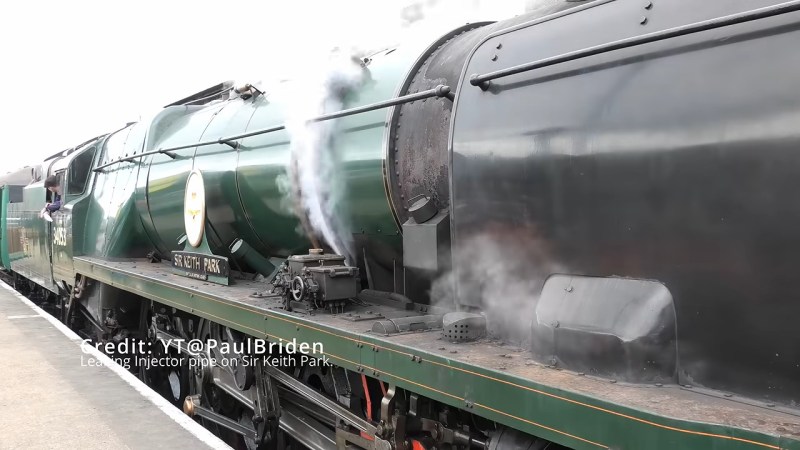
Here’s a historical hack for you: you have a big, rolling pressurized kettle, also known as a steam locomotive. It needs water to make up for the steam constantly chuff-chuff-chuffing away, or bad things happen. How do you get water from an unpressurized tender into a high pressure boiler with no moving parts? What you need is a some way to inject steam with no moving parts — a steam injector, if you will. [Marc Flint] found that the steam injectors were the hardest part of a loco to understand, so he made a video for all of us once he’d figured it out.
The steam injector isn’t a new idea. [Henri Giffard] came up with it back in the 1850s to replace expensive and maintenance-hungry pumps. It’s rather ingenious and uses the fluid mechanics uncovered by another European bloke by the name of Bernoulli. First, the high-pressure steam from the boiler goes through a converging-diverging nozzle to drop its pressure and speed its flow up, just as you’d guess if you’ve seen Bernoulli’s laws. Even more vacuum-inducing is the presence of water: the steam, already cooled by its expansion, hits the water in the pipe open to the tender, and condenses into it, shrinking a couple of orders of magnitude, creating a vacuum that draws in no small quantity of feed water. That one we did not expect from Bernoulli, but it makes sense. So how to get from below atmospheric pressure to the 180-odd PSI or more in the boiler?
Well, the water is now moving at a good clip, between the Venturi effect and the momentum gained from absorbing that steam, so another converging nozzle is the trick. Bernoulli’s law, once more! A one-way valve lets the now-pressurized water into the boiler, with a gap in between to dump water while the pressure builds up. It’s a clever trick, and since the steam coming from the boiler makes it back inside along with at least some of its heat energy, it’s much more efficient in both coal and water than running a pump. It’s also a bit of a head scratcher how it works unless someone sits you down to explain it, so we’re glad [Marc] did.
Not many of us are likely to use this knowledge directly — unless we’re firing up a 90 year old boiler or building a new steam locomotive — but seeing how great engineers of years past made use of basic physical laws can serve both as education and inspiration.












OK, but, are there any moving parts??
Yes: “A one-way valve lets the now-pressurized water into the boiler”
I want my money back
Please, drop the first “r” of name, it’s Henri Giffard, not Henri Griffard.
Tabarnouche, that’s embarrassing.
It’s right now, for what it’s worth.
I ran ino one used in a late 1950 or early 60s era building that used it for a condensate return pump from the far end of the building, on a low pressure boiler
I think time has proven out that it’s not a hack, it’s a genuine engineered solution.
Having spent a fair bit of my non-primary professional life working with high pressure steam devices (never advanced to a red-seal license, never needed it. Yet.) I still find injectors one of my favourite devices to operate and to service. They need a lot of service.
THere are a large number of variants (lifting vs non-lifting, for example) that vary in the number of cones, feed configuration, checks and gaps, and ability to throttle water and steam flow automatically or manually. It can be a dance, especially when under varying loads.
Turns out that injectors really only have great efficiency in applications like a locomotive, where the water is used single pass. In a closed or semi-closed plant (or any plant where waste heat from used steam or post-superheater flue gas can be recovered in feedwater) pumps win. In fact, though the heat from the steam used to power the feed is fully recovered, it is actually difficult to add additional preheat. Feedwater needs to be cool enough to fully condense the steam, and post-injector preheat using lost heat recovery generally is impractical, as the added piping drag reduces efficiency greatly.
Still used as secondary/backup feeds on a lot of equipment in the real world, low and high pressure (up to maybe 20bar) as they are failsafe in theory. In practice, though, many operators can’t even get a Pemberthy with gravity feed to start and feed. That pesky maintainance and training thing…
Could it be used in a single-loop NPP like RBMK? They don’t recirculate water so it could be like a giant steam locomotive.
what makes you think a RBMK doesn’t circulate water?
I’m not a steam engineer, but is my assumption correct that you want to condense the steam to remove all the water, to get proper dry steam?
?? Condense the steam? This turns it to water. In general, you want DRY steam, which requires removing condensate (drops/mist) from the steam. Wet steam carries less energy and greatly increases wear. The liquid carries a lot of momentum that does a job to everything it impacts. Think sandblasting.
The feed steam need not be dry for an injector (though it is more efficient if it is) though shouldn’t, generally, have significant superheat. The feed water MUST be cool enough that ALL of the feed steam condenses to liquid in the combining cone for proper feed. There should be a solid, laminar(ish) stream leaving the combining cone, and in in designs with an automatic overflow check, the overflow chamber should be in vacuum to close it. Uncondensed steam will prevent the appropriate condition and feedwater and steam will be lost through the overflow gap, or the feed will break completely.
This is why testing every shift and regular maintenance is a constant need: Cleaning (descale, remove debris brought in with feedwater, etc), clean and reseat check valves as needed (leaky feed checks will make it impossible to maintain water level and efficient fuel rate), clean the cones and make sure they are not eroded or steam cut, steam feed valve seats, seals and gaskets, moving parts move freely and say in the proper alignment, and so on.
You get dry steam by superheating it, so all condensate evaporates. On expansion in the working machine the temperature drops, and you get condensate again at some point, which has to be bleeded off immediately, or it will destroy the machine (by hitting the blades or by being caught in the small room when the cylinder reaches its returning point, this is why you can see steam escaping under the cylinders of steam locomotives). Or you go multi-stage where you increase the temperature between a high pressure stage and a low pressure stage to prevent condensation in the low pressure stage. This is common in power plants.
Condensing happens after that, to regain water, and/or to lower the low side pressure to gain efficiency (in which case you have to deal with gasses dissolved in the feed water, which will end up in the condenser without condensing).
Short steam lesson:
WET steam is steam that is at the saturation temperature (the temperature at which the transition back and forth between gas and liquid occurs, which is pressure dependent) but has liquid water in it as mist/droplets. There is lower enthalpy than required for all of the water to be gaseous.
Dry steam is steam that has no liquid in it. It may be SATURATED (at the saturation temperature) or SUPERHEATED (above the saturation temperature).
Saturated steam will get mist/droplets– condensate- upon any loss of heat, but without temperature change until ALL of the vapour (gaseous water) has condensed
Dry, saturated steam is the ideal for most injectors. Wet steam brings less energy to the table to get velocity/momentum, and significantly superheated steam leaves momentum on the table while requiring a lower feed water temperature.
Locomotive world:
How do you get dry, saturated steam? Draw it from the dryest point in the boiler, and maintain the piping at or just above the saturation temperature to as near the point of utilization as practicable. Locomotive generally do this by having a dry pipe inlet at the top of the steam dome, sometimes with a screen at the lower part of the dome to control the free surface and splashing from the bubbles as they surface. The dry pipe then runs back through the boiler, so the pipe is at saturation temperature and can prevent condensation, and maybe vapourize a small bit of liquid before reaching the turret valve (the traditional name, on my first license exam, is rather inappropriate), then short, insulated piping close to the boiler shell, generally the wrapper sheet, preferably under the jacket, to the injector.
Saturated, dry steam without (intentional, from a superheater section) superheat. Turns out the loss in pressure due to flow can actually dry the steam a tad, or bring it to a minimal superheat, if temperature is maintained. Oh, the fun of manually pulling thermocouple readings and doing the calculations with a basic calculator on a running system….
Other loco accessories tend to pull the short end, getting longer runs of pipe and less heat maintenance from the boiler. Turbogenerators tend to be designed to handle somewhat wet steam, and require service regularly (Impulse types with maybe one return) . Air pumps/vacuum pumps are designed with sufficient clearance to deal with wet steam, and bleed valves that serve the same purpose as cylinder cocks on the engines to allow for preheating. Steam brakes pretty much don’t care, as they are usually so far out that if they are held on for any length of time, the cylinder is solid with water when released.
Vacuum ejectors for vacuum brakes have similar constraints to injectors, but are more tolerant of wet steam, as they rely solely on the venturi effect. They are heinously inefficient, though. Hated hand firing vacuum ejector equipped locomotives. Worse than an engineer that overuses the whistle. One I trained portable under layed hard on the whistle just to be an a*s. I learned, and never did that to a trainee, portable or locomotive.
Do some locomotives use pressurized water reservoir? Seal the whole system, let the water reservoir and boiler pressure equalize, so you can transfer water from reservoir to boiler with very little effort (probably gravity-fed). Obviously there is the question of reservoir water sucking heat away from steam and condensing it, but it can be solved by several ways. Also you would have to depressurize system at each water refill and it would be probably more expensive to manufacture two high pressure tanks instead of one. Im not saying it’s perfect solution, far from it actually, but seems to be the first one that comes to mind.
Locomotives? Not to my knowledge. It honestly wouldn’t be very practical given that you would now have a second large, pressurized vessel, and to get gravity to do the job it would bring the CG up, when generally it is desirable to have it low.
Boilers and water tanks tend to have large free surface effect issues, both dynamic and static (dynamic: sloshing, such as due changing track curvature or short term gradient changes; static: due to prolonged, steady conditions like climbing or descending a grade or running at speed on a long curved section or track– improperly managed, dynamic roll you over, static expose crown sheets and leave water intakes unflooded) that effect stability and boiler heated-surface coverage. Raising a tank makes the dynamic issue significantly more difficult.
The additional issues of pressure cycling a feedwater tank (one criteria for inspection is pressure cycles, hence the extra fuel and manpower to keep a boiler hot and at least near operation pressure range when it isn’t being used for short periods, such as overnight or a couple days)
In stationary practice…. Well, there are use cases. Already too much here for a weekend afternoon