
Over the years poly(lactic acid) (PLA) – also known as polylactide – has become a popular thermoplastic for a variety of reasons. One of these reasons is that it’s easily produced from a renewable resource, i.e. lactic acid, with the resulting polymer even being compostable if you assume that your compost pile hits a steady 65°C or more, well above the polymer’s glass transition temperature (Tg).
That said, PLA by itself is a pretty crummy material, being exceedingly brittle and inferior to common alternatives like PET(G) in many metrics. Over the decades much research has gone into figuring out this material, its amorphous and crystalline states, as well as how to use plasticizers, copolymers, mechanical manipulation and PLLA/PDLA blends to produce more useful variants of PLA.
Today’s spools of thermoplastic filament that gets marketed as ‘PLA’ are the result of such engineering, though with plenty of remaining issues, as anyone who has struggled through a spool of brittle PLA filament can attest to. Although you can find plenty of tips online about how you should ‘just’ toss said spool into an filament dryer, oven or similar to bake it – with accusing fingers pointed at moisture intrusion, hydrolysis and kin – it helps to understand the fundamentals of how PLA works, and how it degrades.
Stereoisomer
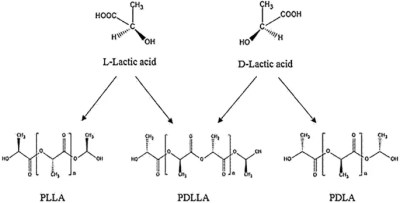
Although we use the generic acronym of ‘PLA’, there are actually two chiral forms of poly(lactic acid). Generally the one that we most commonly find in our spools of consumer-grade PLA filament is poly(L-lactide) (PLLA), while its more rare chiral form is poly(D-lactide) (PDLA). These match their chiral lactic acid forms, being L-lactic acid and D-lactic acid.
If both PLLA and PDLA are combined into a single polymer chain you thus get another type of material with its own set of properties. Overall this PDLLA polymer is quite stable, preferring to stay amorphous while still resisting hydrolysis better than its other polymer forms.
While industrial production of D-lactic acid is possible, most production is in the form of cheaper L-lactic acid, with correspondingly FDM printer filament thus having a high chance of being PLLA. This, along with factors like the ratio of crystallinity versus amorphous areas determines the initial state of the material.
These two states, of crystalline versus amorphous are defined by the state of the polymers, with the crystallized state being the most stable form that is most resistant to degradation through hydrolysis, yet this state is also the most rigid and thus most brittle. This is of course just the beginning of all the fascinating materials science.
Polymer Types
While just the basic PLLA and PDLA polymers already provide a lot of fascinating materials science, there is a whole world of things you can do with these polymers. We already touched on blending PLLA and PDLA, whereby both types of polymers support each other. This same blending can be done with other types of polymers as well, to further modify the properties of PLA, with many of the essentials covered by Vincent DeStefano et al. in this 2020 paper.
In addition to blending polymers, we can also create copolymers, whereby PLA monomers are mixed with other monomers to create a new polymer type with certain desirable properties, like enhanced flexibility. This already gets us right in the territory of the countless additives for PLA to modify its plasticity, nucleation and other characteristics.
Of note are the different crystallinities of PLA, as also covered by DeStefano et al., starting with ɑ and ɑ’-crystallinity as the most common types, and a PLLA/PDLA blend being fully amorphic if it contains more than 10% of PDLA. Since most PLA blends tend to have less PDLA than this we generally classify PLA filament as semi-crystalline.
Plasticizing
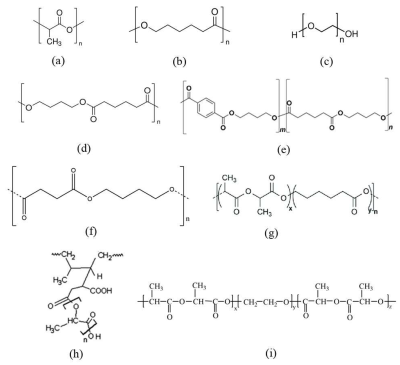
Unsurprisingly, most of the additives and modifications to PLA focus on plasticizing it, which can be done through a number of methods in addition to modifying the amount of PDLA in the blend. A good overview of these methods can be found in this 2024 paper in Polymers by Elena E. Mastalygina et al..
Beyond PDLA/PLLA blends we can also blend in other polymers, including a range of flexible polyesters, though it’s essential to determine intermolecular compatibility. Common here are polycaprolactone (PCL), polybutylene adipate terephthalate (PBAT) and polybutylene succinate (PBSA), which like PLA are biodegradable polyesters.
Where things get interesting is with copolymers, which can also involve the aforementioned PCL, PBAT, etc., as well as polyethylene glycol (PEG), with a wide range of combinations possible. Some of these combinations are summarized in the graphic to the right from said paper by Mastalygina et al. using data from cited papers.
Although these methods, along with the more experimental structural modification approach, make the base PLA polymer more flexible, it’s also possible to introduce oligomeric and low-molecular-weight plasticizers which essentially wriggle into the PLA polymer matrix, thus increasing its mobility.
Another focus of such additives can be to act as nucleation agents for nano-crystallization, creating small spherulites that do not impact plasticity nearly as much as naturally forming large spherulites.
Plasticizer
The aforementioned paper covers a range of these plasticizers, such as PEG. Here a problem is that although PEG as a plasticizer additive does promote PLA ductility, PEG tends to migrate out of the polymer. Fortunately there is a dizzying amount of possible plasticizers here, ranging from lactic acid oligomers to epoxidized sunflower oil, as well as linseed, cottonseed, soybean, castor, and other oils.
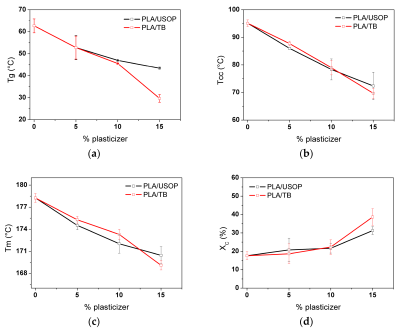
In a 2025 paper in Polymers by D’Amico et al. the use of used sunflower oil (USOP) as PLA plasticizer is compared with the conventional plasticizer tributyrin (TB). Both show a very similar effect on the plasticity of the final product, though long-term stability of the plasticizer was not tested.
Of course, determining which plasticizer was used in any off-the-shelf spool of PLA filament is effectively impossible. A quick look at a number of commercial PLA filament options, ranging from Prusa to Bambu Lab, shows that their material safety data sheet (MSDS) lists the material only as ‘PLA with additives’.
In a way this makes even ‘regular’ PLA about as much of a mystery filament as so-called ‘PLA+’, with its arbitrary additives such as calcium carbonate.
Degradation
As for how that spool of filament degrades, we can thus draw a number of conclusions. The first is that hydrolysis is the primary degradation mechanism, gradually shortening the backbones of the polymer chains. Yet the other type is one that happens regardless of whether the PLA is fully dried and stored in a container of some sort. A good example of this can be found in e.g. a 2021 Polymers research paper by Tien-Wei Shyr et al. in which many variations of additive-free PLA samples were stored for multiple years.
One set of samples was put into zipper bags and stored in a vacuum-free desiccator, while the other set was stored in vacuum-sealed bags. Both sets were stored like this at room temperature for three years, after which their crystallization and hydrolysis levels were checked.
For the vacuum-sealed samples there was no significant degradation compared to the received samples, while the three-year old samples in the zipper bags had degraded significantly, suffering hydrolysis, nucleation and corresponding crystallization and thus brittleness.
Brittleness
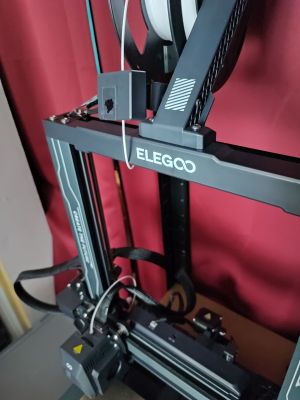
When I recently did some FDM printing for a comparison article series with SLA resin printing, I had dug up a spool of white Sunlu PLA filament that I had left kicking around for probably around three years. This spool had seen itself stuck exposed to room conditions for at least a year when I noticed that after letting it sit fed into the extruder for a number of hours would result in it snapping.
Although I could still print with this filament if I didn’t let it sit too long, it was clear that not only was the PLA rather brittle at this point, it also had assumed a very strong preference for staying in the shape that it was in while on the spool.
What this suggests is thus two things: significant hydrolysis had weakened the filament, and increased crystallization had resulted in both rigidity and brittleness.
Unknown is whether something like a PEG plasticizer was used with this filament, with it having left the building somewhere in the past few years. If the plasticizer is no longer present that would obviously pose somewhat of a conundrum with any attempts to revive the filament.
Ultimately what one can do here is to heat the filament above its Tg for a number of hours, so at least 65 °C for the average PLA blend. This should restore the semi-crystalline state somewhat, although if enough damage has been wreaked by hydrolysis all bets are off. For this particular spool of PLA I did toss it into a Chitu Filapartner filament dryer as it allows you to set the temperature and time, but without a good way to measure the internal material temperature it may not have gotten hot enough.
Considering that this old spool of PLA was fully dried about a year prior in a Sunlu filament dryer using its PLA preset, followed by it being stuffed into a vacuum bag and into an ‘airtight’ container, it’s likely that most of the damage was indeed done by 1-2 years of exposure to room air.
I have saved a few samples of this old filament for later study, but in light of the research covered in this article it highlights just how hard the materials science is, even when it comes to a material as mundane as PLA. Ultimately the best you can do is keep it in that nice vacuum-sealed bag when not printing and pray to the 3D printer gods that you didn’t overlook something important and that maybe one day the filament manufacturers will bless us with details on what these ‘additives’ are.












Quote: “I noticed that after letting it sit fed into the extruder for a number of hours would result in it snapping.”
And it always snaps behind the filament sensor.
Coincidentally enough, I started a print going this morning just before I headed off to work. As I was getting ready to leave I heard an unusual beep from the printer. The filament had broken off behind the feed motor, and the printer used up all of what was left in the Bowden tube, then the runout sensor tripped and–since the break was after the motor–it was able to automatically reload and pick up where it left off. Very nice!
Same here for the “out of filament” handling by my Creality $200 thingy. All those filament changes, print stops (to insert a hex nut into a hole) or out of filament situations are handles very fine.
Although I would expect this, as it is not that magic. Translating into German is the uncharted land for Creality. And the general “we do not love our products, we abandon them after release”. No small fixes, maintenance releases, nothing. Just sell and forget. OTOH, $200.
Abandon and forget…. sounds about like the pulse laser we picked up. Oof. And AI slop is not making it easier for a layman to pick out the legitimate manufacturers.
There’s gotta be a possible filament sensor that senses tension on the line, and thus could handle detecting a snap no matter where it is.. I dunno, I have none on any of my machines
I don’t know about tension, but somewhere I believe I’ve seen sensors that detect the presence/absence of movement in the filament when the extruder is running. I guess it could be optical like a mouse sensor, or encoder based, or something else.
Sloppier than being directly driven by the filament, but I suppose some grippy sorta spool holder with even a crude encoder attached could sense movement and maybe set a bit and hold it for some interval to be analyzed by the control board for correlation to extruder steps being commanded.
meanwhile stupid a⯀⯀ when I got my first 3d printer after installing wall mounts for my filament directly on a wall opposite of a window where the sun rises every day: “wtf why is my filament shattering”
I knew to keep it safe from moisture and made the incorrect assumption that warmth from the sun would help that.
(:3」∠)
Ahem; typos:
*meanwhile my stupid
(also lets find out if slashes make the emoji work!)
*_(:3」∠)_
the warmth from the sun would help to keep it dry, but the UV from the sun would pose a greater risk. PLA does not appreciate UV.
Which is strange because my hydroponics greenhouse has been running PLA endcaps and covers for the last 8 years. It’s down to the quality if the filament, and printing at as low a temperature as you can get away with damn the numbers printed on the box.
I gave up on PLA 10 years ago when the switch blank I’d printed kept falling out of my car’s dashboard. Unless you’re printing ornaments, it’s pretty useless.
except when it’s about prototyping, haptics, or burning it.
https://hackaday.com/tag/lost-pla/
I try my best to use clear petg (so its actually — theoretically — recyclable) and “natural” (uncoloured) ASA/ABS so that I can reuse failed bits as slurry for filler and other things.
my issue with pla is that its just so wildly inconsistent even from the same batch… it’s super frustrating when one spool is perfectly cromulent and then the other is off not just in colour but its strength as well. it’s like this even for well-known and loved brands.
that and pla is always just riddled with garbage/filler that i suspect is literal garbage they had hanging around for free.
I think it’s rather funny the amount of “Makers” on YouTube who have stacks of PLA mounted visibly and openly behind their desk and who have stated the PLA is fine when stored like that, some with instructional videos on how to do the same in your own workshop.
Well Senõr/Senõrita, clearly those reels of polymerised sugars behind you are purely for decoration and you have no intention of printing with that yucky yellow or putrid pink spools that have sat colourfully over your left and right shoulder while you’ve regaled us with your favourable and inexpensive experience of a certain PCB manufacturer periodically for the past 18 months. I, for one, will not be using the affiliate links you’ve conveniently left in the video description for my next filament purchase, as I doubt you’ve even used the filament in the links themselves. Good day!
I still use old spools of Diamond Age PLA that are 10 years old and have been kept in non-vacuum bags. They work fine, even in Prusa XL feed tubes. The reason is that they get all their mechanical properties from carefully skinning (air-cooling immediately after extrusion) and annealing and the only additive is the pigment or dye. I know, because I invented PLA filament and that’s how we made it. Too expensive to compete with additive-laden crap though, sadly. Imagin Plastics still make it that way, and it is particularly useful for metal casting cores.
As a note, we did experiment with using crystalline PLA fibres in PLA filament. Crystalline PLA has a higher melting point than amorphous. The idea was that you could control the stiffness of the part by printing under or over the crystalline melt point.
Super interesting! Do you still do materials research? I would love to hear more about early experimentation done. I got into 3D printing when ABS was the only option, PLA filament is one of the biggest reasons for the proliferation of FDM technology second only to the RepRap project itself imo.
In this community that’s a serious Flex! “I invented PLA filament”.
Sounds really interesting by the way!
One shot print
https://techxplore.com/news/2026-08-holographic-laser-3d-voids-shot.html
Another factor is the minimum diameter of the spool, ie wider spools have shallower rolls on which the filament sits, that tighter bend also causes filament to snap sooner.
Goes to show you shouldn’t stock up too much filament to last for a year or more and use it up before it goes bad. Not sure if keeping it dry and regularly dry it/heat it up will help though.
Nope, dry a mechanically unsound roll of fillament and it’ll still snap like spaghetti. Mechanical stress tends to be the issue with snapping, worse with small rolls as you’re noting.
Holding it off the spool and straight, but dry, and dousing another bit in water but leaving it curled naturally shows which is having a more immediate effect. Usually only takes a few hours.
I am bit angry when people think that pushing PLA through hotend somehow prevents it going bad in future. it gets brittle on the spool before you print it and it will absolutely get brittle even after being printed given enough time (but yeah, print being significantly chunkier than filament gives bit more protection to brittle material). drying the spool will only make it not break in the extruder, but the print will eventualy get weak anyway. that means PLA is really only good for prototyping and non-functional design.
I almost only print PLA. I have some ABS and PETG but I rarely use it, only if it’s needed for strong parts or higher temperature parts, otherwise it’s just PLA. I have brackets mounted to my walls with largen wooden dowels, where I set the PLA on, out in the open. I can store about 20 rolls on it. It’s fine. I can leave it for two years, three years, it’s fine. I had a few spools of weird colors that I put in a large plastic container that is waterproof and made of black plastic, so no UV could enter. I put a motion sensor in and added a bunch of large bags of desiccant beads. The moisture levelled out around 12% (If I remember correctly). Maybe a year later, I wanted to grab a spool and most the filament just broke off into pieces. I lifted out a roll of PLA, which was about 90% full and everything fell off. The old rolls, out in the open, are fine. I still use the container for PLA rolls but I now have spacers underneath the lid so that air can enter, to stop the PLA from degrading quickly and it seems to work. The PLA is no longer breaking into pieces.
the thing about PLA is that it needs to be dry to be printed, or to be used. so if i dry it out, print it, it will still suffer brittle failure 1-10 years later.
i’m not sure about PETG yet but my impression is that you really do want to dry it out to make it printable…just to avoid bubbling and oozing and all that…but once it’s printed, i don’t think i care if it absorbs a little water. knock on wood.
I’ve been printing since I built my first printer in 2012. I’m that time I have printed about 2 spools of PLA. I realized it was shite almost immediately and switched to ABS. The stuff was going brittle and clogging nozzles all the time. In the last 5 years or so I have been printing mostly PETG, otherwise ABS. I recently bought a spool of PLA to use as support material for PETG prints but haven’t tried it yet.
If the stuff is getting brittle sitting on the spool, what do you think is happening to your prints? PLA is crap. Always has been, always will be, suitable only for support material, tugboats, and Star wars junk that will be thrown away a couple minutes after printing.
i 100% agree but in defense PLA, it’s good for anything that will be thrown away within the first year. not just junk, but also prototypes and like tools that only have to survive a couple uses…all sorts of stuff, really. but yeah after a year ugh
Like many others here, I prefer PETG for my functional prints. PLA is just too brittle for anything beyond decorations. The hydrolysis happens to printed parts too, not just filament, so it will go brittle eventually.
I’ve recently been in a love affair with Elegoo’s glass filled PETG-GF.
Been working with 3D printers for years here in Texas and largely worked with ABS and PLA. We have them in airtight containers with dessicants I change every few months or so and hygrometers glued to the top.
My ABS has huge problems sticking on the roll, even kept dry and pre-heated in an enclosed machine. I don’t have those issues with PLA. Of course, I’ve largely printed ABS on my Polyprinter and those machines, bless their hearts, are showing their age now.
I’d love to see a series on different types of 3D printer filaments. This was fascinating.
What do you mean by “sticking on the roll”?
I havent been printing for all that long, and mostly in pla. but i have two pla prints in, well, more than just humid conditions. one print is a pair of crap-catchers in my kitchen sinks. inundated with water many times a day, and hot water at that. somewhere in the vicinity of 40+ C i would guess.
the other print is some baskets in my shower. which obviously get wet and stay in a humid room for some time after.
the crap-catchers are only a few months old, but the shower baskets (a hex mesh with 3mm square walls) are going on a year.
i’m guessing there a lot of factors (as maya’s exellent article points out) that contribute. i dont think “pla bad mkay” is sufficient.
i certainly noticed a big difference between the most expensive pla i have bought (which i used on these items) and some cheap ebay filament that a friend suggested i get.