
Much like Apple’s once vaunted super-slim butterfly keyboard, today’s range of portable devices featuring flexible OLED displays – which can fold said display into a much smaller form factor – are a marvel of engineering.
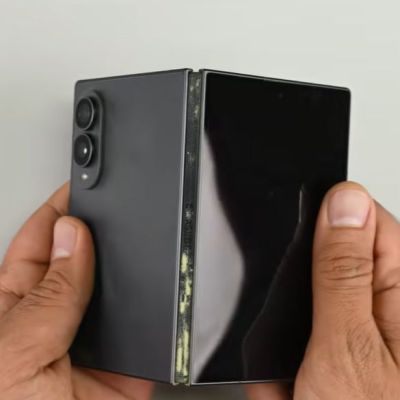
Unfortunately engineering can only do so much against fundamental flaws. In the case of both these flexible OLEDs and butterfly keyboards the main issue is that of dust intrusion, with a recent teardown by [iFixit] going over the reasons for this.
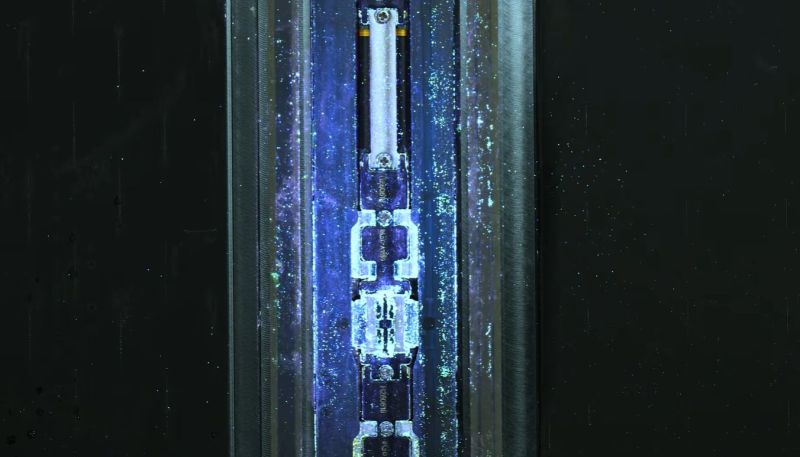
As test subject we got a Galaxy Z Fold 8, as an example of a modern-day foldable smartphone-tablet hybrid. This phone has an IP48 rating, meaning that it’s water-resistant, but not dust-resistant for particles smaller than 1 mm. To test this, [iFixit] used UV-reactive dust particles, making sure that they got literally everywhere inside the phone’s hinge mechanism.
After this treatment, trying to fold the phone caused the hinge mechanism to make absolutely horrific crunching noises, confirming that it’s reached dust-under-butterfly-keycap levels of unusable. During the subsequent teardown a quick pass with the UV lamp showed that not much of the dust had penetrated into the two halves of the device at least, but the hinge mechanism wasn’t as lucky.
Getting to the hinge is sadly rather destructive, as it involves removing the flexible OLED. Once the hinge was exposed and subjected to UV light the spectacle was something to marvel at, as can be seen in the above screenshot. With the dust caking literally every part of the mechanism, it was little wonder that the hinge had ceased to work.
Although this was obviously an extreme case of dust exposure, and the average flexible OLED screen’s hinge won’t see nearly as much dust, one can’t help but feel slightly disconcerted at that crunching noise, knowing that it’s just one big dust exposure away.












Well, I guess we know what will happen to your folding phone if it ever gets into a serious UV dust storm, otherwise I’m not sure this proves anything.
Are your pockets completely clean? Otherwise it proves that over time your $2000 folding phone will get more and more dust in it leading to failure.
C’mon its not that hard to apply logic.
Lots of people work in locations that have a lot of dust.
When the motorola clam phone came out a buddy of mine had to keep his in a zip lock bag because he was welding all day long and the magnets in the phone clasp attracted all the grinder dust in seconds.
The bigger thing is, think about having the phone for 2 years or longer. You’d have to keep the device in a clean room to avoid the hinge slowly fouling due to gradual dust accumulation.
Yes because only UV dust will penetrate your hinge…regular dust does nothing at all
Life must be hard when you read a whole article and it blows right over your head and all you got from it was “UV dust”
I’ve yet to find a foldable display that didn’t make me cringe.
There’s just too much to go wrong… kinda wish we instead would just use the tech to make wrap-around displays, fake-CRTs for that glass curve or rollable displays instead of folding… the hinge is just too much; y’know?
also the creases on them are genuinely disgusting. folding phone owners insist you barely notice them but the way they talk about it always sounds like buyer’s remorse.
Agreed. I would have been tempted to title this article “Dust And The Bane Of Foldable OLED Displays”… ;-}
“the average flexible OLED screen’s hinge won’t see nearly as much dust”
Except you go on a playground, or the beach, with your kid.
Or if you’re just a dusty kind of guy, like me
I recommend avoiding taking a naked phone to the beach or the playground sandbox. One of the few things that can readily scratch modern phone screens is sand.
Even if the hinge doesn’t die, a sand bath can ruin a pristine screen.
I recommend avoiding taking a phone to the naked beach.
Other beachgoers will not take kindly to you waving around a device capable of taking high res photos and video. Consider yourself lucky if you only get reprimanded or asked to leave.
Plus, no pockets so you have to hold it in your hands! Or resort to using nature’s pocket…
Given that most phones available on the market can be considered “phablets”, only very few people (like the world-famous Kirk Johnson) would be able to efficiently use their pocket.
We are in a very bad spot, when it comes to smartphones in 2026.
First it was the SD card slot, then the headphone jack, then the IR blaster (I still miss this little guy, 0.1$ LED in the BoM btw), removable battery, notification LED (0.1$ LED in the BoM btw), camera shutter button, physical navigation buttons (okay I have mixed feelings about this one).
We were offered “curved screens”, because its so great to have your screen extend to the sides of your phone, which just happens to be even more susceptible to breaking when dropped, and which makes your phone even more slippery and hard to grip, causing the said more likely dropping events. Not to mention you have to use a special screen protector that uses special UV curing adhesive that has to be reapplied again, and again. It looks cool though! That’s all that matters, amirite?
Then came foldables. Because its so good to have moving parts in a device that you carry with you, and interact with all day long. And is expensive. And is damaged when you…drop it. Yeah…
My problem is not these weird and wacky experiments, but the social acceptance around them. Whenever some manufacturer launches experimental stuff like this, if the phone with it gets popular or even well known you can bet every manufacturer on the planet will force the “feature” in their own premium phones. And it doesn’t stop at that, eventually their entire lineup right from the 35$ shitbox to 999$ premium phone will have the feature. Even if its a bad idea. Tell me, what was so good about “curved” screens? They weren’t even curved, but just warped on the sides. It gave you a tiny bit more screen area. That’s it.
The part that ticks me off is the fact that people don’t stop and think “what good will that do to me?”, when they see a feature being advertised. Enough people don’t say “this is new, but I like XYZ, not ABC”. Too many people go “new thing, can’t hurt to try?”
Thanks for listening to my rant
But… see, what you aren’t understanding is that they have to make things worse while raising the price (and sometimes, artificially restricting supply) because they make more money that way. They have no choice.
I’m sure there will be no consequences for anyone from any of this. Everything will be fine.
wait, were you talking cars?
just a counterpoint, one stupid ‘progress’ i wound up tolerating
when phablets were new, i didn’t like them. i still remember shopping around for a phone that was 2.3″ wide, so i could use it one-handed. i grudgingly bought a slightly wider phone each generation, until my current one is 3″ wide. and i use it one-handed all the time.
somewhere around 2.8″ wide, i simply had to learn a different way to hold the thing, basically shifting the back of the phone one knuckle closer to my fingertips. and once i learned the new way, the big phones are as comfortable as the little phones ever were. and i hold it nearly as securely, too. it helps that they’re so thin and slippery that i gave up long ago using one without a thin tpu case. i suspect if i went back, i’d be frustrated by the tiny keyboard.
though i am still eyeballing a truly diminuitive temu ‘bezosphone’ when this one bites the dust. turns out, the other thing i’ve discovered is i don’t actually use the phone hardly at all so i kind of don’t care. i get great battery life!
The problem with a folding display phone is that if you fold the phone, it becomes twice as small, but also twice as thick. The volume stays the same. And to be honest, a large but thin phone fits my pockets much better than a small but thick phone.
Try to wear jeans. Put a thin, large phone in one pocket, and a thick small phone in the other pocket. Now try to get both phones out of your pocket. If you can get the thick small phone out of your pocket faster than the thin large phone, you have really tiny hands.
Have you used or seen a Fold 8 though? Even folded, it’s less than a millimeter thicker folder than major folded phones, but when opened, 2x the screen size. Going with the Fold 8 again, it’s literally the size of a passport, which is very comfortable for the backpacked of jeans, and easy to use with small hands. Price is ridiculous unless you have a trade in, but every phone is these days because of the RAMpocalypse.
No.
Bluecollar workwear from the 1900s is simply not compatible with 2020s mobile phones and other crap we have to carry with us.
Around 2015 I finally had to switch from indestructible Nokia C2-02 to some Huawei smartphone.
I immediately realized that, unlike my old Nokia, it’s a delicate and complex touchscreen computing device. If I keep this very nice (no sarcasm there) and somewhat large Android phone in my jeans pocket (along with keys, documents, money etc.) it will be subject to scratching, bending, pressure, perspiration and other harmful conditions as I go around my day. It’s very likely, that it would quickly become damaged or worn and it would be a damn shame because I really liked it.
I did the only right thing and said “f… you” to fashion. I went to military/outdoors store to buy me some comfy cargo pants where a smartphone would get its own, exclusive and large pocket on my thigh. No mechanical stresses, no scratchy keys or something, no risk of it falling out and dropping on the floor. I’ve been carrying this Huawei every day for 7 years until carrier offered me a new phone. When it got retired it still worked fine and looked almost like new.
Wait, that seems redundant. Is there some other kind of pants that I’m not aware of? If so, why??
Pants are overrated, all you need is a belt with large pockets. :-D
Team Fortress 2 – Meat the Soldier 💯
Except all the “thin” phones have a massive camera bump so no it isnt thin. They could literally make the entire back thicker so the camera is flush, and have a larger battery….and if the camera bump can fit in your pocket, the “thicker” phone would too.
Also stop wearing skinny jeans.
I recently got a new iPhone 17 Pro as software dev phone. Previously I was using an iPhone 12 Pro Max.
But man, that camera on the iPhone 17 Pro sticks out another 2.3 mm further than the one of the iPhone 12 Pro Max.
Ridiculous. If I slip it into a case that enables the phone to lie flat on my desk, the iPhone 17 is actually 2.3mm more thick than the iPhone 12.
Yep that is exactly what I am talking about….Just wasted space!
obviously just my personal taste, but i don’t actually agree. there’s certainly a ‘too thick’ but most phones these days, even if you doubled their thickness, wouldn’t reach that level for me. like 2010-2015 i had a phone that was about 2/3rds the width/height and twice the thickness of any of my recent phones, and i liked it just fine even with the pockets of that era.
most clothes come stock with big pockets these days, and through frequent practice i have gotten pretty alright at installing aftermarket big pockets. the problem i have with phablets is that they don’t bend when i bend, and they don’t match the curvature of my leg. honestly even worse than being uncomfortable, it is obviously very delicate (lever arm), and i have to be a little aware of it all the time to avoid destroying it. can’t destroy it because the only thing i hate worse than having one is buying another :)
Completely agree having used an N900 in the past and an fxtec pro1.
Really not the case these things are almost certainly easier to pocket as while folded they are not much thicker than a “normal” phone while being significantly narrower and your small thick phone – perhaps a unihertz jelly series will fit in pretty much any pocket trivially despite being at least double if not more the thickness of any folding phone!
It is much easier to get a thick marker pen into a pocket than the thin notebook etc as despite it being much much thicker it doesn’t actually need to get near the edges of the pocket where the fabric is now being held stretched near its limit with huge contact surface between it and the object and with less room for it to move as you do etc. Narrower and a little bit thicker is way way way easier to get into the pocket!
These folding phones are way to fragile and expensive for me to want one yet, but day to day practicality in use of having all that screen real estate on demand still makes it tempting.
What are you talking about? Modern phones are larger and thicker than 2015 ones.
I never asked for folding screen phones to start with. Cheap ones or clones, same difference.
What I’ve been (unsuccessfully) asking for is the slightly larger flip phone with three screens and normal tactile sliding keyboard. The three screens will be two MODERATELY large screens inside and one tiny screen on the outside. I also need to be only moderately thick, so average pocket can accommodate one without bulging out too much.
Things that are nice, but I can opt out – camera and weird “volume buttons” that seem to have dozens of other intended purposes I’ve never asked for. Keep few important buttons inside where they could not be accidentally pushed, and return proper functionality “opening the phone answers the call”. I’ll let geniuses figure out how to handle hands-free docked phone in a car.
Also needed, headphone jack, and decent USB, current fad of USB-C everywhere is okay, just add another USB for power-only elsewhere. Also dearly needed removable/upgradable battery, so the worn-out one can be replaced at any time.
What I also asked for is built-in tiny projector that can be activated without opening the phone. Simple things like phone lookup, etc can be handled without firing up the main screens, and now there is no shortage of standalone/offline apps that can handle simple things quite well.
Other than that, folding phones is not anything new, just mighty good refinement of the exiting technology. I also don’t see much movements/upgrades either, whatever happened to eInk used in phones? I’d want to see lighted eink screen available as an option, similarly, replaceable/upgradeable, and since I don’t want to have my cell phone as my yootoob viewer, I don’t care if it refreshes at less than 20fps.
Of course, we don’t matter, and our opinions don’t count.
i want a clock app that doesn’t take 1.5 seconds of wall time to display my alarm
Now now, keep it realistic. With all the web-frameworks, so that a toddler can “design” apps, this is asked too much.
Apps should only be allowed to be written in assembly, C or Fortran. If it doesn’t run fast on a 15 year old phone, it should be optimized until it does.
Are you willing to pay $300 for a basic clock app? Sure it will load in 20ms, have the capacity to process 50 petabytes of data generated daily from LHC research while also mining bitcoin for its creator, but it will still crash when you set alarm to 24:00.
I am perfectly fine with either Forth or Rust. There is no shortage of bare metal frameworks for both.
Web-shmeb, rendering should be kept to its bare minimum, and static pages when/if written with proper thorough thinking (as opposed to quick slapdash) render quickly. Compress them, too, and optimize for lightweight CPU uncompressing, but I never liked web as Yet Another GUI inside already existing GUI.
Most things I use could run over command-line faked ASCII GUI just mighty fine (what is it? Text UI = TUI). I don’t need animated pseudo-3D shadowing, nor I care if windows can be drag-dropped around. As a matter of fact, things like email or any of the latest messaging apps would work just fine in the DOS Norton Commander kind of ASCII windows, which doesn’t need three dozens third-party javascript libraries.
So, in short what I NEED is the modern equivalent of MS DOS box doing the cell phone functionality. That’s it. I know I can run DOSBox inside my cell phone (with limited success, tho), but I’d probably want something simpler, FORTH-based (or RUST-based, which seem to be the current fad) OS with the option of low-tech TUI.
Is that too much to ask? : { (I am gradually working through my own, mostly unrelated project that should at the end do that – TUI-based bare-metal things without reinventing the wheel anew).
If they do clamshell-style anyway, wouldn’t it be simpler to just have two panels that lie perfectly level once folded up?