
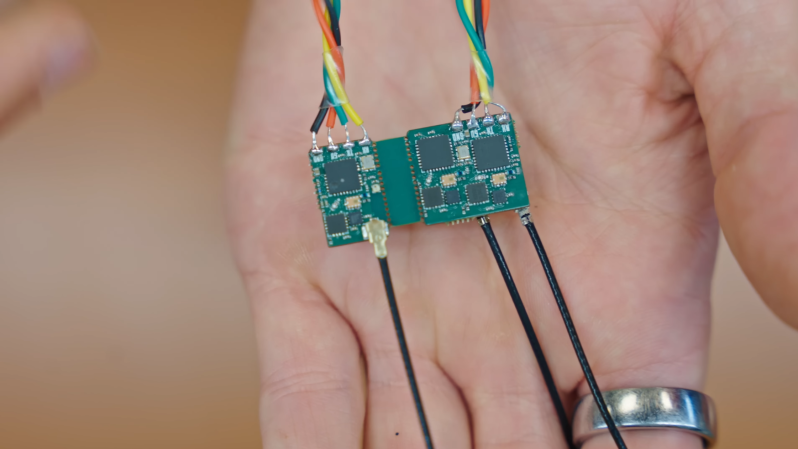
Drone control links are, from a radio signals perspective, nothing short of amazing: using a transmitter capable of transmitting, at most, one watt, a protocol such as ExpressLRS (ELRS) can control a drone over 100 kilometers away. [Stan], who has been building a drone electronics stack from scratch, recently designed four ELRS receivers and went over the principles behind their incredible range.
Up to a certain point, the simplest way to increase a radio’s range is to lower the frequency; lower radio frequencies penetrate better through most materials and don’t attenuate as quickly with distance. However, although ELRS can use 900 MHz bands, [Stan]’s receivers primarily use 2.4 GHz. The major improvement is in modulation: unlike other control protocols, which mostly use frequency modulation, or Wi-Fi, which uses phase and amplitude modulation, ELRS uses Chirp Spread Spectrum modulation. This has a low data rate, but it’s very reliable; every bit is transmitted as a chirp – a linearly rising radio tone – and the data is encoded in the chirp’s starting frequency. To decode this, the receiver multiplies it with an inverse chirp, then takes a fast Fourier transform, revealing the starting frequency. This process has an equivalent gain of 24 dB, which is enough to let it decode signals even below the receiver’s noise floor.
The hardware [Stan] designed to implement this was comparatively simple, just an ESP32 microcontroller, an SX1281 radio chip, and a few peripherals. All four receivers worked in 2.4 GHz, but two had additional 900 MHz antennas. Against RF design convention, one of the receivers used a via to connect the antenna. This would normally cause a significant impedance mismatch, but since there were enough ground-plane vias nearby, the current return path was barely affected; the receiver’s performance hardly changed. In one test, all four receivers maintained a connection at more than five kilometers, despite a forest blocking the signal’s path.
We previously covered ExpressLRS when it was still an emerging technology. To get this kind of range, it builds on LoRa technology, which has reached some impressive distance records.
Thanks to [Keith Olson] for the tip!












433 mhz gfsk @20 dBm gives 50 km range.
Why to bother with any 2.4?
And we have a confirmed TL;DR comment. It is amazing how many of those we see these days. I applaud your ability to not read the article before commenting on it! Go back to Slashdot.
Just imagine what chirp with 433MHz can do…
If I recall correctly, assuming identical power out/amplifiers/antenna gains, the TR/RX budget on an identical chirp signal goes up by about one third squared of the ratio between the high nominal frequency and the low nominal frequency of the bands being compared. So 2.4Ghz/433 = About 6. Divide by 3 = 2. Square it, and you get approximately 4x range. At 433mhz, you would still be talking LOS, but WOW!
Why not increase power to 30-40 dBm
With EME comms and good aerial you could control RC toy car even on another continent
With 1-10W you can’t do an EME bounce, especially for a complex modulation. People are bouncing kW CW signals with huge antennas just to get a recognizable above-the-noise-floor reflection.
The path loss for EME is around 268 dB at 900 MHz. ELRS can receive signals down to about -123 dBm. You can’t fit an antenna on the drone with any significant amount of gain. That means you will need a transmitter and antenna that will put out at least 145 dBm EIRP. Even if you manage to borrow one of NASAs 70 meter dishes, the transmitter will need to be over a megawatt. If you manage to get enough signal strength, the time spreading will probably corrupt the ELRS signals anyways.
With such long ranges, how many communication channels of this (in terms of how many units talking to how many receivers), can operate in a given area? Is some sort of error correction or other method of labelling “this chirp is for that receiver” involved? How else is medium access control for these handled in a decentralised manner, because without something like that then one guy can have it as an impressive tool, but it can’t scale.
If there are hundreds or thousands of drones in the air can you keep them apart with this technology?
The technology that keeps swarms apart is not part of this system and handled locally for ranged swarms using proximity formation control and lead and neighbor systems.
I wonder what the legal limitations are. These guys are located in the EU, so “900 MHz band” is likely the 868 MHz ISM band. As far as I know, there are strict duty cycle restrictions and/or bandwidth limitations. LoRa is a wide band modulation (in contrast to FSK). Using it to control a drone means you will nearly continuously occupy the spectrum. That’s would not be fair spectrum usage.
If they are, then they are breaking the law in three ways:
– illegal frequency
– illegal transmit power (if they are actually at 868, max is 500mW)
– illegal duty cycle usage
So is Hackaday basically publishing article which breaks laws on three points?
No one cares to delve into the technical details. And if you do, they tell you “this is not eevblog” and discussion is over.
And the other funny fact is that people without an actual RF spectrum license are commenting about RF stuff – nice, but not relevant. You know what I’m saying.
I would like to remind you both of the name of the website where you are commenting. Just scroll up if you forgot. We are not all licensed in every available license, nor do we all care to be. Not having a license certainly doesn’t make it illegal to discuss such topics, nor taboo. Reporting on something that someone did that may or may not be illegal does not make reporting on it illegal. Knowledge is not illegal. It’s what you choose to do with that knowledge or lack there of, that makes something illegal. I’d say most people here love to delve into the technical details. It’s a shame that doing so apparently means you’ll face criticism unless you’re already licensed! I can’t imagine how anyone can learn enough to get a license if discussion is limited to licensed professionals. Perhaps you should not be discussing the legality of publishing news if you’re not an accredited journalist? See how that works?
That’s very funny. Writing articles is not regulated by the law, and transmitting RF power actually is, across the globe. Comparing those 2 is basically pointless.
Several people already commented that there are legal limits for RF transmissions that need to be followed (regarding power (EIRP), frequency, modulation, duty ratio). These limits are mandatory, not optional. When getting an amateur license from FCC (or the equivalent agency in your country), FCC are making sure you know how to operate your equipment properly, safely and within regulations, that’s what they certify. I would say – go and get your license, it’s not hard, literally anyone can do it, and it will definitely make you a much more educated spectrum user.
It would be great if experienced authors always remind about these legal responsibilities in an article (or the editor can add some lines along). Just like people say “don’t hack other people’s computer systems, you can easily get into trouble”, it’s the same with RF spectrum – “don’t transmit in the air whatever your mind decides on the spot, you can easily get into actual trouble”.
It is always radio people.
You don’t see every other HaD article saying things like: “Make sure you have a driver’s license before operating a motor vehicle.” “When you change your oil make sure you don’t dump it down the drain.” “Its illegal to implant a microchip in your friends without having appropriate licensure.”
Doing so is a waste of the author’s time, most readers don’t care, and ultimately its condescending to the audience. For whatever reason you radio people just can’t help it though. I’ve done the test, its not that bad. Did you really find it that traumatic that you feel the need to mention the gates you so desire to keep? Or, are you just a valiant defender of the tiny slice of the EM spectrum the government corrals you in?
That’s gatekeeping nonsense, and while douyarou might not have picked the right analogy, his point is valid. FWIW, I do hold an extra class US ticket, so I’m qualified to comment. :)
That said, it IS incumbent upon authors to advise when a project is likely to cross legal boundaries.
Aww, I thought my analogy was apt. Jouni said, “So is Hackaday basically publishing article which breaks laws on three points?” and my reply was to the both of them. In any case, thank you for seeing through my weaknesses to the point underneath. :)
ExpressLRS does not just use standard, static LoRa modulation. It utilizes a FHSS protocol.
Under ETSI EN 300 220, if a device dynamically hops across a required minimum number of channels, the strict time-percentage duty cycle limit per channel is mitigated.
The article says it uses chirp spread spectrum modulation. That’s also how it is explained in the video.
Spread-spectrum is not channel hopping. During a single chirp, multiple channel frequencies are used/affected. For channel hopping the transmitter energy is entirely confined within a single channel boundaries.
It is a very common mistake to accidentally mix up features of the 2.4Ghz and the Sub-Ghz implementations of ELRS.
Within the ecosystem. FHSS is currently only used for 2.4Ghz communication. Though we may eventually see LR-FHSS becoming an option for the sub-Ghz.
FHSS is a technique; LR-FHSS is a specific modulation supported by Semtech chips. ExpressLRS in the sub-GHz and 2.4GHz band uses FHSS for all of its modulation modes, including FLRC, FSK, and LoRa.
ELRS radios slated for deployment within Europe all have a specific feature enabled called “Listen-Before-Talk” (LBT). It does pretty much as it says on the tin: All radios must listen and check if the specific channel (and likely: spreading factor) is available. Only then may they start talking. This feature is seemingly mandatory for compliance within the European frequency band. The maximum polling rate that ELRS radios may be sending data is also limited to 200hz with most running at 100hz. So they can’t continuously occupy the band either and have to wait their turn with every packet.
Unless the radio pair was purposefully configured otherwise*. They should play nice and fair with everyone else.
*Some Drone racers are convinced the LBT is causing their drones to be less responsive and may reflash the receiver to run without it or even use the US FCC configuration which switches to the 915Mhz band. This is frowned upon and also: illegal.
Vias aren’t necessarily a problem for RF, unless you don’t control the impedance (capacitance to inductance ratio).
While it does involve more knowledge to get right, it can be as simple as a trimmable stub, that is the adjustable “C” where the rather inductive via is the “L”.
If this is a small fraction of a wavelength, it can just appear to be a low pass filter, with minimal loss.
… and another that didn’t bother to watch the video.
A catty, rather useless response to a post that was actually informative. You feel better now?
Exactly. And even if there are RF losses (and there always are), the question is how big are they and whether or not will they prevent the RF design from operating correctly and within the link budget.
Blindly following “vias are bad” fallacy is just regrettable. Simple proof – just look around yourself and point in at least one PCB that doesn’t have vias.
Thanks to Stan for the nice video and for the efforts to represent a reasonable amount of RF theory.
One comment from me regarding this statement: “Everything in RF is 50-ohms”. Sorry, but this is not true without explicitly stating the constraings. 50-ohms is a widely used value for a system impedance (for different practical reasons), but there are cases when other impedances are required and used. Examples:
– 75 ohms for TV systems;
– 240/300 ohms balanced feeders;
– 25-, 12.5- ohm (and other custom) coax cables, sometimes used for transmission line transformers;
– other lower-than-50 ohms impedances for low-voltage portable equipment.
Fun fact – in the 1930-1940s, 60-ohms was the general systems impedance standard across Europe. Americans at the same time used lot of impedances across application domains – 30, 40, 51.5, 60, 77 ohms, whatever.
Sure, but 50 Ω is the current general standard, anything else is pretty much an exception.
What about feeder lines used with radio towers?
Hi Mark,
Knowing that 50 ohms is widely accepted as de-facto-standard is a good beginning, but there are lots of places where you can either get away with not following it (gilbert cells are notoriously mismatched in all equipment I’ve seen), or you are forced to work around it (final stages of rf power amplifiers work with output impedances between 0.1 and 20 ohms, especially for portable equipment).
Let me explain it in a different way:
RF impedance is the ratio between the momentary values of RF voltage and current in a RF circuit. There are cases when the voltage can be too high and forcing you to use expensive insulation, or the current can be too high and forcing you to use too expensive conductor. Or your amplifying component (LDMOS, BJT, vacuum tube, whatever) can’t tolerate the operating voltage/current, or doesn’t operate at the required efficiency/linearity. You, as an RF designer can select a different impedance where the design will behave much more favorably.
That’s my point – it’s an informed design choice, not mandatory.
I have to hand it to hackAday on this find. I’ve worked and played in electronics for over 50 years and learned some things today. I’m just a little gobsmacked at being able to reach below the noise floor but it was so well explained that I kinda sorta think I undersand it.