
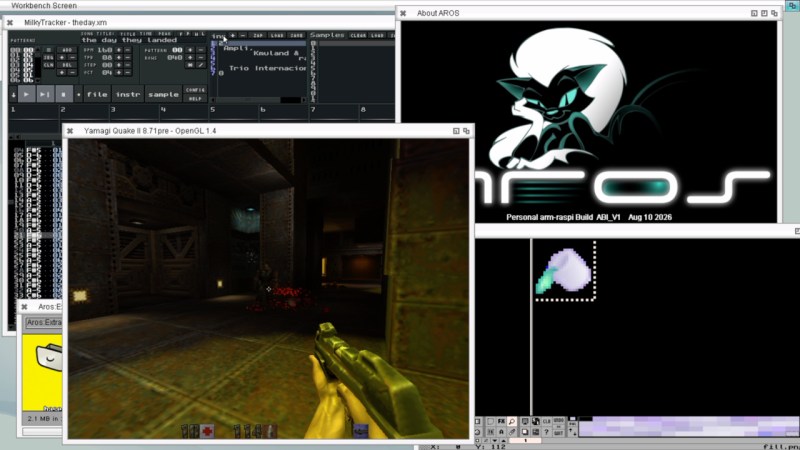
There’s no actual data, but if we had to guess the least-favourite Disney movie of former Amiga owners would have to be Frozen, because none of them will ever be able to “Let it Go”. The Amiga-derived AROS Research Operating System has just been ported to boot bare-metal on the Raspberry Pi, in both 32-bit and 64-bit versions. Yes, there’s a 64-bit Amiga-compatible OS that runs on ARM. It truly is a time of wonders.
AROS has already been ported to a number of platforms. Besides x86, there’s a PPC port that provided a lot of code to the MorphOS, which you can read about here, and a back-port that brings AROS back to original Amiga 68k hardware. There is even a build for RISC V.
AROS developers are making sure that Amiga legacy isn’t stuck on any given hardware, so they never have to let it go. So while not totally out of left field, this development is “pretty nifty” both in that it gives another ultralight operating system for the Pi, with boot times to rival RiscOS, and another platform for ex-Amiga users to play with that isn’t 40 years old. Previously if you wanted to run AROS on a Pi it was virtualized in Linux, making it similar to all other Amiga emulators.
While some software has been recompiled for ARM, the available software isn’t as full-featured as x86, but that’s almost certain to change as time goes on. It’s early days yet and this build is very much a work in progress. Likewise we expect support for other Pi boards to expand, as while right now the target is the Pi3, the forum threads include discussion of the Pi4 and even Zero2W.
You can check the port out in action in a video by [Dan Wood] embedded below, sent to us by tipster [Stephen Walters]. Thanks [Stephen]!
We have featured AROS once before, thought it’s been a while.








This looks fun, a mod tracker and fps is enough for me to justify use. I wonder what the performance is like? Many GUI OS run painfully slow on any th ing less than the pi4
I’m running a Pi zero 2W and it’s fast; boots in 5 s and the UI is really snappy, and this is with the graphics currently just running in a framebuffer (a graphics driver with 2D and 3D acceleration is in the works).
Finally! Imo this is the future of amiga. We have been down the road of ppc to move on from 68k and even x86, but I feel that the most complete path with the best support could be arm platforms. Lets see how it pans out.
Maybe once we get some more hardware standardization centered around PC use in ARM/Risc-V chips.
That would be favorable, indeed. 🙂
If not, then I hope that binary compatibility of applications remains between different ARM ports, at least.
For a standardized platform: RISC OS might be another supporter here.
The Raspberry Pi version managed to keep backwards compatibility of older ARM applications that used to run on Acorn RISC PCs.
Depending on the ARM core, I mean. Those used on Pi 1 and 2 (early) were safe, I think.
The newer ARM chips had changes in the instructions set or something, which caused some compaibility issues with vintage software.
But that’s no issue to AROS, I think, since it starts fresh and doesn’t rely on ARM6 or older ARM architectures.
What exactly makes any of this “Amiga” any longer?
It’s not Amiga but Amiga inspired as the tile reflects, or to be more accurate the Amiga philosphy of how a computer should work.
So from the Amiga, AROS has inherited multiple draggable screens, ram disk, rexx and rexxxmast, logical assigns, shared libraries, resources and devices, the Amiga’s logical file structure (c:, libs:, prefs, WBstartup etc.) and being very lightweight in terms CPU and memory requirements (which make it a very good fit for the Pi). The WIMP system is modelled on Workbench (although DOPUS & Scalos is avaialble if preferred) and the window UI Zune works just like MUI. And for programmers, the API is based on the Amiga’s all the way down to Exec and kernel routines, albeit extended to meet modern standards like USB and wifi.
So, not an Amiga, but if you loved the way Amigas worked and would like the same on modern, cheap and readily available hardware, AROS offers that.
P.S. there is also a version for classic 68k Amigas which has received a lot of optimisations recently.
Very lightweight would fit right into present day unaffordability. Don’t buy a new computer, but update to a better one.
AROS is great. Some distributions feature a seamless integration of UAE and run an 68k version of AROS..
That way, 68k applications can be run from AROS.
At the moment, it’s featured in an i386 version only (AROSOne?), I vaguely remember.
Speaking of i386 (x86) and x64 (x86_64)..
As far as I’m aware, both are separate architectures and i386 has most binaries.
It’s not quite possible yet to run i386 binaries on x64 AROS.
There’s some work in progress, though, I vaguely remember.
True x86 currently has the largest software base but x64 is catching up fast with applications being ported across pretty much daily. There is an emulation layer to run x86 applications such as Hollywood on x64 too. Re. distributions, AROSOne now has both x86 and x64 versions. x64 is the future of AROS – more modern machines, better graphics (currently up to Nvidea GTX 990 but drivers for more recent cards coming soon) and effectively unlimited memory.
To run 68k programs on x64, Amiberry has been ported. It’s quick and stable (I was editing quite a complex PageStream document using it yesterday with no problems).
Prompted by this article, I’m going to check out the AROS page again, because it’s been a while since I last looked into it.
From my own perspective, it’d be really cool if AROS
1) ran on the Pi 400 or 500 (giving a one-box solution similar to the Amiga 500/600/1200),
2) had a WB3.x visual theme for full nostalgia (hey, I LIKE the WB3.1 window decorations and menus – bite me),
3) and_really_ going into the realms of stretch-goals here… had an easy mechanism to import Workbench 3.0 system preferences (colours, WBpatterns, etc) from an existing UAE config.
I have my old Workbench 3.1 setup from circa 1994 still carefully preserved under UAE; it’d be rather cool to port it into the 21st century using AROS.
The developers do hope to get it working on Pi 4 & 5. In the AROSOne distribution for x86/x64 there are lots of theses including Amiga OS3 & 4; they ought to work for the Pi version, although I haven’t tried this.
At least some prefs should copy across; I just opened up my A1200’s emulation in Amiberry within AROS, changed the palette prefs, saved them off to a shared folder and than imported into AROS palette prefs and it worked. More genrally I guess a level of trial and error would be needed for other prefs.
Edit: ‘themes’, not ‘theses’, sorry!
Thanks for the follow-up info, [Nigel Tromans] – appreciated. And my mental autocorrect quite happily dealt with “theses”, no worries there. I wish HaD allowed editing of comments!
Guess I know what I’ll be doing this weekend, in between feeding the livestock, repairing vehicles, cleaning the house, [….]…