
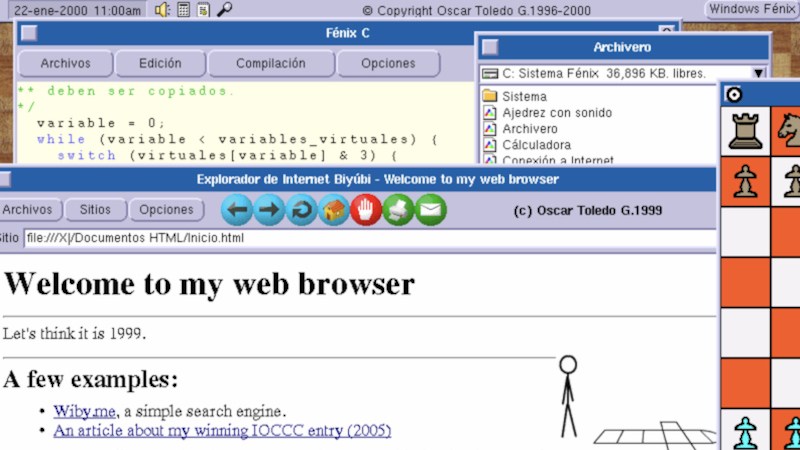
The AM29000 series of processors were AMD’s entry into the world of super-fast next-generation silicon of the late 1980s. It was a time when ARM was still a niche architecture in a British educational computer, the 68000 series was still a major player, and it was by no means certain that the x86 would maintain its position. It therefore wasn’t an unreasonable choice for someone building a high performance computer at the time, which is what [Oscar Toledo G.] and his father did. If that wasn’t enough, he went on to write an operating system for it in AM29000 assembly, complete with a GUI, a C compiler, and an up-to-date web browser for the late 1990s. The story makes for an engaging read.
It’s written across two parts, with the first looking at the computer and the early software development, and the second at the C compiler and web browser. It’s a tale of epic mastery of the machine, and something we remember ourselves, piecing together knowledge in a time before the Internet placed it all at our fingertips. Tales such as hand porting — we can’t really say compiling — C code into AM29000 machine code are completely next-level. You have to read these two write-ups, and there’s even an in-browser emulator should you want to try it.
Meanwhile, in case you think something is a little familiar here, he’s the same person who brought us a Transputer in the browser.










Its not everyday that someone writes an entire OS from scratch by themselves, but it sure as hell impressive when they do!
In the late 90’s to be exact. With internet available only by visiting cybercafe.
That is just out of this world.
(* impressive only when it’s not vide-coded)
TempleOS!
Writing OS or games was the “hello world” of the day.
I thought it said Am2900, which would have been totally insane!
Yay, another homebrew computer with PCI bus within a week!
You couldn’t be more wrong.
Care to elaborate?
The 29K isn’t the world’s easiest processor to write assembler for so I’d have expected that one of the first tasks would be to write a ‘C’ compiler for it. The processor itself is actually a very nice unit but was unceremoniously dumped by AMD because their marketing department said that a (then) tiny slice of the x86 market was better for business than the entire 29K portfolio. (I know about this because we were using versions of these processors designed for embedded products at that time. We had to switch to a different product, in our case the Hitachi HS2 series.)
Its always struck me that architectures like the 29K (and Intel’s RISC, the 8800) became the ‘core’ or the manufacturer’s CISC line. Most people are aware that x86 type processors are heavily microcoded but the internal architecture and associated microcode is closely guarded so we can’t confirm one way or another exactly what’s going on inside these processors.
I’ve always wondered if there was some way to execute Am29000 natively on the AMD K5 that uses an Am29000 back-end to run x86…