
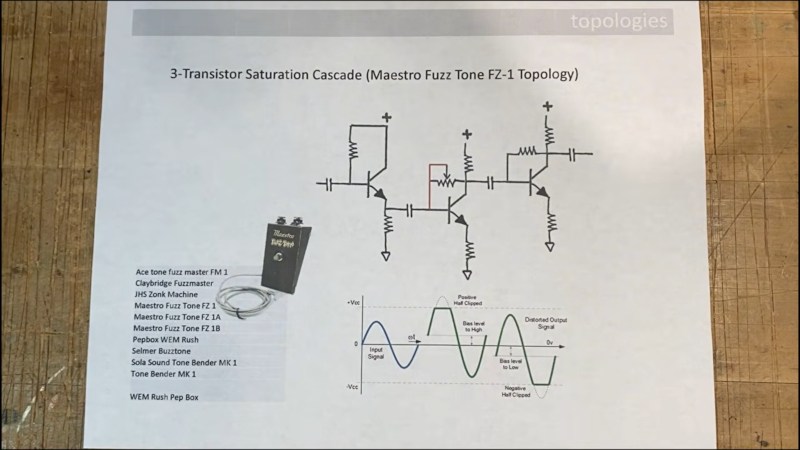
It’s likely that even those of us who have never picked up a guitar in our lives will recognize the sound of an electric guitar with a fuzz box effects pedal. The raspy distorted sound has been at the heart of so many very well known recordings. Behind it is a distortion circuit, or as [Bill Jehle’s Mad Scientist Guitar Lab] is here to tell us, eight different circuit topologies.
The result is a fascinating trip through the evolution of rock music through the 1960s, as he examines circuits from simple diode clippers through to frequency doublers and phase shifters. He’s provided a playlist as an accompaniment so you can even have an immediate listen to each sound. It’ll mess up our YouTube recommendations, but worth it for the informative journey.
It’s also a window into a lost period in electronics where all they practically had was the transistor, so each device had to put in the maximum work for a living. Designing circuits like these called for intimate knowledge of the device characteristics, and just how they could be safely exceeded. The video is below the break, and well worth a watch.
If clever transistor music circuits interest you, you’ll love the flawed devices that gave the Roland 808 its sound.












I have an old (Dunlop) Fuzz Face lying in my basement, which was originally bought by my oldest brother back in the mid-sixties. I haven’t played with it since the late 80’s.
Chances are it’ll be either discarded or given away after I’m dead and gone (which shouldn’t be all that long). My brother was very much a fan of The Ventures back in the day. I’m not sure if they ever used a fuzz face. They often used the latest effects that were happening back then.
You can clearly see two germanium transistors on the main board and a small cluster of resistors and capacitors. Nothing too fancy. It’s hard to believe how guitar distortion came from such humble beginnings.
Why not pass it along to a youngster in the early stages of their music career?
What about Wha Wha
when i was a kid in the early-mid 1980s, i made a single-string guitar that used a piezoelectric element (the brass circle with a thin beige chip on it) as a physical pickup (it sat under the bridge and amplified the actual vibration of the string at that point). i’d plug that into the RCA input of the family stereo and that thing would crunch with a sound i wouldn’t hear until years later when i got into Sepultura. it was such an easy and amazing sound that i am surprised it didn’t appear in music earlier. but perhaps it was just too “out there”
Musicians will kill just to have a unique sound despite using the gear that all the stores offer.
Boston Tom Scholz designed his own gear, it made the band’s sound. Later the Rockman in US Patent 4,584,700
Look at pics of John Mayer’s pedal boards, just crazy complicated. That is taking it to an extreme.
And of course the fortuitous faulty channel on the mixing desk when Marty Robbins’ track “Don’t Worry” was recorded in 1960. The resulting bass guitar distortion was left in the finished recording, and later turned into product form as the Maestro FZ-1 Fuzz-Tone. Arguably one of the first instances of guitar distortion in popular music, let alone country music?
https://en.wikipedia.org/wiki/Don't_Worry_(Marty_Robbins_song)
Keith Richards famously slurred “Give me a guitar and in five minutes I can make it sound like every other guitar.”
Some of Charlie Christian’s recordings have noticeable guitar distortion, bug or feature who can say (I like it) but the original fuzzbox was Link Wray’s speaker cabinet on the studio version of Rumble.
I remember hooking my friend’s guitar up to a whimpy germanium amp circuit late 60’s and we were blown away by the sound. I have a pair of Brian Mays germanium legendary amps still.
I lived in a squat in an old farm house with a leaky roof for a while. Some of the keyboards got a bit damp, notably an old Moog synth. The new sounds that it created were very trippy.
Great article :-)