
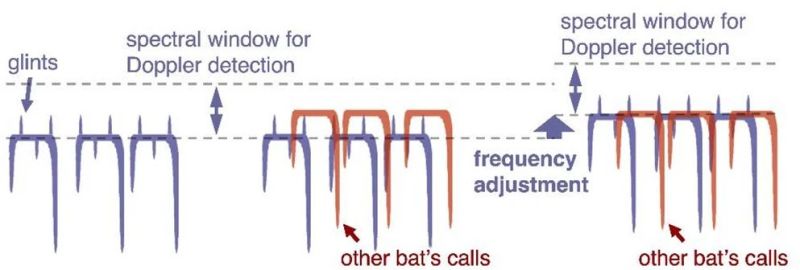
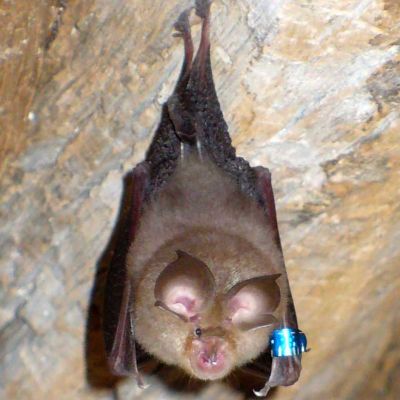
As great as echolocation is, things can get rather messy once it’s not just you chirping away, but also hundreds of your buddies in roughly the same area. This is the scenario that the typical colonies of bats have to deal with. In a recent study by [Haruhito Matsumoto] et al. in Journal of Comparative Physiology they investigated how colonies of greater Japanese horseshoe bats deal with this issue.
Echolocation in animals can use a variety of methods, including frequency modulation (FM, varying the pitch) or constant frequency (CF), with both having their uses during hunting as well as obstacle avoidance. One big advantage of CF is that it can be used for Doppler shift, giving very precise information about location and velocity of objects in the environment, but if used in a busy colony the acoustic interference would effectively render them blind.
What researchers have found is that the CF component frequencies differ per bat colonies, with the mixing of wild-caught and resident horseshoe bats in this experiment showing them adjusting the dominant second harmonic (CF2) to match, with bats using a lower frequency CF2 adjusting it upwards. In this way frequency convergence is used as a strategy to avoid acoustic interference using a so-called ‘silent spectral window’.
As this spectral window for effective Doppler tracking is found above the CF2 frequency, it therefore makes sense that the bats at a lower CF2 harmonic would adjust their CF upwards to match that of their neighbors. Although more research is required to fully confirm these findings, it sheds some more light on the use of echolocation by these amazing flying mammals.












Dolphins and temporal staggering, directional beams, and click-rate modulation.
Reminds me if the old twin-pulse Distance Measuring Equipment (DME) planes used long ago . The pilot set a specific delay between the transmitter pulses and the instrument would ignore pulse pairs returning from the ground repeater that did not have that pulse delay .
would have been quite funny if the US army would have somehow used bat’s to tune their radars.
Like the pigeon’s in missiles.
Bat works on something like 20kHz. WW2 radars used magnetrons from microwave ovens which typically operate at 2.4 GHz.
That’s like 100x higher frequency.
The german u-boats had radar detectors (Metox) that operated in the1.5 meter band ( about 200MHz), from 1942 to 1945, their killrate was truly astonishing. But with the invention of the cavity magnetron that totally changed, in 1943, because the UK’s 3GHz H2S radar became invisible again. The resolution was high enough to detect the periscope of submerged u-boats. The killrates flipped.
Correction: that is about 100’000x
i pecked at that apostrophe hoping the bomb i was riding in would glide toward it
Imagine a parallel pigeon processor today!
The original touchscreen display, didn’t take much thought to use it.
You would have to invent something like a milking machine to suck poop from their anal cavities. On longer computing sessions it could cause pigeons to become aroused from constant stimulation.
I’ve asked chat GPT how to hyperscale anal suction of 300 million pigeons used for computation.
Results were… interestingly creepy. What a perfect yes-man.
Oh and it only took a few messages to go from…
to…
💀💀💀
And this is how one gets bomb sway.
every time i see “i asked (insert your favorite ai bot) about $topic” i substitute the bot with the word “granny” or “my dad”. just to stay sane.
and, on topic again: this methode could come handy if you use more than one ultrasonic range finder in close proximity to each other