
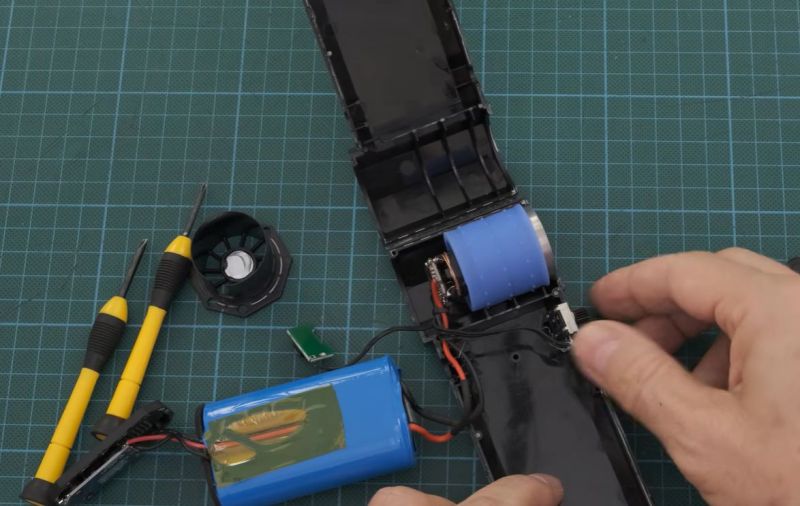
As a certified RC airplane fan, the [RCMakerLab] on YouTube found themselves looking at one of those nifty mini air blowers that provide an alternative to a compressor and canned air for dusting and other high-volume, high-pressure air-related tasks.
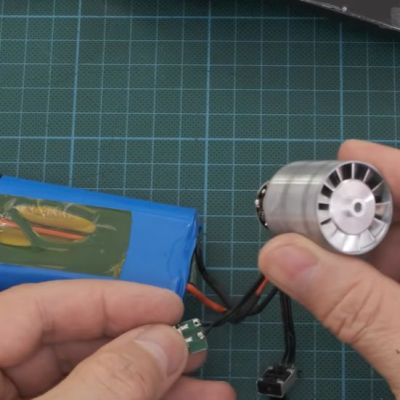
Inside these quite affordable units is a ducted fan (EDF) that can produce fairly high levels of airflow to get to every last dust bunny hiding on a PCB or inside a keyboard, raising the question of whether you could use these to fly a model airplane with.
As can be seen in the torn down unit, there isn’t a lot to these air blowers, with the ESC bolted onto the EDF and only the speed regulator and on/off switch being external controls. This would make it very easy to integrate into an airplane, but leaves the question of whether it can generate enough thrust to make it worth the effort.
Using a custom rig, it was shown to generate up to 110 grams of thrust with a current of 16.5 A, which would at least go a long way to carrying its own battery pack. In order to create an airplane with it, probably two of these motors are needed. There’s also the potential of reducing weight by changing the ESC and such, making reusing these little EDFs from any discarded or broken mini air blowers at least worth a shot.
At the very least, it seems like it has a better shot of working than a plane powered by an electric leaf blower.












How does it compare to a typical BLCD drone motor with 2-3 kg of lift?
Different applications. 2kg of thrust from a brushless motor is absolutely possible, but you’re looking for something like 15-30A draw on a 3/4S setup. Considerably lower kV, so top while you’ll get great lift, you won’t get top speed. Speed is really where EDF setups would win out.
16.5 amps? That seems like a lot.
You know what’s the difference between a pigeon?
Amps without Volts is like Volts without Amps or ten thousands spoons when you need a knife. It’s useless. You need a power to evaluate the efficiency of the motor and a power isn’t a current.
Indeed.
High end ‘consumer’ grade CPUs like the AMD R9 9950X require about 70 amps from the VRMs (Voltage Regulator Modules) near or at full load. Intel devices of the same order a bit more.
Which is a lot of current, but only about 170W as the core voltage is usually around 1.3V
Looks to be a 2s li-ion pack in the screenshot.
For electric flying things, high currents seem to be the norm.
Indeed. This is exactly what happened to my Lincoln inverter stick welder when I got pissed off at it that I’m unable to lay a nice bead without either burning through or constantly sticking the rod and making beads that have no fusion to base material.
There’s a guy who can use an old fashioned variable core buzz box like the ancient one I have. Probably older than me, dead simple, always works. Copper and steel.
Semiconductors? Pfft.
DC? Bah.
If you kick my old Birdsell with steel toed boots, the result might be a dent. (ambiguity intended)
:-)
Stick welder, nice beads, choose one.
Stick welders are great if you got a 24V power supply on an offroad vehicle and you need to make repairs when stuck somewhere in the middle of nowhere. Also great for very specific applications, such as very wide beads when trying to attach two very thick pieces of steel together and it needs to survive everything. Talking 2.5CM/1″ thick plates or thicker. Perfect for it. There are these electrodes that are as thick as your wrist for that use case. It’s welding using pure violence but it works. But it’s not clean, everything near you will be on fire, but it works.
For general use, if you do it rarely and don’t care about looks, use stick welding, if you do it more often and only care about speed, use mig, if you care about looks and proper welds, use tig.
I got all three (although I’m going to sell my MIG) and each has it’s own use case. If you wish to learn how to weld, stick isn’t the right choice. It’s violent, messy, can easily be painful. It’s not nice. I mostly do things like welding up motorcycle frames, and I care about the looks of my welds, so TIG it is. And it’s the easiest, cleanest, nicest method in my humble opinion. It’s silent, it’s smooth, it’s peaceful, it’s fun.
A solid kick with a steel-toed boot sent it flying across the garage. Sadly, after its maiden flight, it didn’t want to weld anymore. About $1000 down the drain.
For an EDF that’s about right. They’re typically less about efficiency and more about velocity.
If you want high power in a lightweight airframe package, you gotta increase either voltage or current.. and I don’t know of a lot of good high-voltage solutions that fit that particular bill. All the wiring is pretty short run and constantly has forced air cooling, so current it is.
You’d be surprised how many peak amps go through a cordless drill. And that’s usually 12 or 24v.
Absolutely! I look forward to seeing what you can accomplish from your inspiration. I look forward to learning from your experience.
In aircraft, every gram counts. Using a geared drive to control speed adds a motor and gearbox. It would make more sense to directly control motor speed electronically, eliminating the old speed control, as well.
It is directly controlling motor speed electronically – article mentions the ESC (electronic speed control). Also visible in the video; I didn’t see a gearbox.
The video shows the receiver driving a servo which is geared to the original speed control potentiometer. Adelaide suggests forgoing the servo, plastic frame+gears and potentiometer completely and taking the receiver digital signal directly with a small bit of circuitry (likely would just need a rc low pass filter) to drive the motor’s esc’s analog input. This would save quite a bit of weight.
Presumably just doing stuff because it’s fun before mangling the source configuration, but who knows; ESC is typically looking for PWM signal from some source to determine output motor speed. Presumably could simply clip the potentiometer free and wire directly to the receiver with whatever spare dupont connectors one has lying around, but I’d need to see the ESC to be 100% sure.
Guess it just all depends on the particular setup. ICE propeller planes sometimes go straight off the crankshaft, sometimes they have big gearboxes, especially on some old warplanes. Those definitely were engineered solutions though, not reusing random stuff from other machines.
LOL, click bait. All that and et the end of the video not put in a plane.
I also was mislead by the thumbnail image… although the concept of harvesting these parts is interesting by itself, I did expect to see it fly. No matter if it was towards the trashcan or towards the sky, I don’t care, but the jet-plane in the thumbnail suggested some type of airborne action to be seen.
At this scale I doubt it will make a particularly good RC aircraft, almost certainly rather heavy and high current for the thrust, so probably very very short flights – a problem with all EDF compared to propeller really, but at this scale I’d expect it further amplified.
@rctestflight on YouTube made a video using one of these last year. Specifically for a “blown wing” airfoil design. The high blade count and small diameter of these fans makes them poor performers in terms of raw airspeed per watt. But allows them to create a greater pressure differential which is what was needed here.
I am planning to go the other way, and convert an aircraft EDF into a handheld blower.