
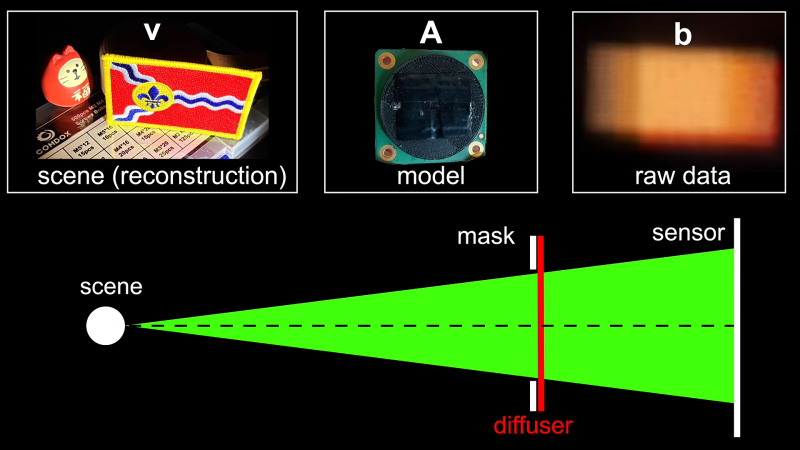
There are plenty of ways to capture 3D images or simulations of such if you know what you’re doing with camera hardware and fancy mathematics. However, a little more unusual is the idea of capturing a 3D image while using no lens at all — and yet, [okooptics] has achieved just that!
The basic concept builds on an older project from [okooptics], wherein images were captured from a Raspberry Pi camera with no regular lens element installed. In its place was a thin layer of Scotch tape over the sensor, acting as a diffuser. With the right deconvolution math, it’s possible to actually recover a real image out of the blurry mess this setup initially captures. [okooptics] was then able to push this into three dimensions by weighting the point spread function used to deconvolute the image.
Adding directional bias to the process creates a similar effect to slightly shifting the cameras position, actually revealing a view from a slightly different angle of objects in front of the camera. [okooptics] does a great job of explaining the science behind how this is possible and the practical limitations of the technique, also referencing research papers that have explored these ideas in great depth.
It’s math heavy to extract 3D data from what otherwise looks like blurry nothingness, but it’s possible if you know what you’re doing. For a fuller understanding, it’s worth diving into [okooptics] earlier work in this realm, taking photos with Scotch tape in place of a lens.












30 years ago i was reading about dsp for the first time and i came up with this hypothesis that you could get near ideal characteristics out of almost any old speaker by applying the right transformation to the signal before DAC — measuring the distortion of the speaker system and then performing the opposite distortion to your signal. sacrificing loudness, of course. i think this is basically the same idea but it takes it so far that i struggle to believe it.
Predistortion is used in hearing aids to compensate for the geometry of the wearer’s ear.
The sequence is firstly to programme and tune the hearing aid to compensate for the wearer’s hearing loss.
Secondly the hearing aid is inserted into the canal and a microphone is inserted alongside the hearing aid. A series of tones and impulses is played by the hearing aid, the microphone picks up how they are distorted by the canal, and the aid is programmed to predistort sounds so as to compensate.
Loudness is not compromised.
Your concept does not compensate for the distortions caused by the room and furnishings.
“Secondly the hearing aid is inserted into the canal and a microphone is inserted alongside the hearing aid.”
Interesting. This must be one of the factors that differentiate prescription vs over-the-counter hearing aids in the US that I recently learned about, I think from a Hackaday article.
More importantly, it is one reason why it is necessary to differentiate hearing aids from OTC things.
Another is that my hearing aid also compands and limits the volume to avoid further damaging my hearing.
you only dont have to compromise loudness because the dynamic range achievable from a hearing aid is massive and full range. Large(er) speaker drivers have bandwidth limits and excursion limits which are easily hit achieving musical volume levels (85-105 dBc peak)
Recently my new hearing aid distorted horribly. It was clipping, or more precisely the loudspeaker was being overdriven at mid and “high” frequencies.
Fortunately a beefier loudspeaker could be obtained, which partially solves the problem. What happens in a few years, I don’t know. Maybe a cochlear implant.
Has anyone done modifications to the human voice to match what the speaker hears–simulating bone conduction.
This might also be done with fisheye lenses to simulate what is seen in a mirror up close rather than farther away.
Speaking of the same idea, your theory makes me think of how they can pre-process the input to an ultrasonic/to ultimately make it seem like sound is just floating in midair after the original signal has been altered by its trip through the air.
https://www.cnet.com/tech/home-entertainment/i-hear-voices-could-highly-directional-sound-advertising-be-the-next-big-thing/
30 years ago I was writing a patent application about pre-distorting images to compensate for chromatic and other distortions in head mounted displays.
As it turns out, what people want in a speaker is max power RMS without clipping, not absence of distortion. A million tests have shown that people don’t really care about THD, in fact they like its character in several cases. Like with vacuum tubes.
They just don’t like the system clipping and breaking up when you crank the volume… usually. Sometimes they like that too.
I have a great grandfather like that. He learned to appreciate the breakup at volume so much that he expanded use to manually induced breakup in response to routine less-than-friendly sounds coming from certain external oral sources. He was reported to be relatively content with the overall result.
This reminds me of the team using a camera to see around corners using a similar technique but the reflected lighting in the room itself becomes the raw image.
Sounds like a scene from the original “Blade Runner” movie
It was covered here on HaD in 2019, although no doubt even the publicly disclosed technology has made a fair bit of progress since then.
https://hackaday.com/2019/08/22/looking-around-corners-with-f-k-migration/
Wow, look at that rig… That’s impressive. I must have missed that one, I’m gonna go back and check it out, thanks.
I think the diffuser is kind of an imprecise microlens array.
Fourier transform
this guy is my new hero
I was working for grad students as a summer job in 1990 at Queens’ University in Kingston, Ontario Canada. This was exactly the research they were doing. I had to code up a bunch of Fourier transforms on a Sun SPARCstation with an outboard array processor to do volumetric image reconstructions.